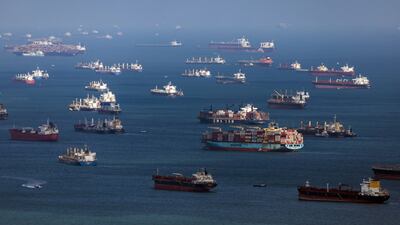
Container ships offshore from Singapore last week. The growth of geopolitical-driven protectionism threatens to limit the gains of globalisation. Bloomberg


The WTO needs to address two underlying issues with global trade


Nicolai Ruge
Danny Quah
  • English
  • Arabic

February 26, 2024

Trade ministers from around the world have convened in Abu Dhabi for the 13th Ministerial Conference of the World Trade Organisation. The event is a biennial opportunity for the 164 members of the WTO to meet at the highest level to review the functioning of the multilateral trading system and decide on its future.

The Ministerial Conference comes at a moment where the global economy is in a fragile state, with the World Bank projecting a decade of historically low growth ahead of just 2 per cent annually. Trade has long been a driver of growth and poverty eradication, having lifted one billion people out of destitution in recent decades. It is now facing strong headwinds as protectionist forces mount.

With leaders in many countries questioning the value of participating in a globalised world economy, the growth of geopolitical-driven protectionism threatens to limit the gains of globalisation.

Against this backdrop, it is not an overstatement to say the conference in Abu Dhabi will be critical to determine the future of global trade. As countries “re-shore” and “friend-shore” their value chains because of legitimate national security concerns, it is essential for ministers to reshape the current global trade system to prevent these trends from resulting in severe fragmentation, which could cost the global economy as much as 7 per cent of gross domestic product, according to the International Monetary Fund.

WTO Director General Ngozi Okonjo-Iweala has been acutely aware of the importance of the moment and has appealed for the need to “be ready to roll up our sleeves and work in Abu Dhabi”. But what would this work need to look like to make a real difference?

On the agenda will be efforts to advance international trade and reform the WTO itself, such as eliminating subsidies that encourage overfishing, extending the moratorium on duties on cross-border e-commerce and restoring the system for settling trade disputes.

WTO Director general Ngozi Okonjo-Iweala and Timor-Leste Deputy Prime Minister Francisco Kalbuadi Lay sign the agreement for Timor-Leste's accession to the WTO in Abu Dhabi on Monday. AFP
If ministers leave Abu Dhabi with little more than symbolic achievements, an opportunity will have been lost to strengthen a system of economic interdependence

Yet, as important as these issues are, addressing them individually – with success uncertain, given the need for consensus to forge an agreement – may have, at best, a marginal impact on global trade. The necessary decision to admit two new members, Timor-Leste and Comoros, into the WTO also cannot be considered significant progress if important topics are yet again kicked down the road.

Leaders meeting in Abu Dhabi will need to be ambitious and focus on solving the underlying challenges affecting the trade system. They will need to address two factors that have enabled deglobalisation to take hold despite the overall benefits trade has delivered over the past three decades: first, that trade is seen as being misaligned with global priorities; and second, that gains from trade have not been equitably distributed within and between countries.

Strengthening the trade system should first and foremost mean expanding the trade agenda beyond delivering efficiencies. Instead, trade needs to advance climate action and social inclusion through multilateral commitments against a “race to the bottom” on environment, labour and consumer standards.

Participating in global value chains can help the spread of climate-friendly technologies, such as solar panels or drought-resistant seeds. The broader the benefits delivered by trade, the more firmly it will be aligned with global priorities such as the Sustainable Development Goals. This, in turn, will enable trade to engender more trust of governments and citizens as they see the real value of it. Trade can thus be “fenced off” from geopolitical rivalry rather than disrupted for near-term political wins.

Here, inspiration can be taken from the African Continental Free Trade Area Agreement, which aims to create a single market for goods and services on the continent and enable the free movement of people. Its Protocol on Investment is designed to support the continent’s green transition by promoting investment in green sectors, encouraging incentives for low-carbon investments, and developing green investment standards.

Second, more inclusive trade mechanisms must be developed. In particular, least-developed countries with structural constraints such as fragile institutions, weak markets and a limited knowledge base, face difficulties taking full advantage of the opportunities offered by globalisation.

Between 2011 and 2020, exports of goods and services from least-developed countries contracted, and their share in global exports stagnated. What little economic growth that has taken place has in most cases failed to trickle down to the poor.

More public-private consultations centred on the Global South are needed to ensure that multilateral trade policies prioritise the sustainable development of countries with the least economic power.

Trade-restrictive measures based on legitimate national security concerns are likely to remain a feature of global trade. To improve transparency, certainty and mutual trust, such measures must be ring-fenced, meaning focused, proportionate and time-bound.

The aspiration of an expanded and rebalanced global trade agenda is not something that can be achieved easily in times when trust is being eroded by rising geopolitical rivalry. But if ministers leave Abu Dhabi with little more than symbolic achievements, an opportunity will have been lost to strengthen a system of economic interdependence that has delivered immense, albeit imperfect, benefits.

The alternative – a more fragmented, protectionist global economy – will make everyone worse off and will be a missed opportunity to strengthen collective action on the very environmental, economic and societal issues most countries care about.


Farage on Muslim Brotherhood

Nigel Farage told Reform's annual conference that the party will proscribe the Muslim Brotherhood if he becomes Prime Minister.
"We will stop dangerous organisations with links to terrorism operating in our country," he said. "Quite why we've been so gutless about this – both Labour and Conservative – I don't know.
“All across the Middle East, countries have banned and proscribed the Muslim Brotherhood as a dangerous organisation. We will do the very same.”
It is 10 years since a ground-breaking report into the Muslim Brotherhood by Sir John Jenkins.
Among the former diplomat's findings was an assessment that “the use of extreme violence in the pursuit of the perfect Islamic society” has “never been institutionally disowned” by the movement.
The prime minister at the time, David Cameron, who commissioned the report, said membership or association with the Muslim Brotherhood was a "possible indicator of extremism" but it would not be banned.

Islamophobia definition

A widely accepted definition was made by the All Party Parliamentary Group on British Muslims in 2019: “Islamophobia is rooted in racism and is a type of racism that targets expressions of Muslimness or perceived Muslimness.” It further defines it as “inciting hatred or violence against Muslims”.

How to apply for a drone permit
  • Individuals must register on UAE Drone app or website using their UAE Pass
  • Add all their personal details, including name, nationality, passport number, Emiratis ID, email and phone number
  • Upload the training certificate from a centre accredited by the GCAA
  • Submit their request
What are the regulations?
  • Fly it within visual line of sight
  • Never over populated areas
  • Ensure maximum flying height of 400 feet (122 metres) above ground level is not crossed
  • Users must avoid flying over restricted areas listed on the UAE Drone app
  • Only fly the drone during the day, and never at night
  • Should have a live feed of the drone flight
  • Drones must weigh 5 kg or less

Torbal Rayeh Wa Jayeh
Starring: Ali El Ghoureir, Khalil El Roumeithy, Mostafa Abo Seria
Stars: 3

Traits of Chinese zodiac animals

Tiger:independent, successful, volatile
Rat:witty, creative, charming
Ox:diligent, perseverent, conservative
Rabbit:gracious, considerate, sensitive
Dragon:prosperous, brave, rash
Snake:calm, thoughtful, stubborn
Horse:faithful, energetic, carefree
Sheep:easy-going, peacemaker, curious
Monkey:family-orientated, clever, playful
Rooster:honest, confident, pompous
Dog:loyal, kind, perfectionist
Boar:loving, tolerant, indulgent   

Company%20profile
%3Cp%3E%3Cstrong%3EName%3A%3C%2Fstrong%3E%20Belong%3Cbr%3E%3Cstrong%3EBased%3A%3C%2Fstrong%3E%20Dubai%3Cbr%3E%3Cstrong%3EFounders%3A%3C%2Fstrong%3E%20Michael%20Askew%20and%20Matthew%20Gaziano%3Cbr%3E%3Cstrong%3ESector%3A%3C%2Fstrong%3E%20Technology%3Cbr%3E%3Cstrong%3ETotal%20funding%3A%3C%2Fstrong%3E%20%243.5%20million%20from%20crowd%20funding%20and%20angel%20investors%3Cstrong%3E%3Cbr%3ENumber%20of%20employees%3A%3C%2Fstrong%3E%2012%3C%2Fp%3E%0A
The specs

Engine: 3.5-litre V6

Power: 272hp at 6,400rpm

Torque: 331Nm from 5,000rpm

Transmission: 8-speed auto

Fuel consumption: 9.7L/100km

On sale: now

Price: Dh149,000


What can victims do?

Always use only regulated platforms

Stop all transactions and communication on suspicion

Save all evidence (screenshots, chat logs, transaction IDs)

Report to local authorities

Warn others to prevent further harm

Courtesy: Crystal Intelligence

Ferrari 12Cilindri specs

Engine: naturally aspirated 6.5-liter V12

Power: 819hp

Torque: 678Nm at 7,250rpm

Price: From Dh1,700,000

Available: Now

The specs: 2017 Ford F-150 Raptor

Price, base / as tested Dh220,000 / Dh320,000

Engine 3.5L V6

Transmission 10-speed automatic

Power 421hp @ 6,000rpm

Torque 678Nm @ 3,750rpm

Fuel economy, combined 14.1L / 100km

Total eligible population

About 57.5 million people
51.1 million received a jab
6.4 million have not

Where are the unvaccinated?

England 11%
Scotland 9%
Wales 10%
Northern Ireland 14% 

The specs: Fenyr SuperSport

Price, base: Dh5.1 million

Engine: 3.8-litre twin-turbo flat-six

Transmission: Seven-speed automatic

Power: 800hp @ 7,100pm

Torque: 980Nm @ 4,000rpm

Fuel economy, combined: 13.5L / 100km

Living in...

This article is part of a guide on where to live in the UAE. Our reporters will profile some of the country’s most desirable districts, provide an estimate of rental prices and introduce you to some of the residents who call each area home. 

Updated: February 26, 2024, 5:39 PM