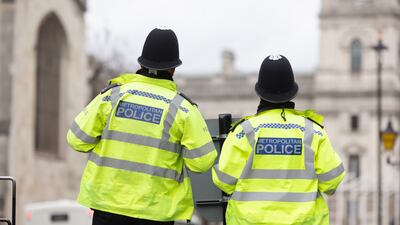
Something is afoot on the streets of London. A fundamental change has taken place in who provides security where you live, work, dine, shop or visit in the UK's capital city.
It is now an arguably unnerving reality in the West End, in particular, but in many other enclaves of London, that the city is most visibly "policed" by private security staff – funded by corporate landlords who own most of the retail spaces in central London – and their demeanour and dress and even powers are increasingly akin to those they mimic and are sometimes more demonstrative.
After English, the language I overhear most in London’s West End is Arabic, with tourism and family visits from the Gulf throughout the year. Visitors from the region are likely to make good use of the new ETA entry visa, though perhaps will keep any prized watches safely at home.
Recent visitors might have noticed that Oxford Street and Regent Street are now routinely patrolled by men and women dressed in black jumpsuits and boots, frankly resembling paramilitaries. These plastic police are sometimes stopped by tourists for directions, just as once a tourist might have stopped an actual police officer.
With the Metropolitan Police reeling from a series of crises it is at a low ebb, despite it in many ways fulfilling its mandate brilliantly, especially in anti-terror measures. This comes just as small private armies of men in bright yellow tabards have, rightly or wrongly, become the first responders in the West End.
The number of licensed private security operatives in the UK has grown by almost 100,000 in the past three years
I watched as private security guards wrestled a man to the ground and restrained him very forcefully, with his head hard on the pavement, to the extent that he was calling out for the police. Eventually a police car pulled up and thankfully officers took over the situation.
On another evening, as I left a Leicester Square cinema, uniformed and plain-clothed police were arresting two men in the immediate aftermath of a crime I had thankfully just missed. Eight of them screamed at and grappled with the suspects and chased accomplices around the corner, as a crowd gathered. With a hint of pepper spray in the air, it was just the sort of grim experience any Londoner would expect, but at least it was the police force at work and not civilians doing the bidding of an unseen landlord.
Data published by the regulatory body, the Security Industry Authority (SIA), reveals that the number of licensed private security operatives in the UK has grown by almost 100,000 in the past three years, dwarfing the 20,000 extra police officers on the streets added in a similar timeframe after the number of police fell below 130,000 five years ago. There are now more than two licensed private contractors for every police officer employed in the UK.
Many of these extra guards for hire are located in London. It is an astonishing increase that reflects the growing demand in services as bespoke as close protection for VIPs to what has become as familiar a sight as bar and nightclub door staff, as well as behind the scenes operators such as CCTV supervisors, and the West End "paramilitaries". The SIA this week published research that shows that six out of 10 British people have confidence in private security contractors, which though not an overwhelming vote of confidence, is fairly respectable.
While these plastic police are highly visible in hotspots such as the West End, we should not kid ourselves that the real police are ultimately there to help ensure our safety, in whichever country we live. A confident, friendly "Good morning" to me from a police officer when I left my front door a few weeks ago, after a triple stabbing in the next street, was a reassuring reminder that whenever something bad happens, the real police are just around the corner.

In numbers: PKK’s money network in Europe
Germany: PKK collectors typically bring in $18 million in cash a year – amount has trebled since 2010
Revolutionary tax: Investigators say about $2 million a year raised from ‘tax collection’ around Marseille
Extortion: Gunman convicted in 2023 of demanding $10,000 from Kurdish businessman in Stockholm
Drug trade: PKK income claimed by Turkish anti-drugs force in 2024 to be as high as $500 million a year
Denmark: PKK one of two terrorist groups along with Iranian separatists ASMLA to raise “two-digit million amounts”
Contributions: Hundreds of euros expected from typical Kurdish families and thousands from business owners
TV channel: Kurdish Roj TV accounts frozen and went bankrupt after Denmark fined it more than $1 million over PKK links in 2013
More from Neighbourhood Watch:
LAST-16 FIXTURES
Sunday, January 20
3pm: Jordan v Vietnam at Al Maktoum Stadium, Dubai
6pm: Thailand v China at Hazza bin Zayed Stadium, Al Ain
9pm: Iran v Oman at Mohamed bin Zayed Stadium, Abu Dhabi
Monday, January 21
3pm: Japan v Saudi Arabia at Sharjah Stadium
6pm: Australia v Uzbekistan at Khalifa bin Zayed Stadium, Al Ain
9pm: UAE v Kyrgyzstan at Zayed Sports City Stadium, Abu Dhabi
Tuesday, January 22
5pm: South Korea v Bahrain at Rashid Stadium, Dubai
8pm: Qatar v Iraq at Al Nahyan Stadium, Abu Dhabi
COMPANY%20PROFILE
%3Cp%3E%3Cstrong%3ECompany%20name%3A%3C%2Fstrong%3E%203S%20Money%3Cbr%3E%3Cstrong%3EStarted%3A%3C%2Fstrong%3E%202018%3Cbr%3E%3Cstrong%3EBased%3A%3C%2Fstrong%3E%20London%3Cbr%3E%3Cstrong%3EFounders%3A%3C%2Fstrong%3E%20Ivan%20Zhiznevsky%2C%20Eugene%20Dugaev%20and%20Andrei%20Dikouchine%3Cbr%3E%3Cstrong%3ESector%3A%3C%2Fstrong%3E%20FinTech%3Cbr%3E%3Cstrong%3EInvestment%20stage%3A%3C%2Fstrong%3E%20%245.6%20million%20raised%20in%20total%3C%2Fp%3E%0A
Killing of Qassem Suleimani
Navdeep Suri, India's Ambassador to the UAE
There has been a longstanding need from the Indian community to have a religious premises where they can practise their beliefs. Currently there is a very, very small temple in Bur Dubai and the community has outgrown this. So this will be a major temple and open to all denominations and a place should reflect India’s diversity.
It fits so well into the UAE’s own commitment to tolerance and pluralism and coming in the year of tolerance gives it that extra dimension.
What we will see on April 20 is the foundation ceremony and we expect a pretty broad cross section of the Indian community to be present, both from the UAE and abroad. The Hindu group that is building the temple will have their holiest leader attending – and we expect very senior representation from the leadership of the UAE.
When the designs were taken to the leadership, there were two clear options. There was a New Jersey model with a rectangular structure with the temple recessed inside so it was not too visible from the outside and another was the Neasden temple in London with the spires in its classical shape. And they said: look we said we wanted a temple so it should look like a temple. So this should be a classical style temple in all its glory.
It is beautifully located - 30 minutes outside of Abu Dhabi and barely 45 minutes to Dubai so it serves the needs of both communities.
This is going to be the big temple where I expect people to come from across the country at major festivals and occasions.
It is hugely important – it will take a couple of years to complete given the scale. It is going to be remarkable and will contribute something not just to the landscape in terms of visual architecture but also to the ethos. Here will be a real representation of UAE’s pluralism.
Founders: Abdulmajeed Alsukhan, Turki Bin Zarah and Abdulmohsen Albabtain.
Based: Riyadh
Offices: UAE, Vietnam and Germany
Founded: September, 2020
Number of employees: 70
Sector: FinTech, online payment solutions
Funding to date: $116m in two funding rounds
Investors: Checkout.com, Impact46, Vision Ventures, Wealth Well, Seedra, Khwarizmi, Hala Ventures, Nama Ventures and family offices
