

The Biden administration will need to delve deeper to understand the thinking of the Arab Gulf leaders, especially the Saudi leadership. This is made even more crucial by the fact that Washington is seeking to achieve a diplomatic breakthrough involving Israel, and to rectify its geopolitical mistakes as it attempts to downgrade Saudi relations with China in exchange for strengthening its own equation with Riyadh.
The days when the old traditional approach to US-Saudi relations used to work are long gone, as a sense of pragmatism and emphasis on mutual interests takes hold in the diplomatic and political language adopted by young Gulf leaders. If anything, this requires American politicians – Democrats and Republicans – to be vigilant, wise and daring enough to move past their old, false assumptions.
A recent article by veteran journalist Thomas Friedman on a “big Middle East deal” being sought by the Biden administration deserves pause and scrutiny.
Indeed, the primary challenges facing the ideas related to Israel revolve around US President Joe Biden’s ability to push Israeli Prime Minister Benjamin Netanyahu and his government to abandon its doctrines and policies that reject the two-state solution and refuse to grant Palestinians their full rights as citizens within Israel or as a people under occupation pursuant to international legal obligations.
Israel has repeatedly rejected American and international efforts to find solutions to its conflict with the Palestinians. Instead, it is seeking to normalise relations with the Arab world while disregarding the Palestinian occupation, which it views as an Arab problem rather than its own.
Here lies the dilemma for the Biden administration – as was the case for previous administrations.
The Trump administration achieved a historic breakthrough through the unprecedented Abraham Accords, which led to the normalisation of relations between major Arab countries and Israel. Egypt and Jordan already had peace treaties with Israel resulting from bilateral negotiations in which the US had played a crucial role.
Saudi Arabia is willing to make peace with an Israel that is as fair to the Palestinians as possible, based on the two-state solution and the Arab Peace Initiative that it proposed during the Arab Summit in Beirut in 2002.

This is what US Secretary of State Antony Blinken, US National Security Adviser Jake Sullivan and the White House’s Middle East policy chief, Brett McGurk, heard from Saudi officials during their visits to Riyadh and Jeddah in recent weeks. In other words, Saudi Arabia, which is showing a combination of flexibility and firmness, does not necessarily reject the idea of normalisation but might consider it if some conditions it deems reasonable are met.
The Biden administration seeks a breakthrough in this regard because its officials fully recognise the importance of such an achievement not only in the context of US-Saudi-Israeli trilateral relations, but also in terms of its implications for the US presidential election.
The US will need to convince Israel that peace with Saudi Arabia cannot be achieved at the expense of Palestine. While concessions are usually inevitable during any negotiation, the assumption that Arabs have forgotten the Palestinian issue and that Saudi Arabia is ready to normalise in exchange for minor concessions from Israel is a fantasy. It will not happen.
Saudi Arabia has been steadfast in its position since the beginning, and it had proposed a comprehensive peace initiative with, and conditions for recognition of, Israel. The kingdom remains prepared to take the initiative but today, the onus is more than ever on the US, because Saudi Arabia is now essential for American administrations due to its new roles regionally and internationally stemming from a reinvention of itself.
This provides the Biden administration with the opportunity to achieve a win-win outcome. But the concern is that it might not be able to do so, because of domestic political considerations. Historically, both of America’s mainstream political parties have had to accommodate Israel during election cycles.
Yet today, the opportunity is favourable for both parties to present fresh proposals and take firm a stance towards Israel because geopolitical considerations require re-evaluating what best serves American interests.
Currently, US interests lie in expanding and globalising Nato. Offering extensive security agreements to Saudi Arabia would be fundamental to this endeavour, aligning it with agreements Washington has with the likes of Japan and Australia.
-

A Ukrainian soldier moves along a trench at a position near the front-line town of Bakhmut. Reuters -

The leader of Russia's Wagner Group Yevgeny Prigozhin, right, talks to his fighters in Bakhmut. AFP -

A Ukrainian serviceman from the 24th Separate Mechanised Brigade keeps watch on the front line. EPA -

An evacuee from eastern Ukraine boards a train in Pokrovsk bound for Lviv. Reuters -

Fighters of the Russian Volunteer Corps, which fights on the side of Ukraine, in the north of the country, not far from the Russian border. AFP -

A Ukrainian army multiple rocket launcher fires at Russian positions on the front line near Bakhmut. AP -
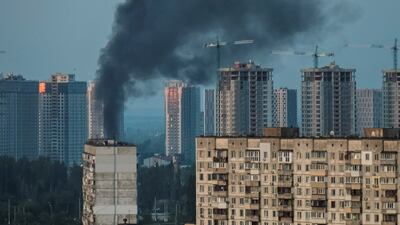
Smoke rises after a Russian missile strike in Kyiv. Reuters -

A Ukrainian man plants sunflowers between a damaged Russian tank and its turret in his garden in the village of Velyka Dymerka, Kyiv region. AP -

Ukrainian servicemen rest at their positions after a battle near the front-line city of Bakhmut. Reuters -

A teenager aims a Kalashnikov AK47 rifle during defence training at a centre for school pupils in Lviv. AFP -

A Ukrainian national flag in the middle of a blossoming field near Brovary, east of Kyiv. AP -

Ukrainian servicemen check Russian positions near the front-line city of Bakhmut. Reuters -

Rescuers put out a fire during a Russian air strike on Kyiv. EPA -

Ukrainian boys play at being soldiers in the village of Stoyanka. AFP -

Ukrainian servicemen during an exercise in the Chernihiv region. Reuters -

Ukrainian soldiers fire a cannon on the front line near Bakhmut. AP


Saudi Arabia welcomes being seen as a key partner, rather than as a subordinate that is sought after only when needed. It understands what Nato’s globalisation means for the Arab region. However, Riyadh doesn’t want to be part of an anti-China axis. It seeks to establish its credibility on the international stage and get allies and friends to respect its right to build relations with everyone pragmatically.
The kingdom sees no utility in disengaging from China, given their economic and political ties. Nor is there a benefit in second-guessing security ties and advanced relations with America.
Those responsible for shaping US policy must understand that China’s sponsorship of the Saudi-Iranian agreements resulted from sovereign decisions made by three countries, and that Riyadh will not backtrack on this path just because the US seeks to broker a Saudi-American-Israeli agreement.
Today, Saudi Arabia is active on the global arena and co-ordinates with other Gulf countries that play important roles in regional and international affairs. The kingdom is, in fact, leveraging its relations with the warring parties in Ukraine to host talks this weekend.
Ukrainian President Volodymyr Zelenskyy expressed hope for holding a peace summit this autumn. Talks being held in Saudi Arabia would be a step towards achieving this goal. This doesn’t mean that peace is at hand, of course, for Russia has rejected participating in the talks.
Nonetheless, the Biden administration has realised that it needs to adjust its perspective, approach and conduct towards the kingdom – and the Arab Gulf more generally – if it wants to build healthy relationships in the region, whose importance has grown domestically, regionally and globally.
If Washington seeks a grand bargain, it must take bold steps in its relationship with Israel and compel it to commit to the two-state solution, rather than settling for the kind of superficial proposals that the world has seen far too many times in the past.

