

Live updates: Follow the latest news on Israel-Gaza
Israel and the UN are in negotiations to use Elon Musk's Starlink communications system in the Gaza Strip, according to a report from Axios.
If an agreement is reached, Starlink would be used to provide protection for humanitarian workers and streamline aid distribution throughout the enclave, Andrea Domenico, head of the UN Office for the Co-ordination of Humanitarian Affairs in the occupied Palestinian territories, said on Wednesday.
“Communication equipment has been a long-standing request of the humanitarian community as a whole,” Mr Domenico said in New York.
“Every time there is a military operation, we lose completely communication with our teams … the internet and connectivity is fundamental to the way we operate and function.”
UN aid distribution in Gaza has largely been suspended on safety grounds and obstruction by Israel.
Humanitarian agencies have had difficulty moving aid to areas farther into Gaza where aid is most needed because convoys have come under attack from Israeli warplanes and Palestinian gunmen.
In June, the world body paused distribution of food and emergency supplies arriving through the US-built temporary pier.
The pause came after the Israeli military used an area near the pier to fly out hostages after their rescue in a raid that killed more than 270 Palestinians, prompting a UN security review over concerns that aid workers’ safety and neutrality may have compromised.
The suspension significantly curtailed the flow of aid to Palestinians, worsening the humanitarian crisis in the enclave.
Mr Domenico stated that he has no preference between Starlink or any other technology, as long as the UN has the tools required to ensure safe and effective communication with their teams for safety and operational purposes.
According to Axios, Israel is concerned the system could fall into the hands of Hamas and make it more difficult for Israeli intelligence to monitor the group's communications, raising the risk of co-ordinated attacks by militants.
Countries drop aid into war-torn Gaza – in pictures
-

Humanitarian aid is dropped over Gaza from an RAF aircraft. AFP -
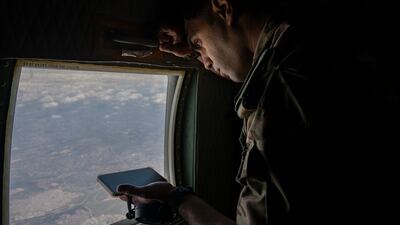
Maj Mohammed Bashabseh of Jordan's Royal Special Forces attempts to track the flight path, a task made difficult due to Israel's move to scramble GPS over Gaza. Matthew Kynaston / The National -

Humanitarian aid is dropped into the Gaza Strip. AFP -

Jordan's air force is providing meals for hungry residents in the northern part of the enclave but the UN says land routes must be opened to avert famine. AFP -
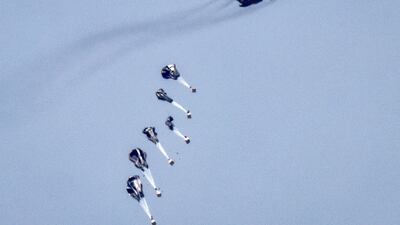
The aid drop carried out on Wednesday was the first flight the Jordanians had managed in three days. AFP -
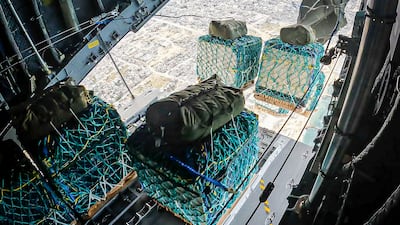
The RAF prepares to drop humanitarian packages over Gaza. PA -
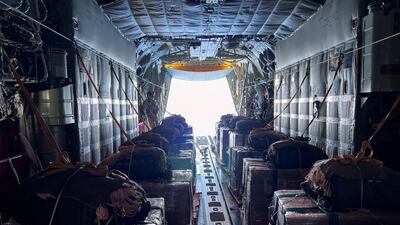
A US military aircraft full of relief parcels to be dropped by parachute into Gaza. Reuters -

Aid agencies have warned that these aerial deliveries are only a drop in the ocean of the aid that is needed to avert famine. AFP -
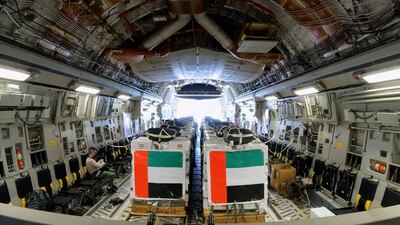
The UAE and Egypt combine to drop aid into northern Gaza. Wam -
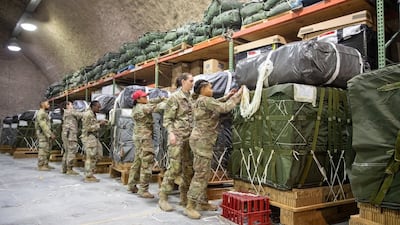
US air force members prepare to load relief pallets to be dropped into Gaza. Reuters -
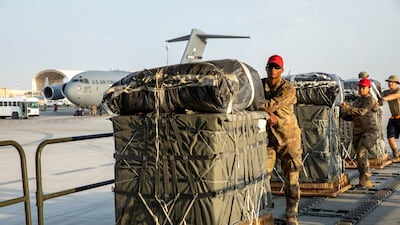
Since Jordan and the US began their drops at the beginning of March, Singapore, Belgium, France and the Netherlands have joined the campaign to deliver aid from the air. Reuters -
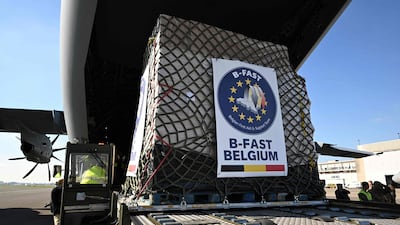
Belgian Air Force personnel load a cargo plane with humanitarian aid for Palestinian civilians in Gaza, at the military airport in Melsbroek. AFP -
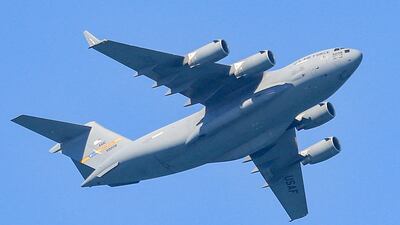
A US Air Force C-17 Globemaster aircraft during an aid drop over the Gaza Strip. AFP -
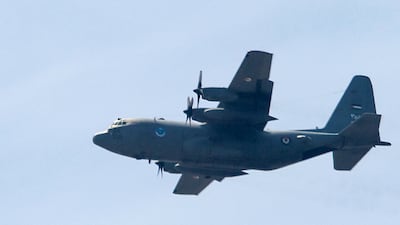
A Royal Jordanian Air Force C-130 Hercules aircraft on its way to deliver humanitarian aid to the Gaza Strip. AFP



