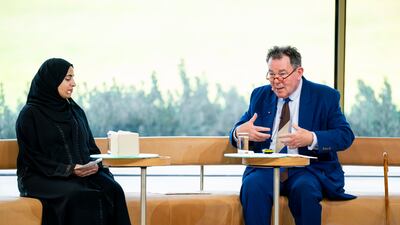
The world needs to break away from the traditional classroom culture for schools, and encourage students to explore non-traditional places like “museums, art galleries and libraries” for learning, a leading education expert has said.
Speaking at the Majlis Mohamed bin Zayed, global education adviser Prof Ger Graus said “our children are more than a test score” and insisted that “we should go beyond academics and seek insights from outside the classroom to provide [a] curriculum that incorporates creativity, progress and innovation”.
“We [must] realise that not all classrooms have four walls, and we [must] realise that museums and art galleries, our cultural heritage, are part of our education.”
In his lecture titled Reimagining Early Childhood Education, he appealed to the students “in every society” to embrace “the museum, the gallery and the library as your home, educationally as well as culturally”.
Prof Graus advocates a holistic approach to education that factors in a child's needs and abilities, rather than blindly following a one-size-fits-all schooling format.
“Educational systems must evolve beyond the industrial-age model of mass schooling and embrace the current era of personalisation and entrepreneurship,” he added.
Liam Cullinan, executive principal at Nord Anglia International School Abu Dhabi, echoed that sentiment.
“Every child has a gift, every child has a talent, every child has something really special to them," he said.
Mr Cullinan said schools and parents must work hand in hand, “looking at opportunities, working together and giving children a platform to use their knowledge to create change”.
Prof Graus, who is renowned for his work in developing educational programmes and strategies around the world, also underscored the strong partnership between schools and the parent community.
Breaking gender stereotypes
Talking about early childhood education, Prof Graus underlined how it goes on to determine future career choices.
Prof Graus, who was also the first global director of education at KidZania, said research showed that career aspirations are set by the age of four and remain largely unchanged through adolescence.
It also showed how children from disadvantaged backgrounds choose less aspirational roles due to their limited exposure to diverse career options.
This, he explained, is because adults often put children in boxes and “pass the parcel” as they move along various stages of education.
So children only grow within the parameters that the adults set and “can only aspire to what they know exists”.
The findings also showed gender stereotypes, with boys picking roles like pilots, while girls opted for cabin crew.
Girls were also seen to choose activities below their age range, while boys selected age-appropriate or older activities.
To break away from these limitations, he emphasised the need to broaden the early education model.
“When we talk about the growing and education of children, we need to think of the foundations and how we can make them as good as possible,” he added.
Designing games to teach concepts
Reem Al Falasi, Secretary-General of the Supreme Council for Motherhood and Childhood, highlighted how children often find answers to their problems.
In a project in 2018 a group of children aged between 7 and 12 designed a video game aimed at highlighting the “dangers of the internet”.
The response was outstanding, she said, adding that it motivated them to “continue exploring innovative ways to teach children in a unique and fun way”.
“We need to remember that the purpose of education is that the mind, once enlightened, cannot again become dark,” Prof Graus added. “You cannot unread what you've read, and that surely has to be the most powerful aspect of education and schooling.”

