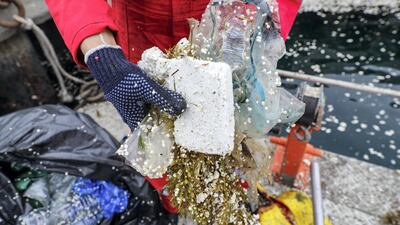
As Abu Dhabi prepares to ban some single-use styrofoam products from June 1, we take a look at how harmful it is to the environment and public health.
Derived from petroleum, styrofoam is not biodegradable and often ends up in landfill for hundreds of years.
One of the main challenges is the lengthy and costly recycling process, leading to many countries banning these products as an effective way to curb pollution.
It is part of a bigger push by Abu Dhabi to reduce the reliance on single-use plastic items and to foster a culture of sustainability and recycling in the emirate. It first announced the comprehensive Single-Use Plastic Policy in 2020.
What is styrofoam?
While styrofoam is a brand name for products made from a form of plastic called expanded polystyrene (EPS), it’s become synonymous with any product made from this material.
It’s popularly used as takeout containers, coffee cups and more as it is cheap, lightweight and a good insulator.
Difficult to recycle
Due to its composition, experts say it takes a long time to decompose.
Once it is collected at a recycling centre, it needs to be sorted and cleaned, before being shredded and compressed into an ultra-dense material. It’s then turned into hard plastic at another centre.
It, however, cannot be turned back into styrofoam due to the compression.
Despite being a bulky, lightweight item – made up of 95 per cent air – the amount of recyclable material it yields is very small.
The recycling costs are also very high.
It poses a health risk
Styrofoam is more than just difficult to recycle, it is made up of toxic chemicals that are harmful to humans and animals.
One of the most concerning characteristics of polystyrene is the presence of styrene, which can be transferred to food and is considered a human carcinogen by the World Health Organisation's International Agency for Research on Cancer.
Long-term exposure to small quantities of styrene can cause fatigue, nervousness, difficulty sleeping, chromosomal abnormalities and lead to acute health issues such as irritation of the skin, eyes, and upper respiratory tract, and gastrointestinal effects.
Chronic exposure is seen to affect the central nervous system causing depression and minor effects on kidney function and blood.
Polystyrene foam is littered more than any other waste product in waterways. The chemicals from these products pollute the water and are ingested by animals and marine life.
-

Shoppers pack goods into long-life bags at the checkout. Abu Dhabi's authorities opted for a total ban instead of a charge per bag. -

Shaikha Salem Al Dhaheri, centre, white mask, secretary general of Environment Agency Abu Dhabi, visits Lulu Supermarket in Mushrif Mall on the first day of a ban on plastic shopping bags. All photos: Chris Whiteoak / The National -

Long-life shopping bags made of jute and cotton on display at Lulu in Mushrif Mall, Abu Dhabi. -

Signs at Spinneys on Abu Dhabi's Muroor Road inform the public that from June 1, 2022, shops cannot stock single-use plastic bags. -

Shoppers are encouraged to bring their own but can also buy long-life bags in shops. -

Exceptions to the ban include plastic packaging used to wrap meats and thin poly bags for vegetables and grains. -

Supermarket staff pose for a photo with trolleys full of long-life bags.


Countries that have banned styrofoam
A growing list of countries have pledged to “significantly reduce” the use of plastic by 2030. Many have already started by proposing or imposing rules on certain single-use plastics.
Rwanda is touted as a “global leader in plastic waste reduction”, implementing a ban on the production, import, and use of styrofoam in 2009.
Haiti banned foam food containers in 2012, while Seychelles stopped the import and sale of styrofoam in 2014, as part of its wider single-use plastic ban. Saint Vincent and the Grenadines and Zimbabwe announced a ban in 2017, and Antigua and Barbuda and Dominica followed two years later.
In 2019, the European Parliament voted 560 to 35 to ban all food containers made from expanded polystyrene throughout the EU member states.
Kenya, which had introduced a single-use plastic ban in 2017, expanded it to include styrofoam cups, plates and cutlery in 2020, while India’s capital city Delhi added styrofoam to its no-plastic ban in 2018.
In 2020, Denmark and France announced similar moves, and Canada amended its 'Environmental Protection Act' to include a styrofoam ban in 2022.
Thailand also followed suit in 2022, and several parts of Australia between 2021-2023 and Nigeria this year.
Many states in the US have also introduced a styrofoam ban, with the latest being Washington State, but there is no federal ban yet.
Several cities in the Philippines also have strict bans on the use of styrofoam.

