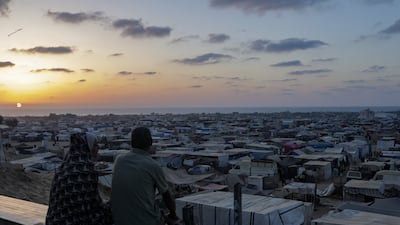
Palestinians who fled Rafah look out over tents for displaced people in Khan Younis, Gaza. EPA

'No one wants us': Gaza's Palestinians caught in an endless cycle of displacement


  • English
  • Arabic

Live updates: Follow the latest news on Israel-Gaza

The world marked World Refugee Day on Thursday as Israeli air strikes hit camps for displaced people in Gaza, where the majority were already refugees before the outbreak of the war.

About 80 per cent of Gaza’s population are refugees who were forced to leave their homes when the state of Israel was created in 1948, according to the UN. They have kept their refugee status for more than 70 years because no solution has been found for them and many hold on to their “right to return” – a dream rejected by Israel.

Since the outbreak of the Israel-Gaza war in October, most people living in the enclave have been displaced yet again.

The UN agency for Palestinian refugees estimated that more than 75 per cent of the 2.3 million population have been displaced within the besieged strip since October, with many forced to flee multiple times. Others have managed to cross the border into Egypt and move on to other countries to once again become refugees.

Most say they took the opportunity to leave Gaza in order to protect their children but that their hearts remain with those left behind.

“I am not happy with this new step. I am still connected to my family in Gaza, who didn't have the chance to leave, and I worry about them all the time,” said Amira Ismael, whose job with an international organisation enabled her to move to Kenya.

The World Health Organisation says that in line with this year’s World Refugee Day theme of solidarity, universal access to quality health care should be in place. But in Gaza, after eight months of war, most hospitals have been destroyed and the few still operating warn they will go out of service unless they receive urgently needed fuel.

Israel's closure of the Rafah border crossing has cut Gazans off from food, fuel and aid, while also preventing the sick and injured in dire need of medical assistance from receiving treatment abroad.

The UN has repeatedly warned of the dire humanitarian situation in the Gaza Strip with food shortages and the threat of famine.

A Palestinian flag flies among the rubble as people inspect the damage following an Israeli air strike on Al Bureij refugee camp. EPA

Hearts in Gaza

Most Palestinians in Gaza have been unable to leave the enclave since the outbreak of the war, with Israel controlling all of the border crossings, including the one at Rafah. In May, Israel seized the Rafah crossing, leaving it with full control of all of Gaza's entry and exit points.

Only dual nationals, and some of the injured who have been evacuated, or those who have paid exorbitant sums of money, have managed to leave Gaza since October. That was via Rafah, before the Israelis seized control.

The majority want to return home once the war is over. Ms Ismael is struggling in Kenya, where she says she cannot afford the cost of living for her and her three children. She would like to return to Egypt, closer to Gaza, but is fearful she will not be granted residence in the country which has so far been reluctant to allow in Palestinians.

Leena Samour fled to Istanbul, Turkey, with her four children to save them from the war and the deteriorating living conditions.

“We have been out of Gaza for six months and still don't feel stable because we are constantly thinking about returning to Gaza,” she told The National. “Life here is not easy and is expensive.”

She clings to the hope that her home is still standing and she can one day return.

Displaced Palestinians wait to collect donated food in Khan Younis. EPA

Constantly displaced

“Leaving Gaza is not an option for me,” said Gaza city resident Munzer Khader, 50. He is one of the many who have no desire to leave their homes despite the constant fear of death.

Mr Khader said he was trying to make arrangements for his three sons to leave in order to continue their studies. “The future is still ahead of them,” he said. But for him, moving to a country that may not accept him is not an option. “At least here in Gaza, we accept our fate and destiny."

The feeling of being unwelcome and unwanted is one echoed by most Palestinians, who for decades have been scattered across refugee camps in the Gaza Strip, or other countries such as Jordan, Lebanon and Syria, clinging to the hope to one day return to a homeland.

“As Palestinians, we never feel stable. We feel like no one wants us, and we are a big problem for the world,” Ms Samour said.

The densely-populated refugee camps in Gaza, especially Nuseirat and Jabalia, have been the target of repeated Israeli bombardment, killing dozens of people at a time.

“The camp is our life and soul. I always say that we don’t just live in the camp; the camp lives in us,” said Mounis Al Khatib, who lost his home in Jabalia camp last month.

“Everything we grew up with and cherished has turned to ashes. But I, along with everyone whose house was destroyed, didn’t leave the camp.”

But Mohammed Washah, 28, who has lived his entire life in Jabalia, would jump at the first opportunity to leave. “In Gaza, there is no respect for human rights, and devastation is everywhere,” he said.

“I love this place deeply but after everything we experienced, I want to seek a new life elsewhere.”

Palestinians in Jabalia camp struggle with food scarcity and basic necessities. Reuters

Last month, Israeli forces carried out a 20-day military operation in Jabalia that destroyed about 70 per cent of the camp and surrounding areas, where more than 100,000 Palestinians live.

Since last month, Rafah has come under attack from multiple directions, with strikes and shelling reported in the eastern and central parts of the city while warships have fired at its coastline.

About 800,000 people have fled the southern city since Israel issued evacuation orders.

The offensive on the city, which was the last refuge for more than a million people forced to flee their homes earlier in the war, has sparked widespread international condemnation. The UN and rights groups have repeatedly called on Israel to halt its military incursion in Rafah out of fears of a mounting civilian death toll.

Palestinians fleeing Rafah have either returned to destroyed buildings in central Gaza or have fled to Al Mawasi, which has been struck several times despite its Israeli army designation as a humanitarian safe zone.


Our family matters legal consultant

Name: Hassan Mohsen Elhais

Position: legal consultant with Al Rowaad Advocates and Legal Consultants.

Test

Director: S Sashikanth

Cast: Nayanthara, Siddharth, Meera Jasmine, R Madhavan

Star rating: 2/5

Jetour T1 specs

Engine: 2-litre turbocharged

Power: 254hp

Torque: 390Nm

Price: From Dh126,000

Available: Now

UK’s AI plan
  • AI ambassadors such as MIT economist Simon Johnson, Monzo cofounder Tom Blomfield and Google DeepMind’s Raia Hadsell
  • £10bn AI growth zone in South Wales to create 5,000 jobs
  • £100m of government support for startups building AI hardware products
  • £250m to train new AI models

Mercer, the investment consulting arm of US services company Marsh & McLennan, expects its wealth division to at least double its assets under management (AUM) in the Middle East as wealth in the region continues to grow despite economic headwinds, a company official said.

Mercer Wealth, which globally has $160 billion in AUM, plans to boost its AUM in the region to $2-$3bn in the next 2-3 years from the present $1bn, said Yasir AbuShaban, a Dubai-based principal with Mercer Wealth.

Within the next two to three years, we are looking at reaching $2 to $3 billion as a conservative estimate and we do see an opportunity to do so,” said Mr AbuShaban.

Mercer does not directly make investments, but allocates clients’ money they have discretion to, to professional asset managers. They also provide advice to clients.

“We have buying power. We can negotiate on their (client’s) behalf with asset managers to provide them lower fees than they otherwise would have to get on their own,” he added.

Mercer Wealth’s clients include sovereign wealth funds, family offices, and insurance companies among others.

From its office in Dubai, Mercer also looks after Africa, India and Turkey, where they also see opportunity for growth.

Wealth creation in Middle East and Africa (MEA) grew 8.5 per cent to $8.1 trillion last year from $7.5tn in 2015, higher than last year’s global average of 6 per cent and the second-highest growth in a region after Asia-Pacific which grew 9.9 per cent, according to consultancy Boston Consulting Group (BCG). In the region, where wealth grew just 1.9 per cent in 2015 compared with 2014, a pickup in oil prices has helped in wealth generation.

BCG is forecasting MEA wealth will rise to $12tn by 2021, growing at an annual average of 8 per cent.

Drivers of wealth generation in the region will be split evenly between new wealth creation and growth of performance of existing assets, according to BCG.

Another general trend in the region is clients’ looking for a comprehensive approach to investing, according to Mr AbuShaban.

“Institutional investors or some of the families are seeing a slowdown in the available capital they have to invest and in that sense they are looking at optimizing the way they manage their portfolios and making sure they are not investing haphazardly and different parts of their investment are working together,” said Mr AbuShaban.

Some clients also have a higher appetite for risk, given the low interest-rate environment that does not provide enough yield for some institutional investors. These clients are keen to invest in illiquid assets, such as private equity and infrastructure.

“What we have seen is a desire for higher returns in what has been a low-return environment specifically in various fixed income or bonds,” he said.

“In this environment, we have seen a de facto increase in the risk that clients are taking in things like illiquid investments, private equity investments, infrastructure and private debt, those kind of investments were higher illiquidity results in incrementally higher returns.”

The Abu Dhabi Investment Authority, one of the largest sovereign wealth funds, said in its 2016 report that has gradually increased its exposure in direct private equity and private credit transactions, mainly in Asian markets and especially in China and India. The authority’s private equity department focused on structured equities owing to “their defensive characteristics.”

THE BIO

Ms Al Ameri likes the variety of her job, and the daily environmental challenges she is presented with.

Regular contact with wildlife is the most appealing part of her role at the Environment Agency Abu Dhabi.

She loves to explore new destinations and lives by her motto of being a voice in the world, and not an echo.

She is the youngest of three children, and has a brother and sister.

Her favourite book, Moby Dick by Herman Melville helped inspire her towards a career exploring  the natural world.

PROFILE

Name: Enhance Fitness 

Year started: 2018 

Based: UAE 

Employees: 200 

Amount raised: $3m 

Investors: Global Ventures and angel investors 

KINGDOM%20OF%20THE%20PLANET%20OF%20THE%20APES
%3Cp%3E%3Cstrong%3EDirector%3A%3C%2Fstrong%3E%20Wes%20Ball%3C%2Fp%3E%0A%3Cp%3E%3Cstrong%3EStarring%3A%3C%2Fstrong%3E%20Owen%20Teague%2C%20Freya%20Allen%2C%20Kevin%20Durand%3C%2Fp%3E%0A%3Cp%3E%3Cstrong%3ERating%3A%20%3C%2Fstrong%3E3.5%2F5%3C%2Fp%3E%0A
The President's Cake

Director: Hasan Hadi

Starring: Baneen Ahmad Nayyef, Waheed Thabet Khreibat, Sajad Mohamad Qasem 

Rating: 4/5

Europe’s rearming plan
  • Suspend strict budget rules to allow member countries to step up defence spending
  • Create new "instrument" providing €150 billion of loans to member countries for defence investment
  • Use the existing EU budget to direct more funds towards defence-related investment
  • Engage the bloc's European Investment Bank to drop limits on lending to defence firms
  • Create a savings and investments union to help companies access capital
Updated: June 21, 2024, 3:25 AM