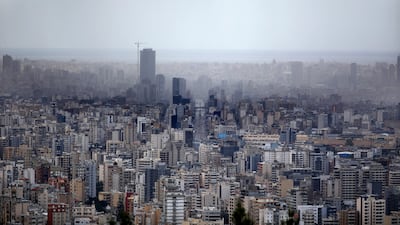
A haze covers southern Beirut in May 2020 as pollution levels began to rise after the 2019 economic collapse. AFP

Carcinogenic pollutants in Beirut double due to generator use, study shows


Nada Maucourant Atallah
  • English
  • Arabic

The level of carcinogenic pollutants from diesel generators in Beirut's air has doubled since 2017, increasing the risk of developing cancer by 50 per cent, a study has found.

Lebanon has become overly dependent on costly and polluting diesel-powered generators since a devastating economic crisis in 2019 dealt the final blow to its already crumbling electricity sector.

Unable to afford the fuel for its power plants, state power company Electricite du Liban provides barely a couple of hours of electricity a day, leaving Lebanese reliant on privately owned generators that use polluting fossil fuels.

“We re-ran the test several times as we could not believe the results,” said Najat Saliba, an atmospheric chemist who led the study and shared its main findings with The National.

We re-ran the test several times as we could not believe the results
Najat Saliba,
atmospheric chemist who led the study

The soon-to-be-published study, led by scientists from the American University of Beirut, monitored three different locations in Beirut through the 2022-2023 year.

The results show that the concentration of highly carcinogenic materials in the air has doubled since the last time the study was conducted in 2017, before the economic crisis, from 0.66 nanograms per metre cube to 1.36 nanograms per metre cube over the year.

In one of the study areas, Makassed, the level of fine particulates - particles less than 2.5 microns in diameter - averaged 25 micrograms per cubic metre over two seasons.

World Health Organisation guidelines say annual fine particulate matter exposure should not exceed 5 micrograms per cubic metre.

Exposure to Beirut's polluted air is on par with smoking at least four cigarettes a day, Ms Saliba said.

Nasser Yassin, the Minister of Environment in Lebanon's caretaker government, said the findings were “extremely worrying” and that he planned to raise the issue at Cabinet meetings.

“The presence of this large number of generators and their use most of the time is an anomaly and should be reduced through better and cleaner sources of electricity,” Mr Yassin told The National.

In collaboration with the AUB research team, the environment ministry issued new and stricter guidelines for generator filters last autumn to reduce the pollutants emitted.

“We now request that the municipality apply it when they give generator approvals,” he said.

“It is being applied, but slowly.”

Surge in 'younger cancer patients'

The AUB team has conducted air quality tests for more than a decade, providing sufficient data to discern overarching trends.

“Our first study focusing on diesel generators and their contribution to airborne carcinogens dates back to 2010. This provides a solid reference for comparison in our current findings,” Ms Saliba said.

The new findings were even more surprising given that pollution levels had not increased dramatically until recently. This raises the question: what has changed?

Lebanon's dysfunctional electricity sector has always relied on private generators, which are technically illegal but tolerated as the only alternative to make up the shortfall from EDL's supply.

According to AUB research, the density of generators in Beirut remained stable over the years – averaging one for every two buildings, or around 9,300 generators.

map of generators in Beirut. Credit Dr. Issam Lakkis and Najat Aoun Saliba

But after the 2019 economic crisis, as the state's power supply shrank from 21 hours in Beirut to just a few hours a day, generators became the primary electricity provider.

As a result, the risk of developing cancer over a lifetime has risen by 50 cents since before the crisis, the study found.

“We calculate cancer risk based on the chemicals emitted from generator exhaust, including some classified as category 1A carcinogens,” Ms Saliba said.

According to WHO figures from 2020, lung cancer is the third most prevalent cancer in Lebanon, after bladder cancer and breast cancer.

Hani Nassar, president of the Barbara Nassar Association for Adult Cancer Patient Support, said he was not surprised by the AUB study's findings.

“We are seeing younger patients more than ever before.

“The government is not taking any action, whether it's prevention or ensuring access to medication,” he said.

Cancer patients have been significantly affected by the economic crisis, facing medication shortages and soaring prices for treatments, when they are available on the black market, as public healthcare services crumbled.

“Every month, we have 1,500 to 2,000 people requesting our services, either unable to afford their medication or because it's unavailable in the market,” Mr Nassar said.

An $1.6 billion financial bonanza

Experts say weak governance, corruption and mismanagement are the root of the power sector's problems.

Lebanon failed to invest in cleaner energy production when it had the opportunity as dollars flowed into a seemingly flourishing banking sector, which was later described as a Ponzi scheme after its complete collapse.

The state has not built power plants in decades or invested in renewable energy, despite several projects planned, which were ultimately hampered by clientelism interests and were unable to agree on profit sharing.

“Generators' health impacts are a crime against every citizen,” Marc Ayoub, an energy researcher at the AUB, said.

“Yet, it is ultimately the government's responsibility for failing to implement affordable, sustainable and green electricity instead of generators.”

He said there is now a minimal incentive to change the status quo given the financial bonanza it represents for the political elite, which has formed a “deep interlinkage” with the “generator market and fuel importers.”

“The stakes are high – we're looking at a diesel import market worth around $1.6 billion in 2023," Mr Ayoub said.

This is around 8 per cent of a shrinking GDP.

“We now need bold political moves to end this and invest in cleaner energy production,” he added.

Ms Saliba, who is also an independent MP, is advocating for “diesel generators' owners to comply with the law,” regarding filters.

But the long-term solution lies elsewhere.

“The government should step up, remove all these generators, and establish a national grid. They've allowed an irregular sector to thrive. It's costing us our lives.”


Common OCD symptoms and how they manifest

Checking: the obsession or thoughts focus on some harm coming from things not being as they should, which usually centre around the theme of safety. For example, the obsession is “the building will burn down”, therefore the compulsion is checking that the oven is switched off.

Contamination: the obsession is focused on the presence of germs, dirt or harmful bacteria and how this will impact the person and/or their loved ones. For example, the obsession is “the floor is dirty; me and my family will get sick and die”, the compulsion is repetitive cleaning.

Orderliness: the obsession is a fear of sitting with uncomfortable feelings, or to prevent harm coming to oneself or others. Objectively there appears to be no logical link between the obsession and compulsion. For example,” I won’t feel right if the jars aren’t lined up” or “harm will come to my family if I don’t line up all the jars”, so the compulsion is therefore lining up the jars.

Intrusive thoughts: the intrusive thought is usually highly distressing and repetitive. Common examples may include thoughts of perpetrating violence towards others, harming others, or questions over one’s character or deeds, usually in conflict with the person’s true values. An example would be: “I think I might hurt my family”, which in turn leads to the compulsion of avoiding social gatherings.

Hoarding: the intrusive thought is the overvaluing of objects or possessions, while the compulsion is stashing or hoarding these items and refusing to let them go. For example, “this newspaper may come in useful one day”, therefore, the compulsion is hoarding newspapers instead of discarding them the next day.

Source: Dr Robert Chandler, clinical psychologist at Lighthouse Arabia

LUKA CHUPPI

Director: Laxman Utekar

Producer: Maddock Films, Jio Cinema

Cast: Kartik Aaryan, Kriti Sanon​​​​​​​, Pankaj Tripathi, Vinay Pathak, Aparshakti Khurana

Rating: 3/5

COMPANY%20PROFILE
%3Cp%3E%3Cstrong%3EName%3A%3C%2Fstrong%3E%20PlanRadar%3Cbr%3E%3Cstrong%3EStarted%3A%20%3C%2Fstrong%3E2013%3Cbr%3E%3Cstrong%3ECo-founders%3A%20%3C%2Fstrong%3EIbrahim%20Imam%2C%20Sander%20van%20de%20Rijdt%2C%20Constantin%20K%C3%B6ck%2C%20Clemens%20Hammerl%2C%20Domagoj%20Dolinsek%3Cbr%3E%3Cstrong%3EBased%3A%20%3C%2Fstrong%3EVienna%2C%20Austria%3Cbr%3E%3Cstrong%3ESector%3A%20%3C%2Fstrong%3EConstruction%20and%20real%20estate%3Cbr%3E%3Cstrong%3ECurrent%20number%20of%20staff%3A%20%3C%2Fstrong%3E400%2B%3Cbr%3E%3Cstrong%3EInvestment%20stage%3A%20%3C%2Fstrong%3ESeries%20B%3Cbr%3E%3Cstrong%3EInvestors%3A%3C%2Fstrong%3E%20Headline%2C%20Berliner%20Volksbank%20Ventures%2C%20aws%20Gr%C3%BCnderfonds%2C%20Cavalry%20Ventures%2C%20Proptech1%2C%20Russmedia%2C%20GR%20Capital%3C%2Fp%3E%0A
Visit Abu Dhabi culinary team's top Emirati restaurants in Abu Dhabi

Yadoo’s House Restaurant & Cafe

For the karak and Yoodo's house platter with includes eggs, balaleet, khamir and chebab bread.

Golden Dallah

For the cappuccino, luqaimat and aseeda.

Al Mrzab Restaurant

For the shrimp murabian and Kuwaiti options including Kuwaiti machboos with kebab and spicy sauce.

Al Derwaza

For the fish hubul, regag bread, biryani and special seafood soup. 

The story of Edge

Sheikh Mohamed bin Zayed, Crown Prince of Abu Dhabi and Deputy Supreme Commander of the Armed Forces, established Edge in 2019.

It brought together 25 state-owned and independent companies specialising in weapons systems, cyber protection and electronic warfare.

Edge has an annual revenue of $5 billion and employs more than 12,000 people.

Some of the companies include Nimr, a maker of armoured vehicles, Caracal, which manufactures guns and ammunitions company, Lahab


Tamkeen's offering
  • Option 1: 70% in year 1, 50% in year 2, 30% in year 3
  • Option 2: 50% across three years
  • Option 3: 30% across five years 
The burning issue

The internal combustion engine is facing a watershed moment – major manufacturer Volvo is to stop producing petroleum-powered vehicles by 2021 and countries in Europe, including the UK, have vowed to ban their sale before 2040. The National takes a look at the story of one of the most successful technologies of the last 100 years and how it has impacted life in the UAE. 

Read part four: an affection for classic cars lives on

Read part three: the age of the electric vehicle begins

Read part one: how cars came to the UAE


UAE currency: the story behind the money in your pockets
The%20Specs%20
%3Cp%3E%3Cstrong%3ELamborghini%20LM002%3C%2Fstrong%3E%3Cbr%3E%3Cstrong%3EEngine%3A%3C%2Fstrong%3E%205.2-litre%20V12%3Cbr%3E%3Cstrong%3EPower%3A%3C%2Fstrong%3E%20450hp%20at%206%2C800rpm%3Cbr%3E%3Cstrong%3ETorque%3A%20%3C%2Fstrong%3E500Nm%20at%204%2C500rpm%3Cbr%3E%3Cstrong%3ETransmission%3A%20%3C%2Fstrong%3EFive-speed%20manual%3Cbr%3E%3Cstrong%3E0-100kph%3A%3C%2Fstrong%3E%209%20seconds%20(approx)%3Cbr%3E%3Cstrong%3ETop%20speed%3A%3C%2Fstrong%3E%20210kph%20(approx)%3Cbr%3E%3Cstrong%3EYears%20built%3A%3C%2Fstrong%3E%201986-93%3Cbr%3E%3Cstrong%3ETotal%20vehicles%20built%3A%3C%2Fstrong%3E%20328%3Cbr%3E%3Cstrong%3EValue%20today%3A%3C%2Fstrong%3E%20%24300%2C000%2B%3Cbr%3E%3C%2Fp%3E%0A
MATCH INFO

Uefa Champioons League semi-final:

First leg: Liverpool 5 Roma 2

Second leg: Wednesday, May 2, Stadio Olimpico, Rome

TV: BeIN Sports, 10.45pm (UAE)

Engine: 3.5-litre V6

Transmission: eight-speed automatic

Power: 290hp

Torque: 340Nm

Price: Dh155,800

On sale: now

SPEC%20SHEET%3A%20APPLE%20IPHONE%2015%20PRO%20MAX
%3Cp%3E%3Cstrong%3EDisplay%3A%3C%2Fstrong%3E%206.7%22%20Super%20Retina%20XDR%20OLED%2C%202796%20x%201290%2C%20460ppi%2C%20120Hz%2C%202000%20nits%20max%2C%20HDR%2C%20True%20Tone%2C%20P3%2C%20always-on%3C%2Fp%3E%0A%3Cp%3E%3Cstrong%3EProcessor%3A%3C%2Fstrong%3E%20A17%20Pro%2C%206-core%20CPU%2C%206-core%20GPU%2C%2016-core%20Neural%20Engine%3C%2Fp%3E%0A%3Cp%3E%3Cstrong%3EMemory%3A%3C%2Fstrong%3E%208GB%3C%2Fp%3E%0A%3Cp%3E%3Cstrong%3ECapacity%3A%3C%2Fstrong%3E%20256%2F512GB%20%2F%201TB%3C%2Fp%3E%0A%3Cp%3E%3Cstrong%3EPlatform%3A%3C%2Fstrong%3E%20iOS%2017%3C%2Fp%3E%0A%3Cp%3E%3Cstrong%3EMain%20camera%3A%3C%2Fstrong%3E%20Triple%3A%2048MP%20main%20(f%2F1.78)%20%2B%2012MP%20ultra-wide%20(f%2F2.2)%20%2B%2012MP%205x%20telephoto%20(f%2F2.8)%3B%205x%20optical%20zoom%20in%2C%202x%20optical%20zoom%20out%3B%2010x%20optical%20zoom%20range%2C%20digital%20zoom%20up%20to%2025x%3B%20Photonic%20Engine%2C%20Deep%20Fusion%2C%20Smart%20HDR%204%2C%20Portrait%20Lighting%3C%2Fp%3E%0A%3Cp%3E%3Cstrong%3EMain%20camera%20video%3A%3C%2Fstrong%3E%204K%20%40%2024%2F25%2F30%2F60fps%2C%20full-HD%20%40%2025%2F30%2F60fps%2C%20HD%20%40%2030fps%2C%20slo-mo%20%40%20120%2F240fps%2C%20ProRes%20(4K)%20%40%2060fps%3B%20night%2C%20time%20lapse%2C%20cinematic%2C%20action%20modes%3B%20Dolby%20Vision%2C%204K%20HDR%3C%2Fp%3E%0A%3Cp%3E%3Cstrong%3EFront%20camera%3A%3C%2Fstrong%3E%2012MP%20TrueDepth%20(f%2F1.9)%2C%20Photonic%20Engine%2C%20Deep%20Fusion%2C%20Smart%20HDR%204%2C%20Portrait%20Lighting%3B%20Animoji%2C%20Memoji%3C%2Fp%3E%0A%3Cp%3E%3Cstrong%3EFront%20camera%20video%3A%3C%2Fstrong%3E%204K%20%40%2024%2F25%2F30%2F60fps%2C%20full-HD%20%40%2025%2F30%2F60fps%2C%20slo-mo%20%40%20120%2F240fps%2C%20ProRes%20(4K)%20%40%2030fps%3B%20night%2C%20time%20lapse%2C%20cinematic%2C%20action%20modes%3B%20Dolby%20Vision%2C%204K%20HDR%3C%2Fp%3E%0A%3Cp%3E%3Cstrong%3EBattery%3A%3C%2Fstrong%3E%204441mAh%2C%20up%20to%2029h%20video%2C%2025h%20streaming%20video%2C%2095h%20audio%3B%20fast%20charge%20to%2050%25%20in%2030min%20(with%20at%20least%2020W%20adaptor)%3B%20MagSafe%2C%20Qi%20wireless%20charging%3C%2Fp%3E%0A%3Cp%3E%3Cstrong%3EConnectivity%3A%3C%2Fstrong%3E%20Wi-Fi%2C%20Bluetooth%205.3%2C%20NFC%20(Apple%20Pay)%2C%20second-generation%20Ultra%20Wideband%20chip%3C%2Fp%3E%0A%3Cp%3E%3Cstrong%3EBiometrics%3A%3C%2Fstrong%3E%20Face%20ID%3C%2Fp%3E%0A%3Cp%3E%3Cstrong%3EI%2FO%3A%3C%2Fstrong%3E%20USB-C%3C%2Fp%3E%0A%3Cp%3E%3Cstrong%3EDurability%3A%3C%2Fstrong%3E%20IP68%2C%20water-resistant%20up%20to%206m%20up%20to%2030min%3B%20dust%2Fsplash-resistant%3C%2Fp%3E%0A%3Cp%3E%3Cstrong%3ECards%3A%3C%2Fstrong%3E%20Dual%20eSIM%20%2F%20eSIM%20%2B%20eSIM%20(US%20models%20use%20eSIMs%20only)%3C%2Fp%3E%0A%3Cp%3E%3Cstrong%3EColours%3A%3C%2Fstrong%3E%20Black%20titanium%2C%20blue%20titanium%2C%20natural%20titanium%2C%20white%20titanium%3C%2Fp%3E%0A%3Cp%3E%3Cstrong%3EIn%20the%20box%3A%20%3C%2Fstrong%3EiPhone%2015%20Pro%20Max%2C%20USB-C-to-USB-C%20woven%20cable%2C%20one%20Apple%20sticker%3C%2Fp%3E%0A%3Cp%3E%3Cstrong%3EPrice%3A%3C%2Fstrong%3E%20Dh5%2C099%20%2F%20Dh5%2C949%20%2F%20Dh6%2C799%3C%2Fp%3E%0A
Global state-owned investor ranking by size

1.

United States

2.

China

3.

UAE

4.

Japan

5

Norway

6.

Canada

7.

Singapore

8.

Australia

9.

Saudi Arabia

10.

South Korea

Updated: April 28, 2024, 6:19 PM