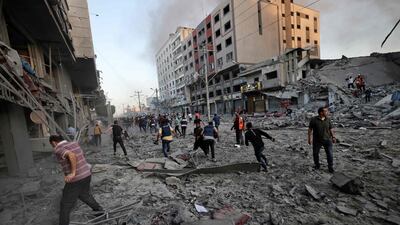
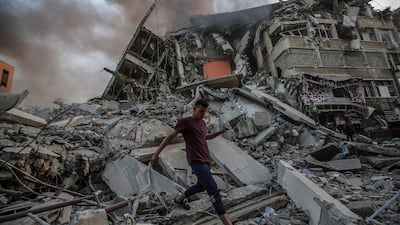
Survivors of Israeli air strikes on the Sheikh Zayed neighbourhood in Gaza said they feared for their lives as their homes crashed down on top of them.
More than 15 Israeli air strikes hit the neighbourhood in the north of the Gaza Strip on Wednesday night, flattening six buildings, residents said.
Rescuers and others in the rubble in front of Al Shorouq tower that collapsed after being hit by an Israeli air strike, in Gaza City. AFP
Sunrise through a haze of cloud and smoke after an Israeli strike on Gaza City. AP
A man walks past the rubble of the destroyed Al Shorouq tower after an Israeli strike in Gaza City. EPA
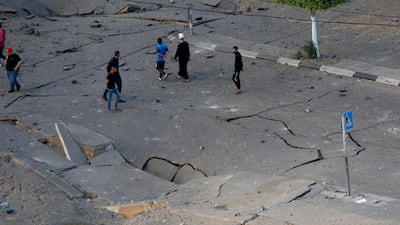
People survey the damage on a street after an Israeli air strike in Gaza City. AP
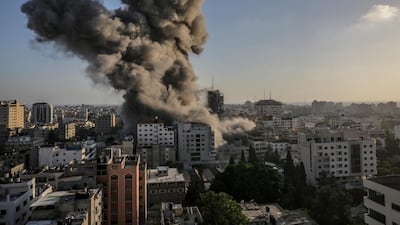
Smoke from the Israeli air strike on Al Shorouq tower in Gaza City. EPA
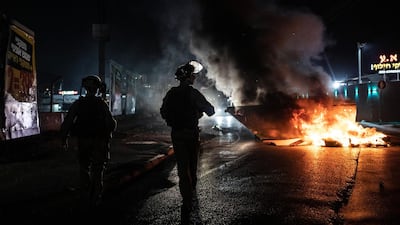
Israeli police patrol during clashes between Arabs, police and Jews, in the mixed town of Lod. As rockets from Gaza streaked overhead, Arabs and Jews fought each other on the streets below. Rioters torched vehicles, a restaurant and a synagogue. AP
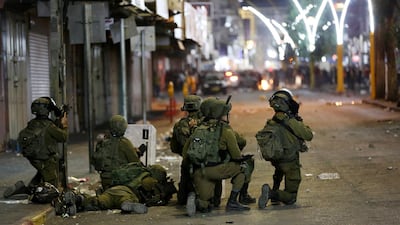
Israeli troops during clashes with Palestinian protesters in the West Bank city of Hebron. EPA
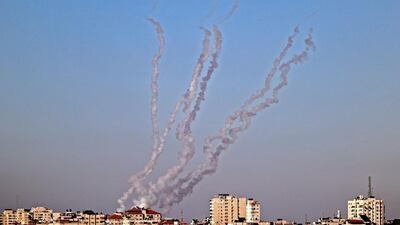
Rockets launched from the Gaza Strip streak towards Israel. AP
Israeli troops during clashes with Palestinian protesters in Hebron, in the occupied West Bank. EPA
A Palestinian man at a hospital in Gaza City, where those injured or killed in Israeli air strikes are transferred. AFP
Smoke and flames from an Israeli air strike on a building in Gaza City. AP
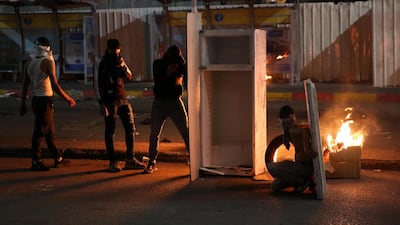
Palestinian protesters in the West Bank city of Hebron, where they clashed with Israeli troops. EPA
Smoke billows from an explosion following an Israeli airstrike in Rafah in the southern Gaza Strip. AFP
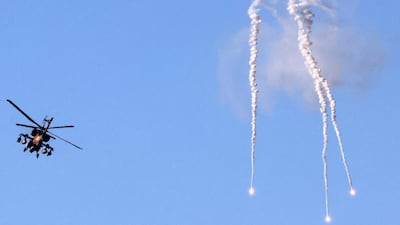
An Israeli Apache attack helicopter releases flares near Sderot, in southern Israel, on the border with the Gaza Strip. AFP
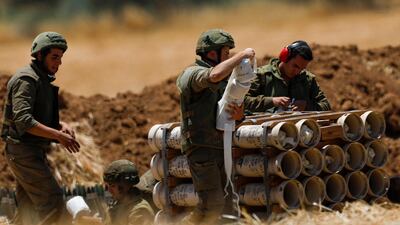
Israeli artillery soldiers prepare propelling charges for a howitzer at the border with Gaza. EPA
Some from rockets fired towards Israel by Palestinian Islamist movement Hamas billows in the air in Gaza City. AFP
Khaled Almalfouh, 25, told The National: "I heard the sound of bombing. It was huge and didn't stop, so we gathered in one room in our home and suddenly the house collapsed around us."
Mr Almalfouh said his mother told them to stay in one room so they could survive, or die, together.
It took rescuers more than 30 minutes to pull Mr Almalfouh and seven other members of his family from the rubble after a bomb landed near by, bringing down the three-storey apartment building in which they live.
“My neighbour who lived on the third floor is lost with his wife and four children,” he said.
“I witnessed death while I was under the rubble. I wondered if we would survive.”
Mr Almalfouh's sister, Alaa, was at the family home with her three children. She left her own home in the Tal Al Zateer neighbourhood two days earlier after receiving a warning of an impending Israeli strike on the building.
“Suddenly bombing was everywhere,” she said. “I hugged my children and told them how much I love them, because I could not imagine we would survive.
“In moments we were under rubble, I started to call for my children and neighbours to be sure if they were alive.”
Alaa’s eldest daughter sustained head injuries.
“My five-year-old daughter cries all the time now, she doesn’t understand what happened,” she said.
Alaa spends her time in the hospital, where her mother is being treated for two broken legs.
The owner of Alaa's building, Rabah Al Madhoun, told The National there was no time to evacuate before the bombs fell.
"My neighbour received a call telling him that the building would be targeted, Mr Al Madhoun said. "He came to warn us but the air strikes started immediately – people didn't have time to evacuate."
Gaza's health ministry said two bodies belonging to members of Mr Al Madhoun's family, who lived in the building, were pulled from the rubble.
Rescuers continued to search for survivors and bodies on Thursday night.
Militants in Gaza continued to fire rockets at Israel in a fourth day of violence, as the Israeli air attacks continued.
Abu Ubaida, the spokesman for Hamas's armed wing, on Thursday announced that a new, longer-range rocket named the Ayyash 250 was in service in revenge for the Israeli killings of several high-ranking leaders of the group.
The new rocket, he said, had a range of 250 kilometres, and several were fired at Ramon airport near Eilat in Israel.
At least 87 Palestinians, including 18 children, have died in Gaza since the fighting began, the health ministry reported. At least 530 people have been injured.

What vitamins do we know are beneficial for living in the UAE
Vitamin D: Highly relevant in the UAE due to limited sun exposure; supports bone health, immunity and mood. Vitamin B12: Important for nerve health and energy production, especially for vegetarians, vegans and individuals with absorption issues. Iron: Useful only when deficiency or anaemia is confirmed; helps reduce fatigue and support immunity. Omega-3 (EPA/DHA): Supports heart health and reduces inflammation, especially for those who consume little fish.
If you go
Where to stay: Courtyard by Marriott Titusville Kennedy Space Centre has unparalleled views of the Indian River. Alligators can be spotted from hotel room balconies, as can several rocket launch sites. The hotel also boasts cool space-themed decor.
When to go: Florida is best experienced during the winter months, from November to May, before the humidity kicks in.
How to get there: Emirates currently flies from Dubai to Orlando five times a week.
Bobby Grudziecki, chief operating officer of Frank Porter, identifies the five most popular areas in Dubai for those looking to make the most out of their properties and the rates owners can secure:
• Dubai Marina
The Marina and Jumeirah Beach Residence are popular locations, says Mr Grudziecki, due to their closeness to the beach, restaurants and hotels.
Frank Porter’s average Airbnb rent:
One bedroom: Dh482 to Dh739
Two bedroom: Dh627 to Dh960
Three bedroom: Dh721 to Dh1,104
• Downtown
Within walking distance of the Dubai Mall, Burj Khalifa and the famous fountains, this location combines business and leisure. “Sure it’s for tourists,” says Mr Grudziecki. “Though Downtown [still caters to business people] because it’s close to Dubai International Financial Centre."
Frank Porter’s average Airbnb rent:
One bedroom: Dh497 to Dh772
Two bedroom: Dh646 to Dh1,003
Three bedroom: Dh743 to Dh1,154
• City Walk
The rising star of the Dubai property market, this area is lined with pristine sidewalks, boutiques and cafes and close to the new entertainment venue Coca Cola Arena. “Downtown and Marina are pretty much the same prices,” Mr Grudziecki says, “but City Walk is higher.”
Frank Porter’s average Airbnb rent:
One bedroom: Dh524 to Dh809
Two bedroom: Dh682 to Dh1,052
Three bedroom: Dh784 to Dh1,210
• Jumeirah Lake Towers
Dubai Marina’s little brother JLT resides on the other side of Sheikh Zayed road but is still close enough to beachside outlets and attractions. The big selling point for Airbnb renters, however, is that “it’s cheaper than Dubai Marina”, Mr Grudziecki says.
Frank Porter’s average Airbnb rent:
One bedroom: Dh422 to Dh629
Two bedroom: Dh549 to Dh818
Three bedroom: Dh631 to Dh941
• Palm Jumeirah
Palm Jumeirah's proximity to luxury resorts is attractive, especially for big families, says Mr Grudziecki, as Airbnb renters can secure competitive rates on one of the world’s most famous tourist destinations.
Frank Porter’s average Airbnb rent:
One bedroom: Dh503 to Dh770
Two bedroom: Dh654 to Dh1,002
Three bedroom: Dh752 to Dh1,152
1. Domestic VAT refund amendments: request your refund within five years
If a business does not apply for the refund on time, they lose their credit.
2. E-invoicing in the UAE
Businesses should continue preparing for the implementation of e-invoicing in the UAE, with 2026 a preparation and transition period ahead of phased mandatory adoption.
3. More tax audits
Tax authorities are increasingly using data already available across multiple filings to identify audit risks.
4. More beneficial VAT and excise tax penalty regime
Tax disputes are expected to become more frequent and more structured, with clearer administrative objection and appeal processes. The UAE has adopted a new penalty regime for VAT and excise disputes, which now mirrors the penalty regime for corporate tax.
5. Greater emphasis on statutory audit
There is a greater need for the accuracy of financial statements. The International Financial Reporting Standards standards need to be strictly adhered to and, as a result, the quality of the audits will need to increase.
6. Further transfer pricing enforcement
Transfer pricing enforcement, which refers to the practice of establishing prices for internal transactions between related entities, is expected to broaden in scope. The UAE will shortly open the possibility to negotiate advance pricing agreements, or essentially rulings for transfer pricing purposes.
7. Limited time periods for audits
Recent amendments also introduce a default five-year limitation period for tax audits and assessments, subject to specific statutory exceptions. While the standard audit and assessment period is five years, this may be extended to up to 15 years in cases involving fraud or tax evasion.
8. Pillar 2 implementation
Many multinational groups will begin to feel the practical effect of the Domestic Minimum Top-Up Tax (DMTT), the UAE's implementation of the OECD’s global minimum tax under Pillar 2. While the rules apply for financial years starting on or after January 1, 2025, it is 2026 that marks the transition to an operational phase.
9. Reduced compliance obligations for imported goods and services
Businesses that apply the reverse-charge mechanism for VAT purposes in the UAE may benefit from reduced compliance obligations.
10. Substance and CbC reporting focus
Tax authorities are expected to continue strengthening the enforcement of economic substance and Country-by-Country (CbC) reporting frameworks. In the UAE, these regimes are increasingly being used as risk-assessment tools, providing tax authorities with a comprehensive view of multinational groups’ global footprints and enabling them to assess whether profits are aligned with real economic activity.
Contributed by Thomas Vanhee and Hend Rashwan, Aurifer