
Live updates: Follow the latest news on Israel-Gaza
Israel appears to be following through on its promise to wipe out Hamas's hierarchy and the people behind the October 7 attacks after a strike killed the militant group's deputy leader.
Saleh Al Arouri was assassinated alongside six other Hamas operatives when a drone struck a building in a busy Beirut suburb on Tuesday, in a move that threatens the risk of a wider war.
Mr Al Arouri, who helped finance the transfer of weapons and money to Hamas since the 1980s, is the group's most senior leader to be killed in the conflict.
Last year, Mr Al Arouri was seen in Lebanon as images emerged of him holding talks with Hassan Nasrallah, the leader of Hezbollah, and Palestinian Islamic Jihad chief Ziyad Al Nakhalah.
Israel has not admitted responsibility for his assassination, but Prime Minister Benjamin Netanyahu warned in November that the military would “operate against Hamas leaders wherever they are”.
'No distinction' between political and military leaders
Experts told The National that Israel would make “no distinction” between Hamas’s political and military leadership and its hit list would be “exhaustive and ranked in value order”.
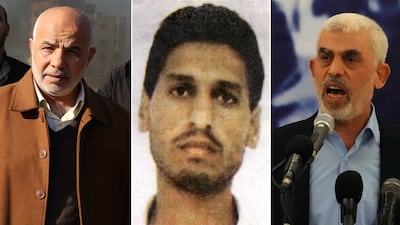
Mohammed Deif, commander of Hamas's military wing, Yahya Sinwar, founding member of its military wing and intelligence service, and the group’s political leader in the Gaza Strip are believed to be the remaining chief targets in Israel’s sights.
Since the start of retaliatory action, Israel has openly declared that Mr Sinwar is "a dead man walking".
Mr Deif, who was born in a Gazan refugee camp, and Mr Sinwar, whose home came under fire in recent weeks, have spent time in prison and been the subject of assassination attempts.

Dr Alan Mendoza, executive director of the Henry Jackson Society, told The National that Israel would be ranking its targets in order of value similar to the 55 playing cards the US-led coalition, which invaded Iraq in 2003, gave to its troops to identify the most wanted members of Saddam Hussein's government.
“Israel’s targets will be the leadership of Hamas located in Gaza, although if the opportunity to eradicate Hamas leaders elsewhere presents itself then we can expect Israel to follow through on this as well,” he said.
“No distinction will be made between political and military leadership because Hamas is a terrorist group, and therefore all its arms are tied to the same cause.
"We can assume that the Israeli list will be exhaustive and ranked in value order, in a similar way to the Baathist playing cards the coalition deployed when removing Saddam Hussein’s regime."
Other names include Tawfik Abu Naim, the head of the security apparatus, Vahi Moshtaha, Mr Sinwar's senior adviser, Marwan Issa, Mr Deif's deputy and the co-ordinator of the military and political wings, and Ahmed Ahandor, commander of the northern Gaza Strip, but there are others.

Director of The Counter Extremism Project, Hans-Jakob Schindler, believes Israel will target Hamas’s military and political leadership but will take aim at its military commanders first.
“It is clear, of course, that 'destroying Hamas' involves at minimum two sets of targets,” he said.
“The priority is the physical terrorist infrastructure, which includes tunnels, weapons, rockets and fighters, as well as the terrorist command and control structure, which is the leadership of the terrorist forces, the commanders and the Hamas intelligence apparatus.
“In my assessment, these are the things that Israel is focusing on first. In addition, in order to reduce the influence that Hamas has, the political leadership in and outside of Gaza is the second priority.
“Hamas is a hybrid organisation and therefore does ideological and social work in addition to its terrorist activities," he added. "However, it is also a strictly hierarchical organisation, meaning the overall leadership of the organisation as well as its political/ideological leadership bear responsibility for the terrorist activities and therefore are also important.
“Furthermore, in order to diminish Hamas’s influence in the Gaza Strip will mean that Israel will also have to focus on the ideological structures that Hamas has set up to maintain power in Gaza.”
Israel's task will be made more challenging because Hamas's main political leadership live abroad between Qatar and Turkey and the organisation also has offices in Lebanon, Syria Iran, and other places.
Who are Israel's key targets?
Mohammed Deif
He was born in 1965 in the Khan Younis refugee camp in the Gaza Strip and is the commander of Hamas’s military wing.
He joined Hamas during the first Palestinian uprising, which began in 1987, and was arrested by Israel in 1989, spending about 16 months in detention.
He earned a degree in science from the Islamic University in Gaza, where he studied physics, chemistry and biology.

Rising through the Hamas ranks, Mr Deif developed the group's network of tunnels and its bomb-making expertise. He has topped Israel's most-wanted list for decades, suspected of involvement in the deaths of dozens of Israelis in suicide bombings.
His wife and children were killed by an Israeli air strike in 2014.
A survivor of seven Israeli assassination attempts, the most recent in 2021, Mr Deif rarely speaks and never appears in public.
His survival while running Hamas's armed wing has earned him the status of Palestinian folk hero. In videos he is masked, or just a silhouette of him is shown.
There are only three known photographs of Mr Deif: one taken in his 20s, another of him masked and an image of his shadow, which was used when the audio tape was broadcast.
His current whereabouts are unknown, although he is most likely in Gaza in the maze of tunnels under the enclave.
Yahya Sinwar
The group’s political leader in the Gaza Strip since 2017 is a founding member of Hamas’s military wing and intelligence service.
Mr Sinwar has served more than two decades in Israeli prisons before being released in a 2011 prisoner swap. He emerged as the militant group’s leader in Gaza – its top leadership resides abroad – in 2017.
After the October 7 attack, Israel described him as the "face of evil" and described him as the "mastermind" behind the raid.
Mr Sinwar grew up in southern Gaza’s main city of Khan Younis.
In early 1988, he was arrested and sentenced to life in jail for killing two Israeli soldiers.
Tawfik Abu Naim
He ran the security apparatus for Hamas.
In 1989 he was arrested by Israel but was released in 2011 in a prisoner exchange. He survived an Israeli assassination attempt in October 2017.

Vahi Moshtaha
He is Mr Sinwar's senior adviser.
Marwan Issa
He acts as Mr Deif's deputy and the co-ordinator of the Hamas military and political wings.
Muhammad Sinwar
Yahya's brother and commander of the southern Gaza Strip, who has previously been accused of kidnapping an Israeli soldier.
Muhammad Shabana
Commander of the Rafah Brigade.
Eaz al-Din Haddad
Commander of the Gaza City Brigade.
Ismail Haniyeh
A senior political leader of Hamas and served as deputy leader of Hamas between 2014 and 2017 and as Hamas’s prime minister in Gaza between 2007 and 2014. He was born in the Al-Shati refugee camp in the Gaza Strip in 1962 and became involved with Hamas while at university. He lives in Qatar.
Khaled Meshaal
The former chief of Hamas’s political bureau and current leader of Hamas’s diaspora office. He lives in Qatar.
Mahmoud Al Zahar
A senior member of Hamas.
'Israel will believe they all played role in attack'
Mr Mendoza said all those listed will be considered to have played a role in the October 7 raid.
“All these individuals and their counterparts located overseas will be deemed to have played a role in the October 7 massacres, as it would have been impossible for Hamas to have taken a decision of such gravity without the buy-in of all its senior players,” he said.
Dr Schindler said pressure will now be mounting on Qatar to reconsider its agreement to allow some of the Hamas leadership to live there.
“This will also mean that there will be political pressure on Qatar from governments to rethink its current, absolutely permissible approach to the Hamas leadership, which the country allows to live and work in Qatar,” he said.
“This has to change following this massive, pogrom-like attack against Israel. Qatar should have been aware that hosting the leadership of a terror group was risky before, but at least now, it should have become obvious to everyone in Doha that the Hamas leadership in Qatar is a massive political liability. Therefore, the stance of Qatar towards these individuals should and must change.”
At least 1,400 people died in the October 7 attack in Israel, and more than 6,500 Palestinians have been killed in Israeli strikes on Gaza, including 2,704 children, in the Israeli military response which followed, the Health Ministry in Gaza said.

