Orphaned in the fall of ISIS, London teen in Syria jail wants to return home


Gareth Browne
  • English
  • Arabic

The skinny boy in oversized glasses and a grubby tracksuit barely flinches as he reels off the grisly list of deaths of his family members during the fall of ISIS in Syria.

His mother and two of his siblings died in an air strike. His older brother was hit in the head by a sniper’s bullet as he carried out an ISIS attack.

The National has found Abdullah, a 13-year-old orphan, who says he's from London, stranded thousands of miles from home in a prison for minors in north-east Syria.

He is one of the thousands who emerged from Baghouz, a dusty town near the Iraqi border where ISIS made its last stand in March 2019 against Kurdish-led forces backed by an international coalition.

Abdullah, a young boy who calls London home, is stuck in Syria. Luke Pierce for The National

Among the ISIS ranks were men and women who had travelled from all over the world to join the group. Some of them brought young children – Abdullah’s mother, Rohana, was one of them.

Alongside the harrowing tales from Baghouz, Abdullah has fond memories of London, a city he once called home.

He remembers riding a red double-decker bus to school every day and weekend lunches at McDonald's.

Although he was born in Pakistan and lived almost half his life in Syria, he speaks with an English accent and repeatedly uses British turns of phrase.

He says England is home and he wants to go back.

“I love London more than I love Pakistan. London is a beautiful country," he says.

"I can do what I want there. I have a lot of friends and I can learn football there really fast and in Pakistan, they play cricket. I don’t like cricket. I want to go to London and learn football there.”

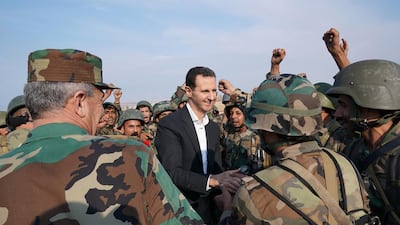
  • Syrian soldiers are seen cheering President Bashar Al Assad during his visit to Al Habit on the southern edges of the Idlib province, in a picture released on October 22, 2019. AFP / Syrian Presidency Facebook page
    Syrian soldiers are seen cheering President Bashar Al Assad during his visit to Al Habit on the southern edges of the Idlib province, in a picture released on October 22, 2019. AFP / Syrian Presidency Facebook page
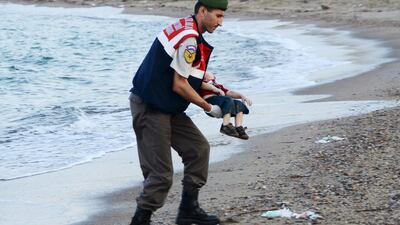
  • A Turkish gendarme retrieves the body of Syrian refugee Alan Kurdi from a beach in Turkey. Reuters
    A Turkish gendarme retrieves the body of Syrian refugee Alan Kurdi from a beach in Turkey. Reuters
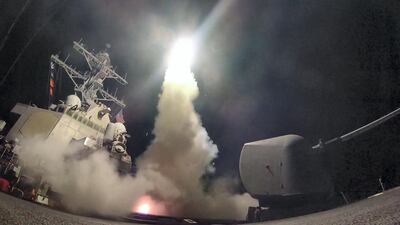
  • The guided-missile destroyer 'USS Porter' conducts strikes while in the Mediterranean Sea, on April 7, 2017. AFP / US NAVY
    The guided-missile destroyer 'USS Porter' conducts strikes while in the Mediterranean Sea, on April 7, 2017. AFP / US NAVY
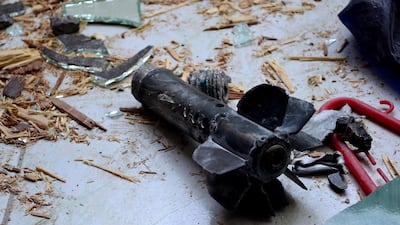
  • A handout picture released by the official Syrian Arab News Agency on October 31, 2013, shows the remains of a mortar after an alleged mortar attack by rebel fighters on the Damascus mixed Christian-Druze suburb of Jaramana. AFP / Sana
    A handout picture released by the official Syrian Arab News Agency on October 31, 2013, shows the remains of a mortar after an alleged mortar attack by rebel fighters on the Damascus mixed Christian-Druze suburb of Jaramana. AFP / Sana
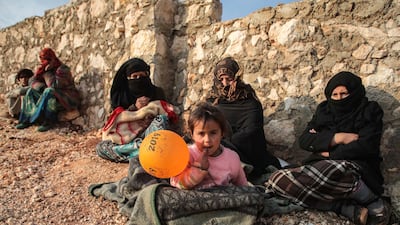
  • Displaced Syrians from the south of Idlib province sit out in the open in the countryside west of the town of Dana in the north-west Syrian region on December 23, 2019. AFP
    Displaced Syrians from the south of Idlib province sit out in the open in the countryside west of the town of Dana in the north-west Syrian region on December 23, 2019. AFP
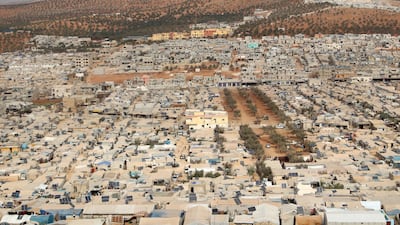
  • This picture shows a general view of an overcrowded displacement camp near the village of Qah near the Turkish border in Syria's north-west Idlib province, on October 28, 2020, during the coronavirus pandemic crisis. AFP
    This picture shows a general view of an overcrowded displacement camp near the village of Qah near the Turkish border in Syria's north-west Idlib province, on October 28, 2020, during the coronavirus pandemic crisis. AFP
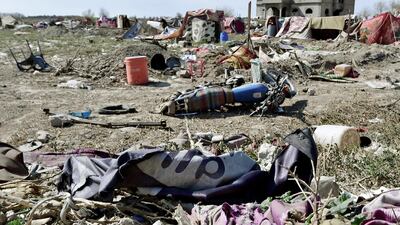
  • A picture taken on March 23, 2019, shows the last ISIS bastion in the eastern Syrian village of Baghuz after the defeat of the group. The Kurdish-led forces pronounced the end of ISIS regime on March 23, 2019, after flushing out the diehard militants from their very last bastion in eastern Syria. AFP
    A picture taken on March 23, 2019, shows the last ISIS bastion in the eastern Syrian village of Baghuz after the defeat of the group. The Kurdish-led forces pronounced the end of ISIS regime on March 23, 2019, after flushing out the diehard militants from their very last bastion in eastern Syria. AFP
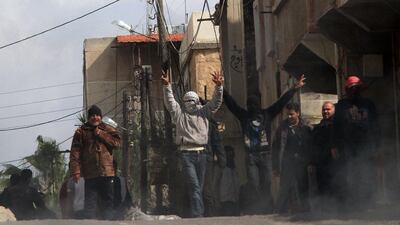
  • Anti-government activists gesture as they gather on the streets of Daraa, 100 kilometres south of the capital Damascus, on March 23, 2011. AFP
    Anti-government activists gesture as they gather on the streets of Daraa, 100 kilometres south of the capital Damascus, on March 23, 2011. AFP
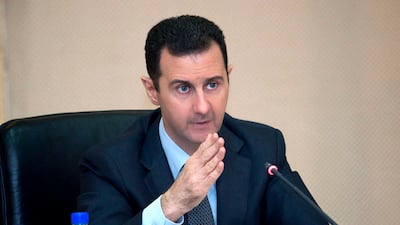
  • Syria's President Bashar Al Assad heading a cabinet meeting in the presidential palace in Damascus in 2013. Sana / AFP
    Syria's President Bashar Al Assad heading a cabinet meeting in the presidential palace in Damascus in 2013. Sana / AFP
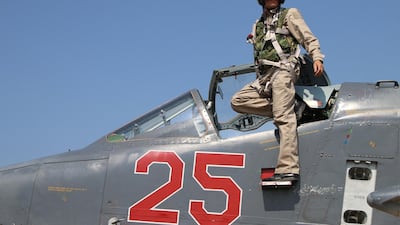
  • A picture taken on October 3, 2015 shows a Russian army pilot leaving the cockpit of a Russian Sukhoi Su-25 ground attack aircraft at the Hmeimim airbase in the Syrian province of Latakia. AFP
    A picture taken on October 3, 2015 shows a Russian army pilot leaving the cockpit of a Russian Sukhoi Su-25 ground attack aircraft at the Hmeimim airbase in the Syrian province of Latakia. AFP
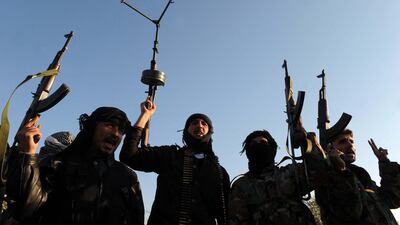
  • Members of the Free Syrian Army raise their weapons during a patrol in Idlib in north-west Syria on February 18, 2012. AFP
    Members of the Free Syrian Army raise their weapons during a patrol in Idlib in north-west Syria on February 18, 2012. AFP
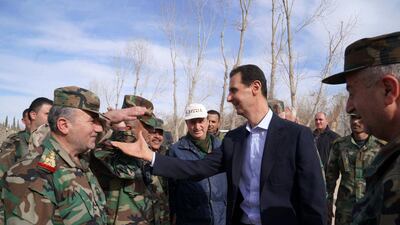
  • Syrian President Bashar Al Assad is shown shaking hands with government troops in Eastern Ghouta, in the leader's first trip to the former rebel enclave outside Damascus in years, in this handout picture released by the Syrian Presidency on March 18, 2018. Syrian Presidency Facebook page / AFP
    Syrian President Bashar Al Assad is shown shaking hands with government troops in Eastern Ghouta, in the leader's first trip to the former rebel enclave outside Damascus in years, in this handout picture released by the Syrian Presidency on March 18, 2018. Syrian Presidency Facebook page / AFP
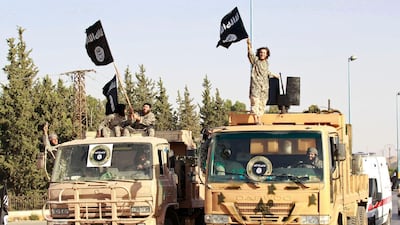
  • Militant fighters wave flags as they take part in a military parade along the streets of Syria's northern Raqqa province, on June 30, 2014. Reuters
    Militant fighters wave flags as they take part in a military parade along the streets of Syria's northern Raqqa province, on June 30, 2014. Reuters

His time in Baghouz is etched into his memory.

Thousands of ISIS members, their families and others caught up in the conflict hunkered down in tents on a bend of the Euphrates as air strikes and artillery pummelled their encampment.

He pleaded with his mother to change tents because she insisted on staying with a group of other foreign women.

“On the last night, I said to my mum: ‘Come out of the house because they are going to strike the house because it’s so big’,” he said.

Fearing it could be a target, he ran away and stayed instead with some Turkish friends.

The decision saved his life.

The next morning, he says, he awoke to see that an air strike had hit the tent, killing his mother, his sister Zeinab and his younger brother, Mohammed.

Another sister, Aisha, was hit by a rocket-propelled grenade. His oldest brother, Rabi Allah, had already been shot trying to carry out an ISIS suicide attack in Al Shaddadi, about 230 kilometres north of Baghouz.

Abdullah understands that his father, who did not travel to Syria with the family, is also dead.

After the fall of Baghouz, he spent months living alongside other orphans in Al Hol camp. The camp is run by Kurdish forces to house those who surrendered in Baghouz.

For the past two years, unbeknown to extended family or the UK government, he has been held in camps and jails across north-east Syria.

The UK government is largely refusing to repatriate adult Britons who joined the group, but it has bought back a small number of unaccompanied children.

This policy has left as many as 60 British children stuck in Syria, something rights groups have condemned. Children, they say, should not live with the consequences of the decisions of their parents.

It was 2015 when a new, mysterious man entered the family’s life in London and, soon after, Abdullah’s mum packed up their home in the UK and moved the family to Syria.

“She said to me ‘pick up all the stuff you have, we’re going to sell this house’,” he recalls.

"There was a man who was helping us, he was taking our stuff and selling our house, I remember that."
On reaching Syria, Abdullah remembers watching his mother make the ultimate pledge of loyalty to ISIS.

“We had passports, but my mum burnt them,” he says.

The family moved between Raqqa – once the de facto capital of ISIS’s so-called caliphate – the village of Al Mayadeen and the Iraqi city of Mosul.

Now, alone and missing his life in London, he wants to go home.

After more than five years in the war zone, he struggles to remember the names of his relatives in the UK.

He says he and his mother would occasionally speak with family members outside Syria but they always pretended to be in Turkey. This means that what remains of his family may not be aware he is even in Syria, nor that his mother and four siblings are dead.

Tracking down his relatives in the UK may be Abdullah’s only chance of repatriation and a normal life.

The National has informed the British government of Abdullah's situation and whereabouts. The British government may choose to repatriate Abdullah if they can establish his citizenship or deem a duty of care.

Save the Children, which has campaigned for the UK government to take action on British minors stuck in Syria, said children are the victims of war and need protection.

“The UK government has demonstrated more than once that repatriation of British children from Syria is feasible,” said Orlaith Minogue, Senior Conflict and Humanitarian Advocacy Adviser at Save the Children.

“It is critical that all British children are repatriated and supported to recover from their experiences and restore a sense of normality. We call on the UK government to take urgent steps to work with the Kurdish authorities in control of north-east Syria to ensure the safe repatriation of all British children.”

Earlier this month, the UK's Supreme Court upheld a decision to deny Shamima Begum, who left the UK as a child to join ISIS in Syria and is now also in a camp in the country's north-east, the right to return. Ms Begum wanted to come back to the UK and fight a court battle to reinstate her British citizenship.


Company%C2%A0profile
%3Cp%3E%3Cstrong%3ECompany%20name%3A%20%3C%2Fstrong%3ETuhoon%0D%3Cbr%3E%3Cstrong%3EYear%20started%3A%20%3C%2Fstrong%3EJune%202021%0D%3Cbr%3E%3Cstrong%3ECo-founders%3A%20%3C%2Fstrong%3EFares%20Ghandour%2C%20Dr%20Naif%20Almutawa%2C%20Aymane%20Sennoussi%0D%3Cbr%3E%3Cstrong%3EBased%3A%20%3C%2Fstrong%3ERiyadh%0D%3Cbr%3E%3Cstrong%3ESector%3A%20%3C%2Fstrong%3Ehealth%20care%0D%3Cbr%3E%3Cstrong%3ESize%3A%20%3C%2Fstrong%3E15%20employees%2C%20%24250%2C000%20in%20revenue%0D%3Cbr%3EI%3Cstrong%3Envestment%20stage%3A%20s%3C%2Fstrong%3Eeed%0D%3Cbr%3E%3Cstrong%3EInvestors%3A%20%3C%2Fstrong%3EWamda%20Capital%2C%20Nuwa%20Capital%2C%20angel%20investors%3C%2Fp%3E%0A
What is the FNC?

The Federal National Council is one of five federal authorities established by the UAE constitution. It held its first session on December 2, 1972, a year to the day after Federation.
It has 40 members, eight of whom are women. The members represent the UAE population through each of the emirates. Abu Dhabi and Dubai have eight members each, Sharjah and Ras al Khaimah six, and Ajman, Fujairah and Umm Al Quwain have four.
They bring Emirati issues to the council for debate and put those concerns to ministers summoned for questioning. 
The FNC’s main functions include passing, amending or rejecting federal draft laws, discussing international treaties and agreements, and offering recommendations on general subjects raised during sessions.
Federal draft laws must first pass through the FNC for recommendations when members can amend the laws to suit the needs of citizens. The draft laws are then forwarded to the Cabinet for consideration and approval. 
Since 2006, half of the members have been elected by UAE citizens to serve four-year terms and the other half are appointed by the Ruler’s Courts of the seven emirates.
In the 2015 elections, 78 of the 252 candidates were women. Women also represented 48 per cent of all voters and 67 per cent of the voters were under the age of 40.
 

Results

2pm: Serve U – Maiden (TB) Dh60,000 (Dirt) 1,400m; Winner: Violent Justice, Pat Dobbs (jockey), Doug Watson (trainer)

2.30pm: Al Shafar Investment – Conditions (TB) Dh100,000 (D) 1,400m; Winner: Desert Wisdom, Bernardo Pinheiro, Ahmed Al Shemaili

3pm: Commercial Bank of Dubai – Handicap (TB) Dh68,000 (D) 1,200m; Winner: Fawaareq, Sam Hitchcott, Doug Watson

3.30pm: Shadwell – Rated Conditions (TB) Dh100,000 (D) 1,600m; Winner: Down On Da Bayou, Xavier Ziani, Salem bin Ghadayer

4pm: Dubai Real Estate Centre – Maiden (TB) Dh60,000 (D) 1,600m; Winner: Rakeez, Patrick Cosgrave, Bhupat Seemar

4.30pm: Al Redha Insurance Brokers – Handicap (TB) Dh78,000 (D) 1,800m; Winner: Capla Crusader, Bernardo Pinheiro, Rashed Bouresly

Coal Black Mornings

Brett Anderson

Little Brown Book Group 

Pakistan squad

Sarfraz (c), Zaman, Imam, Masood, Azam, Malik, Asif, Sohail, Shadab, Nawaz, Ashraf, Hasan, Amir, Junaid, Shinwari and Afridi

Results

5pm: Wathba Stallions Cup Maiden (PA) Dh 70,000 (Dirt) 1,000m, Winner: Hazeem Al Raed, Antonio Fresu (jockey), Ahmed Al Shemaili (trainer)

5.30pm: Handicap (PA) Dh 85,000 (D) 1,000m, Winner: Ghazwan Al Khalediah, Hugo Lebouc, Helal Al Alawi

6pm: Maiden (PA) Dh 70,000 (D) 1,400m, Winner: Dinar Al Khalediah, Patrick Cosgrave, Helal Al Alawi.

6.30pm: Handicap (TB) Dh 70,000 (D) 1,600m, Winner: Faith And Fortune, Sandro Paiva, Ali Rashid Al Raihe.

7pm: Maiden (PA) Dh 70,000 (D) 1,600m, Winner: Only Smoke, Bernardo Pinheiro, Abdallah Al Hammadi.

7.30pm: Handicap (PA) Dh 70,000 (D) 1,600m, Winner: AF Ramz, Saif Al Balushi, Khalifa Al Neyadi.

8pm: Maiden (PA) Dh 70,000 (D) 2,000m, Winner: AF Mass, Tadhg O’Shea, Ernst Oertel.

Sinopharm vaccine explained

The Sinopharm vaccine was created using techniques that have been around for decades. 

“This is an inactivated vaccine. Simply what it means is that the virus is taken, cultured and inactivated," said Dr Nawal Al Kaabi, chair of the UAE's National Covid-19 Clinical Management Committee.

"What is left is a skeleton of the virus so it looks like a virus, but it is not live."

This is then injected into the body.

"The body will recognise it and form antibodies but because it is inactive, we will need more than one dose. The body will not develop immunity with one dose," she said.

"You have to be exposed more than one time to what we call the antigen."

The vaccine should offer protection for at least months, but no one knows how long beyond that.

Dr Al Kaabi said early vaccine volunteers in China were given shots last spring and still have antibodies today.

“Since it is inactivated, it will not last forever," she said.

Avatar: Fire and Ash

Director: James Cameron

Starring: Sam Worthington, Sigourney Weaver, Zoe Saldana

Rating: 4.5/5

2019 ASIA CUP POTS

Pot 1
UAE, Iran, Australia, Japan, South Korea, Saudi Arabia

Pot 2
China, Syria, Uzbekistan, Iraq, Qatar, Thailand

Pot 3
Kyrgyzstan, Lebanon, Palestine, Oman, India, Vietnam

Pot 4
North Korea, Philippines, Bahrain, Jordan, Yemen, Turkmenistan

COMPANY%20PROFILE
%3Cp%3E%3Cstrong%3ECompany%20name%3A%3C%2Fstrong%3E%20Clinicy%3Cbr%3E%3Cstrong%3EStarted%3A%3C%2Fstrong%3E%202017%3Cbr%3E%3Cstrong%3EFounders%3A%3C%2Fstrong%3E%20Prince%20Mohammed%20Bin%20Abdulrahman%2C%20Abdullah%20bin%20Sulaiman%20Alobaid%20and%20Saud%20bin%20Sulaiman%20Alobaid%3Cbr%3E%3Cstrong%3EBased%3A%3C%2Fstrong%3E%20Riyadh%3Cbr%3E%3Cstrong%3ENumber%20of%20staff%3A%3C%2Fstrong%3E%2025%3Cbr%3E%3Cstrong%3ESector%3A%3C%2Fstrong%3E%20HealthTech%3Cbr%3E%3Cstrong%3ETotal%20funding%20raised%3A%3C%2Fstrong%3E%20More%20than%20%2410%20million%3Cbr%3E%3Cstrong%3EInvestors%3A%3C%2Fstrong%3E%20Middle%20East%20Venture%20Partners%2C%20Gate%20Capital%2C%20Kafou%20Group%20and%20Fadeed%20Investment%3C%2Fp%3E%0A
Top financial tips for graduates

Araminta Robertson, of the Financially Mint blog, shares her financial advice for university leavers:

1. Build digital or technical skills: After graduation, people can find it extremely hard to find jobs. From programming to digital marketing, your early twenties are for building skills. Future employers will want people with tech skills.

2. Side hustle: At 16, I lived in a village and started teaching online, as well as doing work as a virtual assistant and marketer. There are six skills you can use online: translation; teaching; programming; digital marketing; design and writing. If you master two, you’ll always be able to make money.

3. Networking: Knowing how to make connections is extremely useful. Use LinkedIn to find people who have the job you want, connect and ask to meet for coffee. Ask how they did it and if they know anyone who can help you. I secured quite a few clients this way.

4. Pay yourself first: The minute you receive any income, put about 15 per cent aside into a savings account you won’t touch, to go towards your emergency fund or to start investing. I do 20 per cent. It helped me start saving immediately.