

Moshe Shitrit was touched “deep in his soul” on visiting his family’s village in Morocco, a trip which will soon become easier for fellow Jewish Israelis after the two countries agreed to normalise ties.
Moshe’s mother was heavily pregnant with him when she clambered aboard a boat bound for Gibraltar, along with her husband and their 10 children, before flying onwards to Israel in 1961.
“When the conditions were there, they just did it,” said Moshe, 59, at his home in Tel Aviv, sitting beside his 58-year-old brother Itzhak Shitrit.
The family moved in 1948 from their village of Kasbat el-Mahzen to Casablanca, where Itzhak said they lived until Israeli authorities arranged their travel.
“My parents waited to receive the call to leave,” said Itzhak, a lawyer, recounting how the family had to go immediately to the port.
"We came from the airport to Kiryat Gat, a small town in the south. Today all of us still live in Israel but more than half live outside of Kiryat Gat. He (pointing to his brother) lives in Jerusalem, me and another sister in Tel Aviv, and the rest are scattered all over the country."
More than 275,000 Moroccans have emigrated to Israel since the country was founded in 1948, according to the Central Bureau of Statistics.
Generally the Jewish community in Morocco had good relations with the broader public, said Itzhak, although there was a period of anti-Semitism during the Second World War.
The announcement of the US-brokered deal in December came after Israel inked accords last year with the UAE, Bahrain and Sudan.
Lior Ben Dor, from Israel's foreign ministry told The National that talks with Rabat so far are "really going very well."
The renewed relationship comes two decades after Morocco closed its liaison office in Tel Aviv, at the start of the second Palestinian uprising.
“There is great potential for co-operation,” said Mr Ben Dor, director of the ministry’s Egypt and the Maghreb department in the ministry.
An Israel delegation travelled to Morocco in December and there have since been online ministerial meetings on everything from health to security, Mr Ben Dor said, with direct flights between the two countries set to start within months.
-
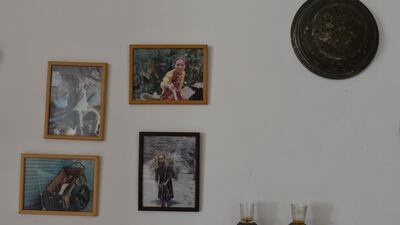
Mementos from Morocco adorn the wall of Moshe Shitrit's home in Tel Aviv. Rosie Scammell for the National -
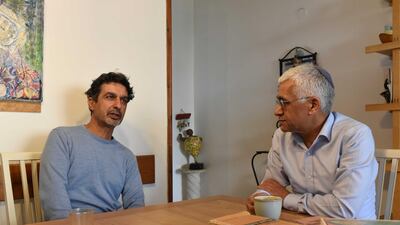
Moshe Shitrit, left, sits at home in Tel Aviv with his brother, Itzhak Shitrit. Books about Morocco are seen on the table. Rosie Scammell for the National -
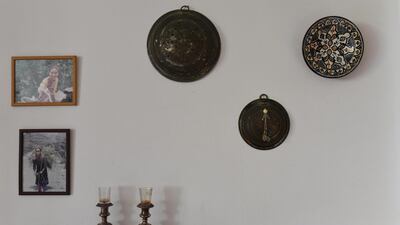
Memento from Morocco adorn the wall of Moshe Shitrit's home in Tel Aviv. Rosie Scammell for the National -
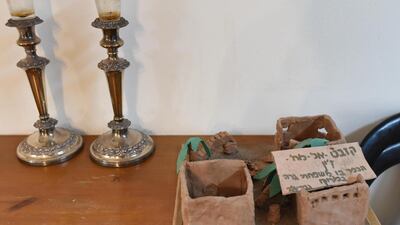
A model of the family's village in Morocco, created by one of Moshe Shitrit's children, is on display at their home in Tel Aviv. Rosie Scammell for the National -

A photograph of Shitrit family's village, taken during a visit two years ago in Morocco, is shown on the phone. Rosie Scammell for the National -
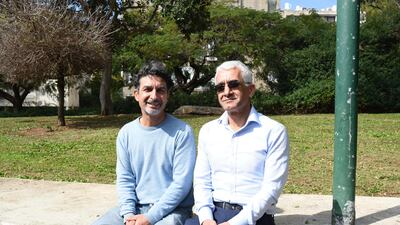
Moshe Shitrit,left, sits beside his brother Itzhak Shitrit in a park in Tel Aviv. Rosie Scammell for the National -
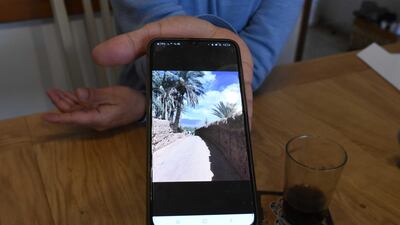
Moshe Shitrit holds a phone with a picture of his family's village in Morocco. Rosie Scammell for the National


Taking indirect flights, five Shirit siblings and some of their children visited the family’s former homes in Casablanca and Kasbat el-Mahzen two years ago.
“It was something really huge, deep in my soul,” said Moshe, who works in real estate. He previously visited the country with his wife in 1995 and mementos from the country adorn the wall of their home.
Growing up in Kiryat Gat, a southern city, the Shirits spoke Arabic and ate Moroccan food at home, but felt a desire to focus on their future as Israeli citizens.
“In a way, we tried to forget our culture,” said Moshe, who in recent years has been trying to learn more about his heritage.
The two brothers have taken a course in Judeo-Moroccan, an Arabic dialect written with Hebrew letters, and this month they have launched an online lecture series.
The first session on the bilateral relationship drew around 50 participants, Moshe said, with upcoming topics set to include art, humour, and Jewish-Moroccan newspapers.
One of the speakers is Einat Levi, whose parents emigrated from Morocco in 1952. After becoming interested in her family’s heritage as an adult, she began organising tours for Israelis to the country.
“There were always warm ties between the people, in the last 20 years they went on deepening even though there were no diplomatic relations,” said Ms Levi, a researcher at the Mitvim Institute think tank.
Since bilateral ties resumed, she said it has become easier for Israelis to collaborate with universities and official bodies in Morocco.
Going forward, Ms Levi anticipated the sale of Israeli technology to Morocco in areas such as agriculture and renewable energy. The economic advantages may not be apparent to many Israelis, however, due to a lack of knowledge about the country today.
“Morocco is like a familiar place and it’s part of the heritage of Israel, but at the same time it got stuck in the 1950s and 1960s, in the memories of our grandparents,” she said.
While Israelis can look forward to closer relations with Morocco, the resumption of ties has been condemned by the Palestinians. The recent deals have broken with decades of consensus among Arab states that an Israeli-Palestinian peace deal must precede normalisation.
Ms Levi was certain that Moroccans would not forget about the Palestinians, while the Shirits said Moroccan diplomats could now play a central role as mediators.
“I hope the relationship between Morocco and Israel will help us in solving the problem with the Palestinians, or at least have a chance to improve the dialogue,” said Itzhak.
Describing the bilateral deal as “a public marriage between a hidden couple”, he said it will not bring considerable change for the family as they already have a relationship with Morocco.
Beside a pile of second-hand books bought to learn more about the country, Moshe said he feels like he is constantly trying to catch up.
“I feel in a race after my past, after my history, after my roots,” he said.

