


Record numbers of Palestinians are dying from coronavirus in Gaza, where doctors face a sharp increase in the number of critical patients and shortages of vital drugs.
Gaza's health ministry on Tuesday announced a daily coronavirus death toll of 21, after 16 deaths the previous day and a record 23 on Sunday.
“The situation in the hospital is getting worse because of the large number of coronavirus cases and their critical condition,” said Dr Yousef Al Akad, general manager of the European Gaza Hospital in Khan Younis.
The hospital in southern Gaza is close to capacity, with all but 12 of 150 beds for coronavirus patients occupied.
Dr Akad said the hospital will need more staff and more oxygen supplies before it can take in more patients.
Gaza confirmed its first coronavirus case in August, followed by a surge in case numbers in December.
The latest wave of infections is markedly worse, with health authorities for the first time registering cases of a more transmissible coronavirus variant first detected in the UK.
More than half of Gaza's 798 coronavirus deaths occurred in 2021, with fears the situation is set to worsen for the enclave's two million residents.
At the European hospital, medics are exhausted from providing round-the-clock care to dozens of patients.
Coronavirus – in pictures
-

A nurse prepares a dose of vaccine against Covid-19 during a vaccination session for people with disabilities and the elderly, at the Exhibition Center in Quito, Ecuador. EPA -
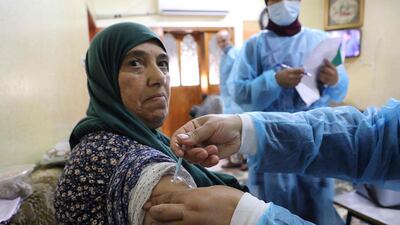
A Palestinian ministry of health nurse administers a dose of the Comirnaty Pfizer-BioNTech Covid-19 coronavirus vaccine in the village of Dura near Hebron in the occupied West Bank. AFP -

Nursing staff are seen at the mass vaccination hub at the Royal Exhibition Building in Melbourne, Australia. Getty Images -
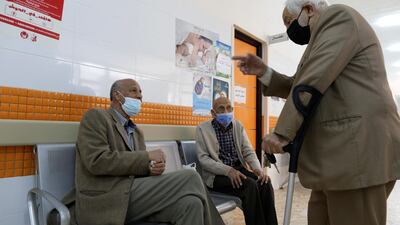
People wait to receive a dose of the AstraZeneca Covid-19 vaccine, in Benghazi, Libya. Reuters -

People exit a gate at the Lok Nayak Hospital in New Delhi, India. Bloomberg -
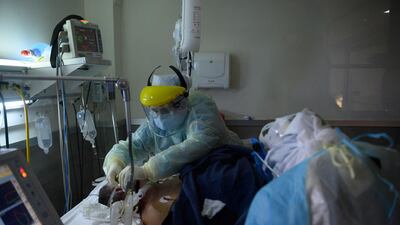
Health workers assist a patient at a Covid-19 Intensive Care Unit in a private hospital in Montevideo, Uruguay. AFP -

Patients breathe from oxygen tanks as they wait for a bed to open in the Covid-19 treatment area of the hospital in Villa Elisa, Paraguay. AP Photo -
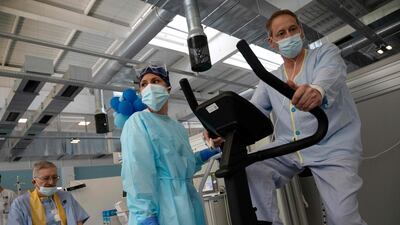
Covid-19 patients Jesus Nogales, left, and Juan Macero attend a physiotherapy session at the Isabel Zendal Hospital in Madrid, Spain. AFP -
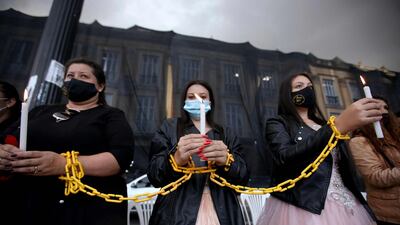
Entertainment industry workers take part in a protest against the measures adopted by the Colombian government to fight the Covid-19 pandemic, in Bogota. AFP -

Cologne's Greek midfielder Dimitrios Limnios puts on his face mask prior to the German first division Bundesliga football match Arminia Bielefeld v Schalke 04 in Bielefeld, northern Germany. AFP -
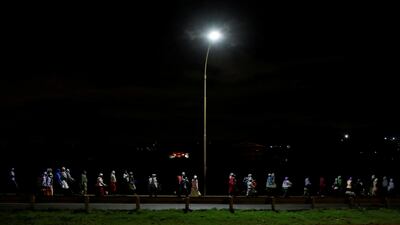
Residents walk home along a highway during the extended curfew to curb the spread of Covid-19 in the outskirts of Nairobi, Kenya. Reuters -

Britain's Prime Minister Boris Johnson holds a news conference at 10 Downing Street in London, Britain. Reuters -

A man using his cellphone prays in a mosque during the holy month of Ramadan in Najaf, Iraq. Reuters


“At the moment there is no successful treatment. All the treatments are to sustain the patients and this demands work 24/7,” said Dr Mahmoud Al Sheikh Ali, who heads the hospital’s coronavirus department.
“The patients’ condition is not stable. We always face surprises, every minute we face losing a patient and them dying,” he said.
Gaza, which has been under an Israeli and Egyptian blockade since 2007, also suffers chronic shortages of medicine.
The proportion of drugs with less than a month's supply remaining increased from 42 per cent in January to 45 per cent the next month, according to figures from the United Nations office for humanitarian affairs.
“The shortage of some medicines and medical supplies reduces patients’ chance of survival,” Dr Al Sheikh said.
Authorities in Gaza tightened measures to tackle coronavirus in recent weeks, including a ban on gatherings and a 9pm curfew.
But the surge in infections shows no sign of abating, with 37 per cent of the latest tests returning positive.
The International Committee of the Red Cross on Tuesday described an “alarming increase” in cases and a worsening humanitarian situation across Gaza.
While countries such as neighbouring Israel have administered millions of vaccines, fewer than 34,000 Gazans have received a dose, according to health ministry data.
Dr Al Sheikh said the lack of vaccines is the main obstacle to overcoming coronavirus.
“We need a sufficient quantity of vaccines to cover the largest number of citizens possible,” he said.
“Also, we need citizens to be informed about the importance of taking the vaccine.”
With misinformation about the pandemic and coronavirus vaccines widespread in Gaza, some residents are fearful of being inoculated or seeking treatment.
In Gaza city, Dr Munzer Khader, an independent doctor, has been treating people with mild coronavirus symptoms.
"Patients come to me asking me for prescriptions. They prefer not to go to the hospital," he told The National.
But Dr Khader also encountered people suffering from serious symptoms, who have no option but to seek further care. "I advise the patients who suffer difficulties in breathing to go to hospital, before it's too late."

