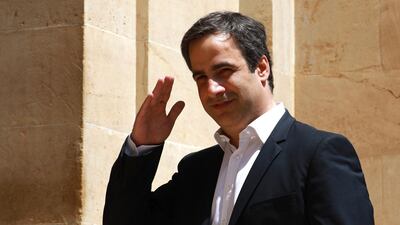
Michel Moawad stepped down as an MP after the port explosion in Beirut last August. AFP

Son of slain president urges action before Lebanon becomes ‘failed state’


Elias Sakr
  • English
  • Arabic

Lebanon's economic crisis will lead to chaos if left unchecked, one of the country's political leaders has told The National.

For more than 15 years, Michel Moawad, leader of the Independence Movement, has campaigned for a sovereign and independent Lebanon.

But the country, he said, can ill-afford to wait for a new Parliament to begin tackling the worst economic crisis in its modern history.

The National is interviewing political and civil society figures  who are looking ahead to elections in 2022, claiming they can offer a route out of the crisis.

We are very close to reaching a comprehensive agreement that will bring major opposition groups under the umbrella of a uniform programme

Once known for its vibrant banking sector, tourism industry and nightlife, more than half of Lebanon's people are now in  poverty.

"The cost of inaction will be tremendous both for ordinary Lebanese and the international community if Lebanon were to turn into a failed state," Mr Moawad – the son of Rene Moawad, the Lebanese president murdered in November 1989 after just 18 days in office – told The National.

Mr Moawad was speaking from his residence in Baabda overlooking Beirut port – the site of a massive explosion in August which strained Lebanon's already battered economy.

Mr Moawad resigned from Parliament after the blast in protest at what he said was widespread corruption throughout the state.

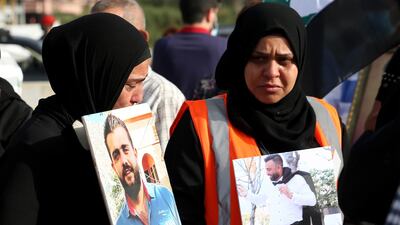
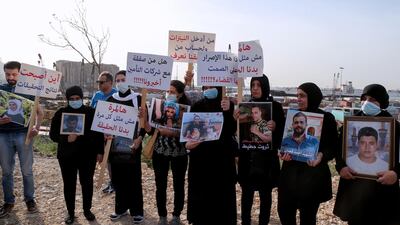
  • Families of August 4 Beirut port blast victims carry portraits of the deceased during a protest near the scene of explosion in the Lebanese capital, on May 4 2021. EPA
    Families of August 4 Beirut port blast victims carry portraits of the deceased during a protest near the scene of explosion in the Lebanese capital, on May 4 2021. EPA
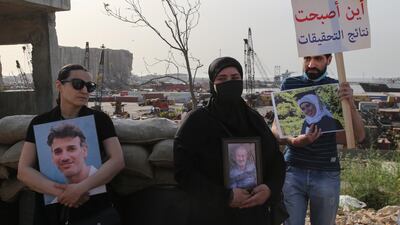
  • Family members of August 4 Beirut blast victims carry portraits of the deceased relatives, during a protest at the scene of the explosion, on May 4 2021. EPA
    Family members of August 4 Beirut blast victims carry portraits of the deceased relatives, during a protest at the scene of the explosion, on May 4 2021. EPA
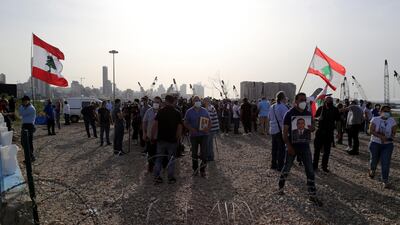
  • Protesters gather at the scene of August 4 Beirut port blast that killed more than 200 people, on May 4 2021. EPA
    Protesters gather at the scene of August 4 Beirut port blast that killed more than 200 people, on May 4 2021. EPA
  • Families of the August 4 Beirut blast victims carry portraits of the deceased relatives as they stage a protest in the Lebanese capital. EPA
    Families of the August 4 Beirut blast victims carry portraits of the deceased relatives as they stage a protest in the Lebanese capital. EPA
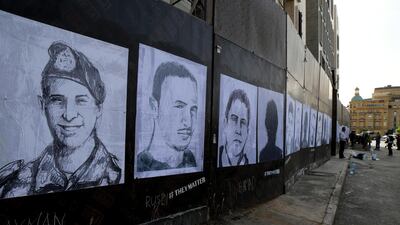
  • Activists hang portraits of the victims of the August 4 Beirut port explosion on a wall in the Lebanese capital. Artist Brady Black, in partnership with the Art of Change organisation, drew more than 200 caricatures of the victims. EPA
    Activists hang portraits of the victims of the August 4 Beirut port explosion on a wall in the Lebanese capital. Artist Brady Black, in partnership with the Art of Change organisation, drew more than 200 caricatures of the victims. EPA
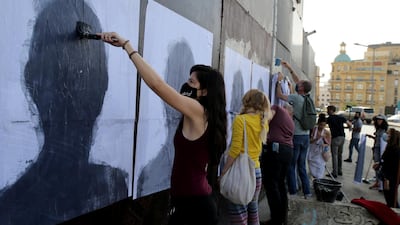
  • Activists hang portraits of the victims of the August 4 Beirut port explosion on a wall in the Lebanese capital. Artist Brady Black, in partnership with the Art of Change organisation, drew more than 200 caricatures of the victims. EPA
    Activists hang portraits of the victims of the August 4 Beirut port explosion on a wall in the Lebanese capital. Artist Brady Black, in partnership with the Art of Change organisation, drew more than 200 caricatures of the victims. EPA
  • Protesters carry portraits of August 4 Beirut port blast victims during a demonstration in the Lebanese capital on May 4 2021. EPA
    Protesters carry portraits of August 4 Beirut port blast victims during a demonstration in the Lebanese capital on May 4 2021. EPA
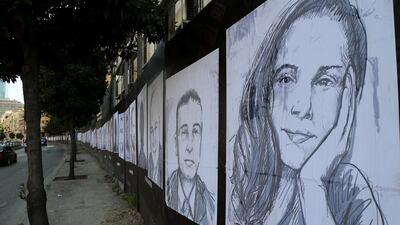
  • Artist Brady Black drew caricatures of more than 200 victims of the August 4 Beirut port blast as part of the campaign titled 'They Matter'. EPA
    Artist Brady Black drew caricatures of more than 200 victims of the August 4 Beirut port blast as part of the campaign titled 'They Matter'. EPA
  • Activists hang portraits of August 4 Beirut blast victims on a wall in the Lebanese capital. Artist Brady Black, in partnership with the Art of Change organisation, commemorated the deadly explosion that killed more than 200 people. EPA
    Activists hang portraits of August 4 Beirut blast victims on a wall in the Lebanese capital. Artist Brady Black, in partnership with the Art of Change organisation, commemorated the deadly explosion that killed more than 200 people. EPA
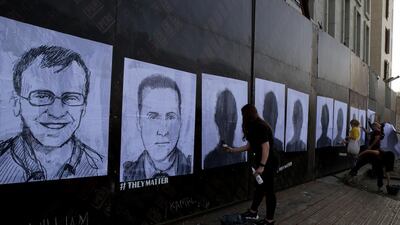
  • Silhouette images representing the unidentified victims were also part of the artist's tribute to Beirut port blast victims. EPA
    Silhouette images representing the unidentified victims were also part of the artist's tribute to Beirut port blast victims. EPA

He was joined by a number of independent MPs and members of the Kataeb party, another opposition group.

Since then, Mr Moawad has called for a transitional government of independent experts  to contain the crisis and prepare for parliamentary elections scheduled for May 2022.

But Mr Moawad's calls, like those of his opposition peers,  are falling on deaf ears.

Lebanon is still without a fully functioning government  and it is still not known what triggered the explosion, who owned the explosive chemicals stored there or why they were kept unsafely for six years at one of the region's busiest ports, with the knowledge of the country's top officials and security agencies.

A new economic model

Mr Moawad said the lack of accountability and worsening economic crisis led  the Independence Movement and like-minded opposition groups to rethink their programme beyond the traditional political divide over the pivotal issue of Iran-backed Hezbollah's weapons.

“Prioritising Lebanon’s national interests over foreign agendas is key to the stability and prosperity of our country but should go hand in hand with a new economic model that protects our free-market economy and upholds our liberal values while advancing social justice,” he said.

That model is currently being discussed with the Kataeb party among other opposition groups, Mr Moawad said.

“We are very close to reaching a comprehensive agreement that will bring major opposition groups under the umbrella of a uniform programme that touches on reforming Lebanon’s political system and economic model.”

This programme touches on a wide array of reforms, from the introduction of structural economic changes to decentralisation – one of the main political changes stipulated in the 1989 Syrian-Saudi brokered Taif agreement that ended Lebanon's 15-year civil war.

“Our ultimate objective is to build a functioning decentralised civic state that safeguards pluralism and allows the Lebanese to prosper,” he said.

Like his father, Mr Moawad has long-held the belief that Lebanon would prosper only when the state exercises its full sovereignty.  This was at the core of the alliance that emerged following the assassination of former prime minister Rafik Hariri in 2005, an event that divided the country into two major rival camps.

The western-backed alliance that brought Mr Moawad together with other members of the March 14 coalition pressured Damascus – blamed by many at the time for Mr Hariri's assassination – into withdrawing its forces from Lebanon after decades of political and military domination .

Rene Moawad died  when a car bomb hit his motorcade on Independence Day. He was known for his moderate positions and his efforts to bridge the gap between warring parties.

His assassination, less than three weeks after his election and the ratification of the Taif agreement, was widely blamed on Damascus.

Mr Moawad says his message resonates more than ever today because Lebanon can no longer afford the costs associated with regional tensions between Iran and its rivals.

The heavy toll the economic crisis is taking on the country’s armed forces was evident in the Lebanese army chief's recent, rare criticism of the ruling class.

"Where are we are heading? What are your plans?" Gen Joseph Aoun asked politicians in March as hundreds of Lebanese took to the streets to protest against a record plunge in the Lebanese pound, which has lost more than 85 per cent of its value against the dollar since August 2019.

  • An anti-government protester shouts slogans in front of the Lebanese Central Bank, at Hamra street, in Lebanon's capital Beirut. EPA
    An anti-government protester shouts slogans in front of the Lebanese Central Bank, at Hamra street, in Lebanon's capital Beirut. EPA
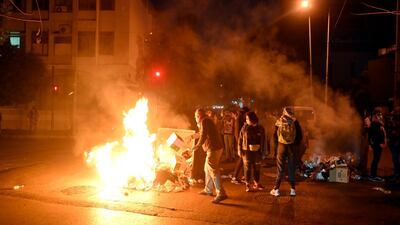
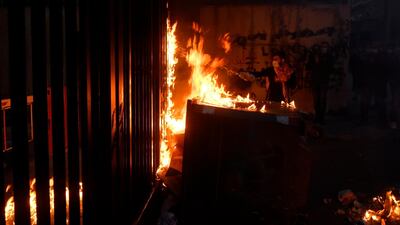
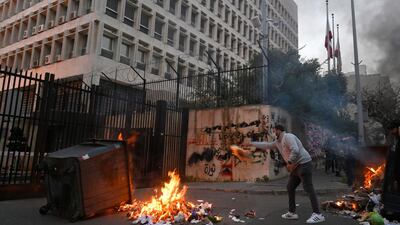
  • Anti-government protesters burn tyres and rubbish bins to block the road leading to Hamra street, during a rally against power cuts, the high cost of living and the low purchasing power of the Lebanese pound, in Beirut. EPA
    Anti-government protesters burn tyres and rubbish bins to block the road leading to Hamra street, during a rally against power cuts, the high cost of living and the low purchasing power of the Lebanese pound, in Beirut. EPA
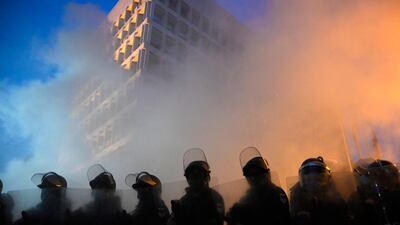
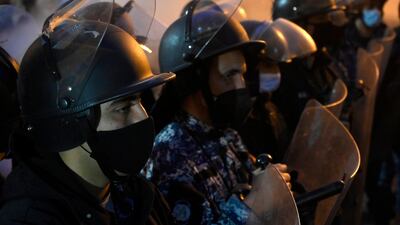
  • Riot police stand guard in front of the Lebanese Central Bank during an anti-government demonstration. Many Lebanese are angered at the deadlock among political parties in forming a new Cabinet. EPA
    Riot police stand guard in front of the Lebanese Central Bank during an anti-government demonstration. Many Lebanese are angered at the deadlock among political parties in forming a new Cabinet. EPA
  • The Lebanese Central Bank is shrouded in black smoke from burning tyres and rubbish bins. EPA
    The Lebanese Central Bank is shrouded in black smoke from burning tyres and rubbish bins. EPA
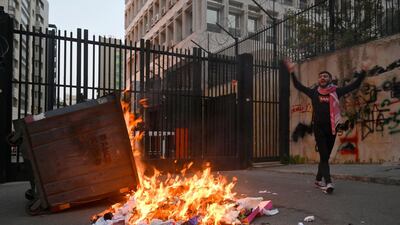
  • An anti-government protester shout slogans during a demonstration in Beirut. The national currency has lost more than 85 per cent of its market value against the dollar. EPA
    An anti-government protester shout slogans during a demonstration in Beirut. The national currency has lost more than 85 per cent of its market value against the dollar. EPA
  • Demonstrators have also been protesting against power cuts, caused by fuel shortages and mismanagement in the electricity sector. EPA
    Demonstrators have also been protesting against power cuts, caused by fuel shortages and mismanagement in the electricity sector. EPA
  • An anti-government protester in front of the Lebanese Central Bank, at Hamra street, Beirut. EPA
    An anti-government protester in front of the Lebanese Central Bank, at Hamra street, Beirut. EPA
  • Riot police stand guard in front of the Lebanese Central Bank during an anti-government rally in Beirut. EPA
    Riot police stand guard in front of the Lebanese Central Bank during an anti-government rally in Beirut. EPA
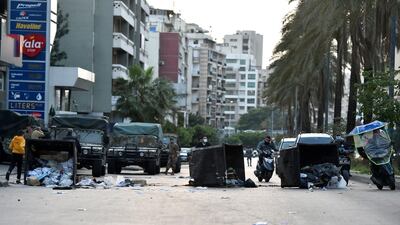
  • Anti-government protesters block a main road in Beirut. EPA
    Anti-government protesters block a main road in Beirut. EPA

Since then, Gen Aoun has engaged major powers, including the US and France, to secure financial and logistical aid for the army, as discontent grows among soldiers whose salaries are losing value.

Co-ordinating international aid 

French Foreign Minister Jean Yves Le Drian warned Lebanese officials during a visit to Beirut last month that his government was preparing sanctions on officials they regard as responsible for obstructing the formation of a new Cabinet.

Mr Le Drian’s latest visit featured meetings with members of Lebanon’s growing opposition movement, including Mr Moawad.

Mr Moawad said he was urging the international community to support Lebanon's army, healthcare industry and education sector.

“Maintaining a strong and cohesive military institution and vital health and educational services is key to saving Lebanon and laying the foundations for a strong state,” Mr Moawad said.

“Otherwise, chaos will prevail.”

Skewed figures

In the village of Mevagissey in southwest England the housing stock has doubled in the last century while the number of residents is half the historic high. The village's Neighbourhood Development Plan states that 26% of homes are holiday retreats. Prices are high, averaging around £300,000, £50,000 more than the Cornish average of £250,000. The local average wage is £15,458. 

RESULTS

Welterweight

Tohir Zhuraev (TJK) beat Mostafa Radi (PAL)

(Unanimous points decision)

Catchweight 75kg

Anas Siraj Mounir (MAR) beat Leandro Martins (BRA)

(Second round knockout)

Flyweight (female)

Manon Fiorot (FRA) beat Corinne Laframboise (CAN)

(RSC in third round)

Featherweight

Bogdan Kirilenko (UZB) beat Ahmed Al Darmaki

(Disqualification)

Lightweight

Izzedine Al Derabani (JOR) beat Rey Nacionales (PHI)

(Unanimous points)

Featherweight

Yousef Al Housani (UAE) beat Mohamed Fargan (IND)

(TKO first round)

Catchweight 69kg

Jung Han-gook (KOR) beat Max Lima (BRA)

(First round submission by foot-lock)

Catchweight 71kg

Usman Nurmogamedov (RUS) beat Jerry Kvarnstrom (FIN)

(TKO round 1).

Featherweight title (5 rounds)

Lee Do-gyeom (KOR) v Alexandru Chitoran (ROU)

(TKO round 1).

Lightweight title (5 rounds)

Bruno Machado (BRA) beat Mike Santiago (USA)

(RSC round 2).

Mercer, the investment consulting arm of US services company Marsh & McLennan, expects its wealth division to at least double its assets under management (AUM) in the Middle East as wealth in the region continues to grow despite economic headwinds, a company official said.

Mercer Wealth, which globally has $160 billion in AUM, plans to boost its AUM in the region to $2-$3bn in the next 2-3 years from the present $1bn, said Yasir AbuShaban, a Dubai-based principal with Mercer Wealth.

Within the next two to three years, we are looking at reaching $2 to $3 billion as a conservative estimate and we do see an opportunity to do so,” said Mr AbuShaban.

Mercer does not directly make investments, but allocates clients’ money they have discretion to, to professional asset managers. They also provide advice to clients.

“We have buying power. We can negotiate on their (client’s) behalf with asset managers to provide them lower fees than they otherwise would have to get on their own,” he added.

Mercer Wealth’s clients include sovereign wealth funds, family offices, and insurance companies among others.

From its office in Dubai, Mercer also looks after Africa, India and Turkey, where they also see opportunity for growth.

Wealth creation in Middle East and Africa (MEA) grew 8.5 per cent to $8.1 trillion last year from $7.5tn in 2015, higher than last year’s global average of 6 per cent and the second-highest growth in a region after Asia-Pacific which grew 9.9 per cent, according to consultancy Boston Consulting Group (BCG). In the region, where wealth grew just 1.9 per cent in 2015 compared with 2014, a pickup in oil prices has helped in wealth generation.

BCG is forecasting MEA wealth will rise to $12tn by 2021, growing at an annual average of 8 per cent.

Drivers of wealth generation in the region will be split evenly between new wealth creation and growth of performance of existing assets, according to BCG.

Another general trend in the region is clients’ looking for a comprehensive approach to investing, according to Mr AbuShaban.

“Institutional investors or some of the families are seeing a slowdown in the available capital they have to invest and in that sense they are looking at optimizing the way they manage their portfolios and making sure they are not investing haphazardly and different parts of their investment are working together,” said Mr AbuShaban.

Some clients also have a higher appetite for risk, given the low interest-rate environment that does not provide enough yield for some institutional investors. These clients are keen to invest in illiquid assets, such as private equity and infrastructure.

“What we have seen is a desire for higher returns in what has been a low-return environment specifically in various fixed income or bonds,” he said.

“In this environment, we have seen a de facto increase in the risk that clients are taking in things like illiquid investments, private equity investments, infrastructure and private debt, those kind of investments were higher illiquidity results in incrementally higher returns.”

The Abu Dhabi Investment Authority, one of the largest sovereign wealth funds, said in its 2016 report that has gradually increased its exposure in direct private equity and private credit transactions, mainly in Asian markets and especially in China and India. The authority’s private equity department focused on structured equities owing to “their defensive characteristics.”

Russia's Muslim Heartlands

Dominic Rubin, Oxford

The Comeback: Elvis And The Story Of The 68 Special
Simon Goddard
Omnibus  Press

The%20Iron%20Claw
%3Cp%3E%3Cstrong%3EDirector%3A%3C%2Fstrong%3E%20Sean%20Durkin%C2%A0%3C%2Fp%3E%0A%3Cp%3E%3Cstrong%3EStarring%3A%3C%2Fstrong%3E%20Zac%20Efron%2C%20Jeremy%20Allen%20White%2C%20Harris%20Dickinson%2C%20Maura%20Tierney%2C%20Holt%20McCallany%2C%20Lily%20James%3C%2Fp%3E%0A%3Cp%3E%3Cstrong%3ERating%3A%3C%2Fstrong%3E%204%2F5%3C%2Fp%3E%0A
Avatar: Fire and Ash

Director: James Cameron

Starring: Sam Worthington, Sigourney Weaver, Zoe Saldana

Rating: 4.5/5