
The months-long political and economic crisis engulfing Lebanon is expected to intensify, against the backdrop of rising domestic tensions and growing regional friction between the US and Iran, experts said.
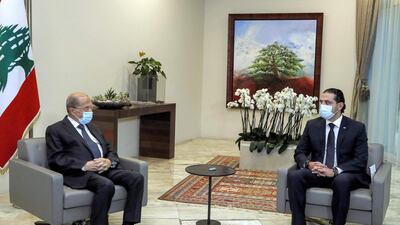
Intransigence on both sides in Beirut has led to the collapse of talks on the formation of a government between President Michel Aoun, a staunch ally of the Iran-backed armed group Hezbollah, and his political nemesis, Prime Minister-designate Saad Hariri.
Their disagreement has left Lebanon without a functioning government since the massive explosion that shook Beirut seven months ago, killing at least 200 people and compounding the country's economic and financial woes. Protests in the aftermath led to the government resigning.
Despite the current deadlock, Mr Hariri was not considering stepping down, Mustapha Allouch, a senior official in Mr Hariri's Future Movement told The National.
Mr Hariri, who met Mr Aoun on Monday for the 18th time since his designation as prime minister, publicly blamed the president for derailing the formation of a Cabinet of non-partisan experts by seeking over a third of the government's seats – and consequently veto power over key resolutions.
Mr Aoun’s office retaliated, accusing Mr Hariri of stalling for “unknown reasons”.
Analysts say the falling out between the pair, which came days after Hezbollah leader Hassan Nasrallah urged Mr Hariri to form a Cabinet of both experts and politicians who could manage the crisis, reflects the high stakes in the ongoing tug of war between warring sides.
"This is a two-dimensional crisis fuelled by intertwined and conflicting domestic and regional agendas," Rosana Bou Mounsef, a political analyst and longtime columnist for An-Nahar, Lebanon's oldest daily newspaper, told The National.
Ms Bou Mounsef said both the president and the prime minister-designate have now less room for manoeuvre.
On one hand, Mr Aoun is seeking to capitalise on Hezbollah's hardline position to empower his son-in-law, Gebran Bassil, leader of the largest parliamentary bloc, before the coming elections, Ms Bou Mounsef said.
Parliamentary and presidential elections are scheduled for 2022.
On the other, Mr Hariri is looking to revitalise Lebanon’s ties with the international community and traditional Arab allies who have long provided the small Mediterranean nation with financial support.
"Both have much at stake to concede under the current circumstances," Ms Bou Mounsef said.
Mr Bassil, a presidential aspirant who was the target of US sanctions last year over allegations of corruption, has accused Mr Hariri of seeking to dictate the Cabinet line-up to the president.
But the prime minister-designate says only a Cabinet of non-partisan experts committed to the implementation of reforms would unlock international financial support to help Lebanon weather its economic crisis.
Ms Bou Mounsef expects the deadlock to persist as long as Hezbollah maintains its hardline position, pending the outcome of negotiations between the US and Iran.
Until then, the armed group "will continue to support the president in his endeavour to secure Mr Bassil's political ambitions, as evidenced by Hezbollah's remarks last week", she said.
Mr Allouch said the only solution to the crisis is for the president to accept Mr Hariri’s proposal or to step down from his role as head of state, echoing earlier remarks by the prime minister-designate.
Mr Hariri has called on Mr Aoun to allow for early presidential elections after the latter invited him to step down if he can’t form a government, reflecting the deep schism between the two officials.
The political crisis is further complicated by the lack of constitutional mechanisms to break the deadlock, said Dr Antoine Sfeir, a lawyer, professor and expert in constitutional law.
Since the formation of the Cabinet requires both the approval of the president and prime minister-designate before it can seek a vote of confidence in Parliament, their disagreement leaves the country in an open-ended crisis, he said.
But Dr Sfeir argues the constitution allows for the caretaker Cabinet, led by caretaker prime minister Hassan Diab, to hold exceptional meetings to address specific urgent matters.
Such a scenario is now becoming increasingly likely, despite Mr Diab's reluctance so far to breathe life into his caretaker Cabinet, under pressure from Hezbollah and the president, Mrs Bou Monsef said.
Mr Diab, who resigned as prime minister following the Beirut port explosion, has recently threatened to abstain from his caretaker duties, if this would help pressure politicians into forming a fully functioning Cabinet.
Lebanon has been without a government since last August, when the country’s political leaders promised French President Emanuel Macron, who visited Beirut after the blast, that they would quickly form a Cabinet exclusively tasked with enacting reforms, in exchange for financial aid.
But seven months later, no progress has been made, while the country's economic woes have deepened, with the national currency losing over 85 per cent of its value against the dollar and over half the population plunging into poverty.
The Arab League on Tuesday voiced concerns over the deepening Lebanese crisis and offered “to do whatever was asked from it to heal the current rift”.
The failure to break the deadlock will eventually have a devastating impact on Lebanon, financial expert and former banking executive Dan Azzi told The National.
Mr Azzi said the lack of reforms will force the Central Bank to consume its remaining $16 billion in foreign currencies in less than 18 months, eventually disrupting vital supplies of fuel, food and medicine, unless Lebanon's Parliament authorises the Central Bank to tap its gold reserves.
“Lebanon will turn into Mogadishu in 1993,” said Mr Azzi, who expects the currency crisis to worsen to the point of undermining social order.
But such an outcome could be easily avoided, he said, if the necessary reforms are undertaken without further delays.

