

Lebanon and Iraq plan to exchange about $200 million worth of heavy fuel for in-kind services, including medical expertise, caretaker energy minister Raymond Ghajar told The National on Sunday.
The deal, which has been in discussion for “two to three years”, involves Lebanon buying 500,000 tonnes of heavy fuel from Iraq, currently worth roughly $200m, Mr Ghajar said.
The Lebanese government will deposit the money in a special account at Lebanon’s central bank for Iraq to spend locally on “any type of service, like health services”, said Mr Ghajjar.
“It’s not up to us, it’s up to them to decide what to do with the money,” he added.
Since the beginning of Lebanon’s worst-ever economic crisis in mid-2019, local banks, including the central bank, restricted access to foreign currencies.
As a result, the local currency’s value has dropped by around 85 per cent on the parallel market despite remaining officially pegged at 1,507 Lebanese pounds to the dollar.
Depositors with dollar accounts – locally dubbed as Lebanese dollars or “lollars” – can withdraw cash at the rate of 3,900 Lebanese pounds to the dollar. They cannot transfer funds overseas.
In practice, this means that Iraq will spend Lebanon’s fuel payment in “lollars” or in Lebanese pounds,” said Mr Ghajar.
On Friday, Lebanese state media reported that caretaker Health Minister Hamad Hassan and his Iraqi counterpart signed in Beirut a preliminary agreement to trade medical expertise for fuel supplies.
-

A shopper checks the price of cooking oil at a supremarket in Beirut, Lebanon. Mahmoud Rida -

Sister Juliette Watsha, a nun who runs a boarding house for women in Beirut, organises food distribution in the Bourj Hamoud suburb north-east of the Lebanese capital called . Mahmoud Rida -

Volunteers and workers unload food for distribution at an NGO in Beirut as more and more Lebanese turn to handouts to survive. Mahmoud Rida -
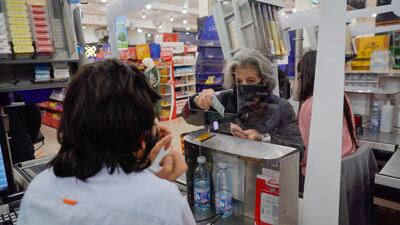
A woman pays for goods at a supermarket in Beirut, Lebanon where an economic crisis has pushed up prices and drastically reduced spending power. Mahmoud Rida -

Shop owners are facing anger from customers over a lack of government-subsidised products as prices go up because of Lebanon's economic crisis. Mahmoud Rida.


Lebanon's state-run electricity company faces dire cash shortages.
Oil-rich Iraq, which has seen Covid-19 cases soar in recent weeks, suffers from a chronic lack of drugs and medical care as decades of war and poor investment have left its hospitals in bad shape.
"The two parties are currently working on the details of the framework agreement," a source at Lebanon's Health ministry told The National.
Mr Ghajjar had previously announced the deal during a visit to Iraq in late February, telling Iraqi state-run newspaper Al Sabah that the heavy fuel oil will be exported to Beirut from the port of Basra.
Nothing has changed since, Mr Ghajar said. “The [Lebanese] Health Ministry will benefit after we strike our deal,” he said.
Read More
Cash and fuel shortages hit Lebanon's electricity providers
Lebanon will run out of money for subsidies in May, minister says
Saudi Arabia and Iraq announce $3bn fund for development
The Lebanese and Iraqi prime ministers are expected to sign it at a date that is yet to be determined. Lebanon’s energy minister and Iraq’s oil ministry will agree on the quantity and price.
“The contract will be between myself and SOMO,” said Mr Ghajar, in reference to Iraq’s state organisation for marketing of oil.
In March, Mr Ghajar had warned that Lebanon would plunge into "total darkness" by the end of the month if no money was secured to buy fuel for power stations.
Last week, Lebanon's parliament approved $200m in emergency funding to keep the lights on.
Electricity cuts have increased from three hours a day in Beirut to around 20 hours a day in the past weeks.
Because of chronic underinvestment in the sector, production never met demand since the end of 1975-1990 civil war.
Locals must pay for private generators to have electricity 24/7.
Lebanese energy experts previously told The National that the high sulphur content of Iraqi fuel could damage local power plants in addition to harming the environment.
Mr Ghajar acknowledged that Iraqi fuel cannot be used directly by Lebanese power plants.
“We propose that once the agreement is signed, we swap the fuel for fuel with the specifications we want,” he said.
Lebanese power plants rely on three types of imported fuel that they burn to produce electricity: grade A heavy fuel, grade B heavy fuel and gas oil.
“We can take the heavy fuel from Iraq and swap it with any of the three,” said Mr Ghajar.
Lebanon does not have the capacity to refine fuel. Sending the 500,000 tonnes of Iraqi fuel to refine abroad is “not worth it”, said Mr Ghajar, because the quantity is small.
Lebanon needs 2 million tonnes of heavy fuel oil a year.

It currently relies on spot cargo imports, which involve buying fuel in one-off transactions for near-time delivery.
A corruption scandal over tainted fuel ended its five-times renewed 15-year contract with Algerian oil company Sonatrach in late 2020.
Late February, Lebanon’s public tenders’ department launched a bid for a one-year contract to import grade A heavy fuel, grade B heavy fuel and gas oil.
The opening of bids will take place on three consecutive days between April 19 and April 21.
Mr Ghajar said that the spot cargo system was working well, and that electricity output should increase in the coming weeks.
He explained the recent surge in power cuts by the blockage of the Suez Canal last week by a giant container vessel.
This delayed the arrival of a ship that is expected to unload Sunday.
Additionally, two cargoes had a specifications issue with German conglomerate Siemens, which manufactured turbines that are used in two Lebanese power plants in the northern coastal town of Deir Ammar and in the region of Zahrani, near the southern city of Saida.
“There is a disagreement between the laboratory and the original equipment manufacturer about how to test for gum content,” said Mr Ghajar, in reference to a certain kind of residue found in gas oil.
“This is a technical issue they are trying to resolve,” he added.
Energy consultant Jessica Obeid warned that the Energy Ministry’s decade-long strategy of relying on expensive imported fuel and temporary solutions is unsustainable.
“The key problem is that the country is running out of foreign currency reserves necessary to import fuel,” she said.
“There has been no willingness for reform so far.”

