
Public anger over Lebanon's worst economic crisis is spilling over into its supermarkets, with fights going viral on social media as people scramble for dwindling supplies of subsidised milk, rice and oil.
Analysts said the Lebanese might soon be going hungry if the government does not change strategy to appropriately tackle the social repercussions of the crisis.
"If there is meat, we give it to the children and eat something else," said Raghida Hweiss, 47, an accountant in Beirut.
"We'll soon be eating only bread just to be able to feed the kids," her elderly mother said.
Their bill for oil, milk, rice and coffee is four times higher than it was before a severe economic crisis hit the country late in 2019. The women said they would forgo traditional home-made Easter cakes this weekend because pistachios, a key ingredient, are unaffordable.
Lebanon relies on imports to feed its people, and their price has risen in proportion to the fall of the local currency, which has lost about 90 per cent of its value against the dollar since late 2019. In a report last month, the World Bank said Lebanon had the highest food prices in the region.
But incomes are unchanged. At two million Lebanese pounds a month, Mrs Hweiss's salary used to be worth $1,333. This was more than three times the minimum wage, guaranteeing her a decent standard of living.
Now it is the equivalent of $160, barely enough to eat. “We are educated people and it’s a shame that we have to live like this,” she said.
Others are unable to buy the basics. Tony, 60, put three small bags of macaroni, semolina and sugar back on the shelf after scanning the prices. "These prices are amazing," he said sarcastically.
Tony lost his salary of 600,000 pounds a month when he was fired from his job because of the crisis. “I’ll try another supermarket to see if I find subsidised goods,” he said.
Like Tony, many people spend hours going from supermarket to supermarket to find dwindling stocks of subsidised goods such as rice, oil and sugar.
Supermarket owners say these products are scarce because importers buy less as the government runs out of cash and is less able to make up the difference between the market cost and the sale price.
The government reduced the number of subsidised goods from 300 last summer to less than 30 today, said Nabil Fahed, the head of the union of supermarket owners. Caretaker economy minister Raoul Nehme did not respond to a request for comment.
"People feel that there will be a shortage, so they start hoarding," Mr Fahed told The National. "On top of that, you have groups of people whose business is to collect these goods and resell them" at a higher price, he said.
Last week, one of his two supermarkets north of Beirut sold 5,000 gallons of subsidised cooking oil in five hours. Usually, this takes a month. Three weeks ago at a local supermarket chain called Charcutier Aoun, 70 gallons of oil went in a few minutes. "People buy hysterically," said Riad Khairallah, the marketing manager.
Recently, Charcutier Aoun, like many other supermarkets, started to allow only one subsidised product per customer. But such rationing caused fights as angered shoppers demanded to buy more or violently elbowed each other to reach the shelves.
-
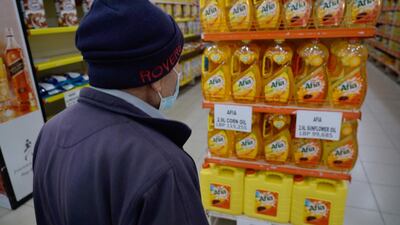
A shopper checks the price of cooking oil at a supremarket in Beirut, Lebanon. Mahmoud Rida -
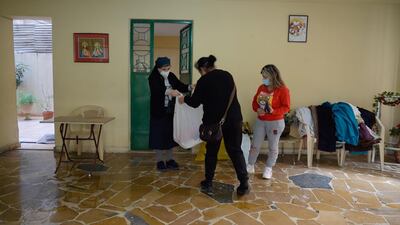
Sister Juliette Watsha, a nun who runs a boarding house for women in Beirut, organises food distribution in the Bourj Hamoud suburb north-east of the Lebanese capital called . Mahmoud Rida -

Volunteers and workers unload food for distribution at an NGO in Beirut as more and more Lebanese turn to handouts to survive. Mahmoud Rida -
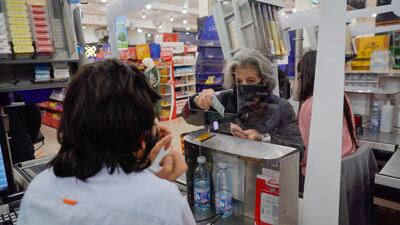
A woman pays for goods at a supermarket in Beirut, Lebanon where an economic crisis has pushed up prices and drastically reduced spending power. Mahmoud Rida -

Shop owners are facing anger from customers over a lack of government-subsidised products as prices go up because of Lebanon's economic crisis. Mahmoud Rida.


“When you start rationing and it’s not done formally, then you have conflict and friction. Our employees are not trained for this,” said Mr Fahed, who has asked the economy ministry to replace subsidised goods with a system of cards to help poor families to buy petrol, food and medicine.
On March 12, parliament approved monthly cash payments to the poor totalling $246 million, financed by a World Bank loan.
But the problem is that there is no policy strategy, said Marie-Noelle Abi Yaghi, a professor at the Institute of Political Science at the Saint-Joseph University in Beirut.
"The government is simply kicking the can by merely adopting ad hoc decisions, such as subsidies and cash transfers," she told The National.
"Historically, social rights were outsourced to the private sector and charities, furthering the divide between the governed and the state, nurturing nepotistic and confessional allegiances but also breaking democratic processes of accountability and political participation," she said.
Besides poverty alleviation schemes, the government needs to adopt "an overall social policy that is based on a sturdy social security system that ensures and guarantees the rights of all”, Ms Abi Yaghi said.
Diana Keyrouz, homemaker
The shortage of subsidised goods has turned public opinion against supermarkets and caused rumours to spread about them hiding stock to sell later at a higher price. Activists regularly organise surprise inspections. “We are doing the government’s job,” said activist Fadi Kanj. “We are expecting a social explosion.”
Mr Fahed denied these claims, saying that it was born of a misunderstanding after the union decided with the economy ministry to start scheduling the display of subsidised products so that they would be available throughout the day.
But after activists started organising inspections, some supermarkets refused to carry subsidised goods at all. Mr Fahed stopped regulating their sale in his stores. “It’s not our responsibility to organise distribution,” he said. “We tried to play it fair. You can’t be fair when you’re accused.”
Lebanon’s poorest avoid supermarkets as they increasingly rely on charity to obtain food, medicine and clothes.
“Everything is expensive, we can’t buy anything,” said Diana Keyrouz, 33, a homemaker with two young children.
"I have never seen this situation," said Juliette Warsha, 52, a nun who organises food distribution in Bourj Hamoud, a suburb north-east of Beirut, and has run a boarding house for women for the past 30 years. "People are becoming less ashamed to come and ask. They'll take whatever you offer them."

