

Residents of Beirut who remember the country’s bloody civil war in the 1970s and 1980s say Lebanon, now gripped by soaring poverty and inflation, faces a worse crisis.
Chehade Hatoum recalls standing in line to buy bread during the 15-year conflict, which broke out on April 13, 1975.
Now 67, he shakes his head and tells The National that history repeats itself as he drives by familiar queues outside bakeries in Beirut, where he works as a public taxi driver.
“The only difference is that back then, people actually had money to buy bread,” he said. “They could still afford it.”
Mr Hatoum’s income was hit hard in 2019 when Lebanon plunged into one of the worst economic and financial crises since the end of the civil war.
Lebanese citizens were denied access to the bulk of their savings when banks imposed informal capital controls and the Lebanese pound lost over 85 per cent of its value.
The outbreak of the Covid-19 pandemic compounded Mr Hatoum’s economic woes, as it did with other daily-wage earners. He has relied on his children to make ends meet.
"Can you imagine how awful the situation is today that it makes people see the civil war as the lesser of two evils?" Mr Hatoum told The National. "They're making us choose between war and hunger."
Estimates of the number of deaths during the civil war vary, from 100,000 to double that toll. The whereabouts of many more remain unknown.
Yet despite the atrocities of that time, survivors say it was Lebanon’s recent crises that broke the camel’s back.
“We’ve never been this humiliated,” said Mohammad Ballout, 53. “We never had to worry about affording basics like we do today or wait in turn for food rations.”
Mr Ballout was in his teens when the war broke out. Employed in the cement industry at the time, he would work for several weeks in Beirut then head back to his home town in south Lebanon to seek refuge when the fighting escalated.
The trips were always daunting for Mr Ballout, who had to pass through several checkpoints set up across the country by armed militias to reach his home.
"The whole country was divided, your sect would determine where you can and can't go," Mr Ballout told The National.
Although Lebanon’s civil war ended in 1990, sectarian tension among the country’s major political leaders and religious factions still simmers.
“People are still divided today, and maybe even more than before,” Mr Ballout said. “Political leaders paved the way for this divide since the war and now, almost 50 years later, they’re still holding on to power like octopuses.”
-
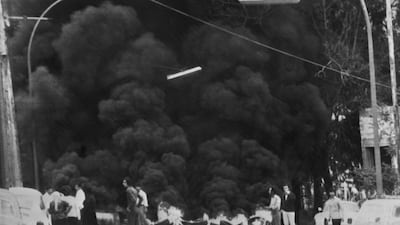
Smoke rises in a Beirut street during clashes between Palestinians and members of Christian militia the Lebanese Forces, backed by Lebanon's Christian Kataeb Phalangist party, on April 15, 1975. AFP -

Guerrilla fighters on a tank in a street in Beirut during Lebanon's civil war, in December 1975. Getty Images -
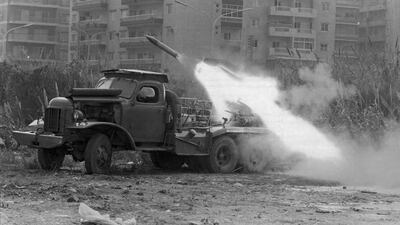
A Katyusha rocket is fired from the back of an army lorry into an apartment complex during the first year of the Lebanese civil war, in 1975. Getty Images -
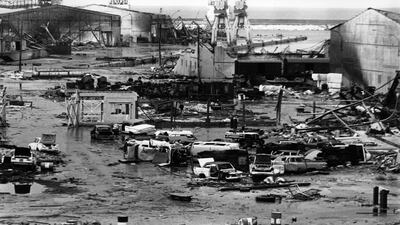
A mass of burnt vehicles in the harbour area of Beirut after the outbreak of civil war in 1975. Getty Images -
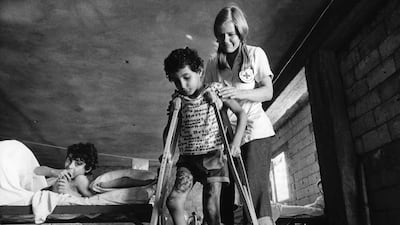
A Red Cross nurse from Sweden takes care of a boy shot in the heel by a sniper, on September 9, 1976, at a hospital in the Coral Beach Hotel, on the road between Beirut and Saida. AFP -
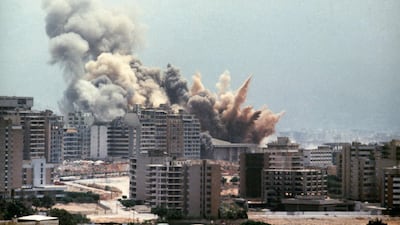
Israeli shelling on west Beirut on August 2, 1982. AFP -

A man sits on rubble in a desolated area of west Beirut on August 20, 1982. AFP -
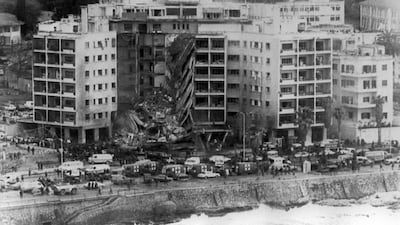
The US embassy in Beirut on April 18, 1983, after a bomb destroyed part of the building. AFP -
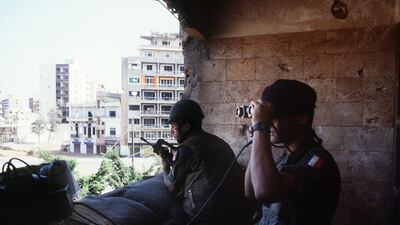
French soldiers watch the skyline in Beirut on September 26, 1983. The troops were part of the Beirut security multinational force sent to keep security after the Israeli invasion of 1982. AFP -
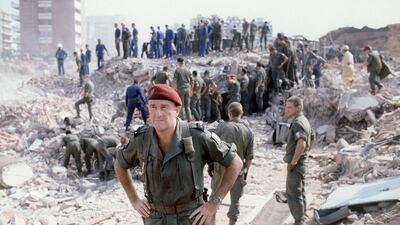
General Francois Cann, commander of the French troops of the multinational forces, on October 23, 1983, as rescuers search for survivors in Beirut through the rubble of a building that was destroyed by a suicide lorry bomber overnight. Fifty-eight French soldiers and five Lebanese were killed in the attack. AFP -
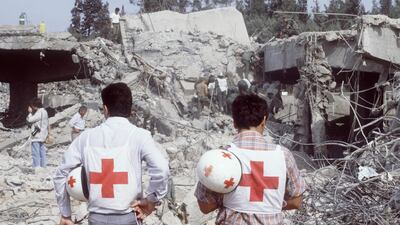
Rescuers continue to search on October 31, 1983, for corpses and identify the victims of the attack on October 23 on the headquarters of US troops from the multinational force in Beirut. AFP -
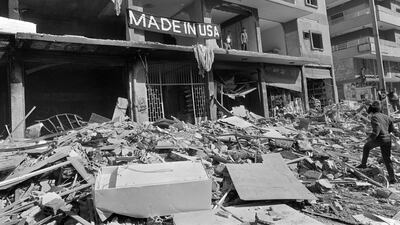
Rescuers search for victims on March 8, 1985, 15 minutes after a car, packed with an estimated 250kg of TNT, exploded in a crowded street of the southern Bir Al Aabed district in mainly Shiite southern suburb of Beirut. At least 75 people were killed and 256 injured in the explosion. AFP -
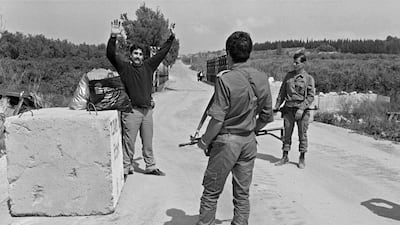
Israeli Defence Force soldiers on March 19, 1985, confront a civilian at Kasmyah bridge after troops the month before evacuated about 500 sq km around Saida. AFP -
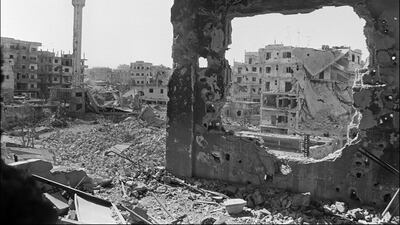
Tripoli, in northern Lebanon, on October 4, 1985, after a ceasefire between pro-Palestine and pro-Syrian militias was agreed to in Damascus. AFP -
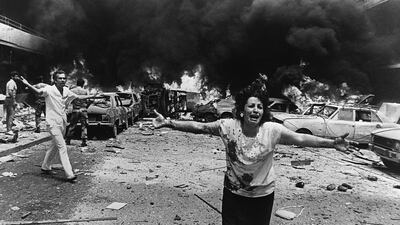
A woman cries in shock, minutes after a car bomb exploded in a crowded neighbourhood of mainly-Muslim west Beirut on August 8, 1986, killing 13 people, including three children, and wounding at least 92. AFP -
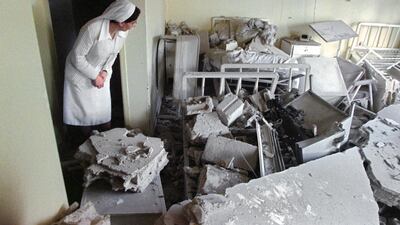
A nun inspects a damaged room in the Hotel Dieu Hospital in east Beirut on February 25, 1990, after a break in the battle between rival Christian factions. AFP


Nationwide protests erupted in Lebanon in October 2019, calling for the downfall of the ruling class. But months later, the movement lost momentum.
The country remains without a fully functioning government since the massive explosion that shook Beirut last August, killing more than 200 people and destroying much of the capital.
Since then, officials have bickered over the government’s make-up and reform agenda. This is despite repeated calls from the international community to form a Cabinet that fights endemic corruption and undertakes reforms, in exchange for financial support.
Politicians “have blood on their hands from the war, and now they’re responsible for this crisis,” Mr Ballout says.
UN figures show food prices in Lebanon have risen 402 per cent year on year, becoming the most expensive in the Mena region.
Sawsan bore witness to the harrowing clashes that pitted warring militias against one another, having lived near an area that separated the western and eastern parts of Beirut. Yet, she thinks today’s crisis is more painful.
“The war was very difficult, but at least people could still feed themselves,” she said.
“It hurts that the Lebanese waged a war among themselves, and it hurts even more that all Lebanese regardless of sect are in the same boat today. Meanwhile, politicians don’t care.”
Sawsan recalls volunteering with humanitarian organisations during the war to support the vulnerable.
“People could still afford basics back then – they could support themselves if they had to escape for short periods of time. Now it’s completely different,” she said.
A recent report by the UN placed Lebanon on the global “hunger hotspot” list. Humanitarian organisations said people in the country were at risk of acute hunger and food insecurity owing to “multiple political and economic shocks”.
With no genuine attempt at the reform needed to unlock international aid, homemaker Aaliya Salame, 64, fears the situation will only worsen.
"During the war, we watched our neighbour die with a bullet to his head. Soon, we'll be watching people die of hunger and poverty," she told The National. "What are they waiting for?"

