

Lebanese critical of Hezbollah say they are being threatened with violence on the Clubhouse social media application that has gained popularity worldwide as a platform for free discussion and debate.
“I live in constant fear. One anonymous user said I will not make it alive past this Ramadan,” said Rashad, who moderates Clubhouse chat rooms that are critical of Hezbollah.
“They call us 'collaborators'. It is very offensive, they are demonising us.”
Like other Hezbollah critics who spoke to The National, he asked for his real name to be withheld because of fears about his safety.
Clubhouse, an invitation-only audio app, has garnered more than 10 million users since it was launched last April. Users can speak to one another in “rooms” dedicated to the topic of their choice, with talks facilitated by moderators who determine whether members can speak or just listen.
In Lebanon it had been seen as a safe place where people of different backgrounds could not only socialise but also vent their frustrations about a political elite that is widely blamed for leading the country to economic collapse.
-

An anti-government protester shouts slogans as other demonstrators burn tyres to block the road during a rally against the power cuts, the high cost of living and the low purchasing power of the Lebanese pound, in front of Lebanese Central Bank at Hamra street in Beirut, Lebanon. EPA -

Riot police stands guard in front of Lebanese Central Bank during a rally against the power cuts, the high cost of living and the low purchasing power of the Lebanese pound, at Hamra street in Beirut. EPA -
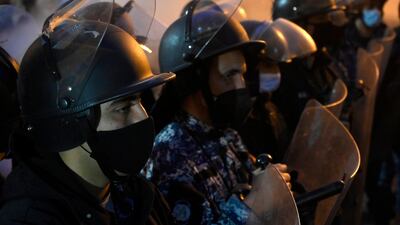
Riot police stands guard in front of Lebanese Central Bank during a rally against the power cuts, the high cost of living and the low purchasing power of the Lebanese pound, at Hamra street in Beirut. EPA -
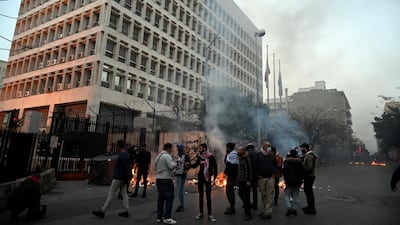
Anti-government protesters burn tyres and rubbish bins to block the road during a rally against the power cuts, the high cost of living and the low purchasing power of the Lebanese pound, in front of Lebanese Central Bank at Hamra street in Beirut. EPA -
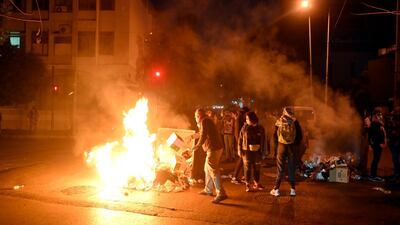
Anti-government protesters burn tyres and rubbish bins to block the main road leading to Hamra street during a rally against the power cuts the high cost of living and the low purchasing power of the Lebanese pound, in Beirut. EPA -
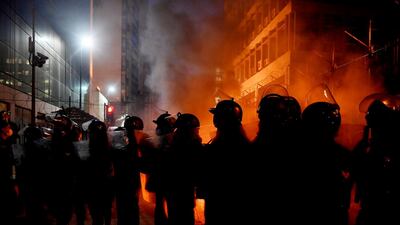
Riot police stands guard in front of Lebanese Central Bank during a rally against the power cuts, the high cost of living and the low purchasing power of the Lebanese pound, at Hamra street in Beirut. EPA -
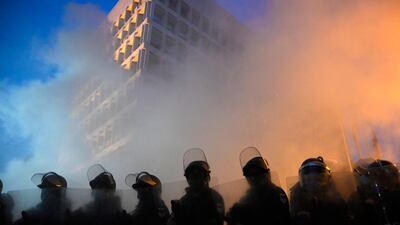
Riot police stands guard in front of Lebanese Central Bank during a rally against the power cuts, the high cost of living and the low purchasing power of the Lebanese pound, at Hamra street in Beirut. EPA


Now, however, critics of Hezbollah say supporters of the powerful Iran-backed party and militant group are threatening and harassing those who speak out against them on the app.
“This political class ruined my life; their incompetence bankrupted my business, blew up my capital and I can’t even vent?” said Rashad, referring to the explosion at Beirut port last August that destroyed large areas of the city and killed more than 200 people.
Representatives from Clubhouse and Hezbollah did not immediately reply to requests for comment by The National on Thursday.
The application has allowed Lebanese to share ideas with people from outside their community, and to ask political questions that are usually taboo.
Rashad said he moderated Clubhouse chats with pro-Hezbollah media figures and supporters, which enabled him to debate them.
“I asked one of their talking heads: if you are the resistance, tell me when did Iran ever fight Israel? They could not reply,” he said.
“Hezbollah doesn’t want these voices to reach their support base. I was so excited that there was a place where we could vent but now I’m really scared.’’
Hezbollah was the only militia allowed to keep its weapons after the end of the Lebanese civil war in 1990. The group says it needs to bear arms to resist Israel, which once occupied Lebanon’s south.
Zouheir, 40, who said he had a passion for debates and sometimes spent more than seven hours a day moderating rooms on Clubhouse, also reported intimidation by users who support Hezbollah.
“I am used to receiving insults and threats from Hezbollah on Twitter but there is something deeply terrifying about hearing someone threatening you live on Clubhouse,” he said.
Hezbollah supporters use co-ordinated tactics to silence activists on Clubhouse, he said. The chat rooms he moderates are often overtaken by hundreds of listeners who share the same profile picture of Hezbollah’s leader Hassan Nasrallah.
“Some people come in as listeners and when they notice we are talking about Hezbollah they will do a mass attack. The room will suddenly go from 70 participants to 400 with profile pictures of Hassan Nasrallah,” he said.
He said supporters of the group routinely accused him and others of being "Saudi agents" or supporters of the terrorist group ISIS in rooms he moderates.
Hezbollah’s backer Iran is the arch-rival of Saudi Arabia in a region rife with proxy wars.
“Their point is to intimidate us into silence,” said Zouheir, who remains active on Clubhouse.
"I consider this to be a death threat. When Hezbollah says someone is an agent, they are making their blood halal."
Threatening fellow users goes against Clubhouse guidelines and those who do so can be reported and blocked.
Zouhair says it is difficult to banish these users "when you get attacked by 150 or 200 accounts in one go".
Activists said they began receiving abuse and threats on Clubhouse last month after a user named Ibrahim gave orders for Hezbollah supporters to leave a room in which the group was being criticised. Ibrahim said the orders came directly from Jawad Nasrallah, the son of Hezbollah’s leader, who activists say is present on the application.
In a tweet last month, Nasrallah wrote that Twitter was the only social media platform he used.
Nivine, a student living outside Lebanon, said she was harassed and insulted for moderating rooms that discussed Hezbollah’s weapons and their involvement in conflicts in Yemen, Iraq and Syria.
For the past three weeks, she said Hezbollah supporters had been targeting the rooms where she speaks, accusing her of being a “foreign agent" and pressuring moderators to shun her.
Anyone can open a room on the app and share their thoughts but moderators are the ones who decide who can speak and who remains a listener.
Nivine said supporters of Hezbollah and of its ally Amal had engaged in conversations with her and others about sensitive topics such as Hezbollah’s foreign presence and the group’s suspected role in former prime minister Rafik Hariri’s assassination in 2005.
She said that Hezbollah felt threatened by the debates she and her friends initiated with its supporters because the leadership could control what was being said in those rooms.
While Hezbollah has managed to silence many of its critics on traditional media – even blocking some broadcasters in its strongholds – “these voices have now come back even louder on Clubhouse,” she said.

