
Lebanon's farmers are rushing to find new buyers for their produce 48 hours after a Saudi ban on fruit and vegetable imports from the country sent prices into freefall.
At the fruit and vegetable market in Beirut's Madina Al Riyadiye, the wholesale price of lemons dropped by 40 per cent in two days, while the price of bananas was down more than 50 per cent.
A ban on all fruit and vegetables transiting or originating from Lebanon was introduced by Saudi Arabia on Sunday morning, after millions of amphetamine pills were discovered hidden in a shipment of pomegranates.
Saudi Arabia says it has seized more than 600 million pills coming from the country over the past six years and that Lebanon is being used to flood the region with narcotics.
-

Saudi authorities found almost eight million pills hidden in a shipment of pomegranates from Lebanon. SPA -

Saudi authorities found almost eight million pills hidden in a shipment of pomegranates from Lebanon. SPA -
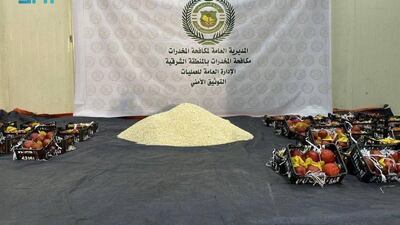
Saudi authorities found almost eight million pills hidden in a shipment of pomegranates from Lebanon. SPA -

Saudi authorities found almost eight million pills hidden in a shipment of pomegranates from Lebanon. SPA -

Saudi authorities found almost eight million pills hidden in a shipment of pomegranates from Lebanon. SPA


Lebanon’s Syndicate of Fruit and Vegetable producers criticised the suggestion that a Lebanese farmer was responsible for the pomegranate shipment that put the industry at risk.
The ban leaves crises-hit Lebanon with yet another problem to deal with: a surplus of fruit and vegetables.
Exports to the Gulf account for 55 per cent of trade in this sector, the Lebanese farmers’ association said.
As the surplus of produce causes domestic prices to collapse, traders are desperately trying to find other buyers for their fruit with sell-by dates approaching.
"It's not only Saudi Arabia. It's about all the Gulf markets," said Mahmoud Al Sanousi, floor manager at Al Fadl trading company's banana-processing plant in Adloun.
“We have refrigerated products that transit through Saudi Arabia to Kuwait and Qatar.
"We have trucks currently on the road to Dubai and Kuwait. Now they have to go back or dispose of the products.
"If this is not solved soon, we are going to be throwing out a lot of fruit."
For Al Fadl and most other exporters, Saudi Arabia is a centre for sending produce to the rest of the Gulf. Without it, exports to the entire GCC region stop.
Two options are Jordan and Syria, although their markets have limited capacity for extra produce.
“The farmers here won’t be able to sustain their production because produced quantities are higher than local consumption demand, or exports to Jordan," said Said Aatiyah, a Jordanian trader.
Mr Aatiyah was making the most of the crash to arrange extra shipments to Amman on Tuesday.
“We are going to export more to Jordan certainly, but it definitely won’t be enough to soak up the excess," he said.
Some fruit can also be sent to Iraq but moving a container of fruit across the Iraqi-Syrian border costs an extra $4,000 in fees, making the arduous journey across war-torn Syria barely profitable.
There is anger throughout the sector, with traders feeling they are being punished for the state's failings.
“This is not a fair decision,’’ said Ali Al Fadl, owner of Al Fadl trading company.
"In all countries big and small drug smuggling exists, but that doesn’t mean you cut commercial relations between brotherly countries.
“As farmers and traders, our politics is the lemon and the banana. This is our religion and political affiliation," he said.
“We are being victimised with this ban. Farmers and traders are paying the price of the security situation.’’
The fruit crisis is just another challenge hitting a country already on its knees.
While rampant inflation pushes up the costs of most goods for the average person, fruit in Lebanon is just about the only thing becoming cheaper.

