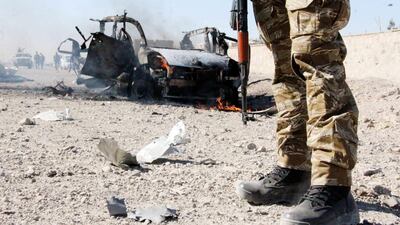
An Afghan security officer at the scene of an attack at the National Directorate of Security in Kandahar, Afghanistan, on January 16, 2021. EPA

Kabul watching Taliban-Iran meetings with unease, say sources


  • English
  • Arabic

Kabul is eyeing a visit by top Taliban members to Tehran with unease, a senior Afghan official told The National on Wednesday, even as Iran said no group could win control through war and urged the insurgents to co-operate with the government in peace talks.

A delegation of top Taliban members, led by Mullah Abdul Ghani Baradar – a founder of the movement – arrived in Tehran this week for a series of meetings around ties to Tehran and the situation in Afghanistan.

The government and Taliban are currently engaged in peace talks in Doha and the future of the country. However, talks have stalled and little progress made.

"The general sentiment about this is not a pleasant one as the Taliban-Iran relationship has always been cantered on the support for the war in Afghanistan," the official, who works in national security in Kabul, told The National.

While the Afghan Foreign Ministry assured that the government was aware and had helped co-ordinate the Taliban’s visit, the security official said there was discontent from many at the sight.

“Any recognition of non-state actors by Iran isn’t encouraging the state-to-state relations between our two countries,” the official said.

In Tehran on Wednesday, General Ali Shamkhani, secretary of Iran's Supreme National Security Council, told the Taliban delegation that Iran “will never recognise a group that wants to come to power through war," and urged them to make a deal with the government, according to comments published in local media.

Gen Shamkhani also said that the government and Taliban should co-operate on the battle against ISIS – which both sides is battling in Afghanistan.

The Iranian official criticised the US role in the country and Millah Baradar told attendees: “We do not trust the United States and we will fight any group that is a mercenary for the United States. We believe that in the future of Afghanistan, all tribes and clans must participate."

While Iran appeared to urge the Taliban to work with Kabul, the government official said the meeting in Tehran could do the opposite given the increasing lag between meetings by delegates from both sides in Doha – the latest gap in sessions is now 11 days.

“Iran is using these meetings to send a message to the US. But, the Taliban, as Afghans, should work with the Afghan people for peace instead of advancing the interest of another state,” the official said.

The Taliban appear to be signalling that they have working relationships with a range of America's allies and adversaries


The US signed a deal with the Taliban last year that will see a halt in attacks on US troops, moving towards all foreign forces leaving Afghanistan and an agreement for the Taliban to sit down with the government.
Experts agreed with the official's reading that the Tehran meetings were a power move on the part of Iran, a longtime US rival, to flex its influence in the region with the arrival of the new administration of President Joe Biden.

"The meeting is mostly to pressure the Biden administration and the Afghan government, given the Biden administration's effort to reset the Doha [peace] process," Asfandyar Ali Mir, counterterrorism scholar at the Stanford University, told The National.

Mr Biden’s administration has already said it is reviewing the February 2020 deal with the Taliban signed by Donald Trump.

Saber Ibrahimi, a researcher at the US based Centre on International Co-operation, saw the meeting in a similar light.

“Iran and the Taliban share one common goal, that is to make sure the US stays committed to the deals that it has made with them – the JCPOA and the US-Taliban withdrawal agreement,” he said. The JCPOA, also known as the 2015 nuclear deal, removed sanctions on Iran in exchange for binding rules over nuclear enrichment. Mr Trump withdrew from the deal but Mr Biden is expected to look at returning.

“Both are showing their diplomatic power in the region by continuing to maintain a relationship despite their bitter past,” he added. “The Taliban appear to be signalling that they have working relationships with a range of America's allies and adversaries.”

While the Taliban and Tehran have not always seen eye-to-eye, they have more than just distrust of American in common. Both have relationships with Al Qaeda.

“Al Qaeda and Iran have a three-decade long, complicated relationship, which has oscillated between some degree of cooperation and confrontation. While the Taliban nominally mediated that relationship pre-9/11, post-9/11 Al Qaida has brokered and managed the terms of ties with Iran by itself,” said Mr Mir, who has deeply researched the insurgent group’s rise and decline over the years.

Earlier this month, then US Secretary of State Mike Pompeo accused Iran of sheltering top Al Qaeda leaders.

There have also been reports of Taliban’s continued support to Al Qaeda members in Afghanistan with several top leaders reportedly killed in ambushes with Afghan forces in recent months.

“Al Qaida's current global deputy leader, Saif Al Adal, is in Iran, most likely in Tehran, Mr Mir said. A public meeting between the Taliban and the Al Qaeda official, he said, would be significant but unlikely.

“While, as an Arab entity, Al Qaeda may not feel comfortable in Iran, it will co-operate against common enemy such as US, perhaps at small tactical level if not strategically,” Mr Ibrahimi added.

Iran, meanwhile, seeks to remain a major stakeholder in the Afghan peace process, Mr Ibrahimi said.

“They want use this influence to leverage against all players to secure its interests now and in the future if there is a political settlement,” he said.


Groom and Two Brides

Director: Elie Semaan

Starring: Abdullah Boushehri, Laila Abdallah, Lulwa Almulla

Rating: 3/5

Countries recognising Palestine

France, UK, Canada, Australia, Portugal, Belgium, Malta, Luxembourg, San Marino and Andorra


Which honey takes your fancy?

Al Ghaf Honey

The Al Ghaf tree is a local desert tree which bears the harsh summers with drought and high temperatures. From the rich flowers, bees that pollinate this tree can produce delicious red colour honey in June and July each year

Sidr Honey

The Sidr tree is an evergreen tree with long and strong forked branches. The blossom from this tree is called Yabyab, which provides rich food for bees to produce honey in October and November. This honey is the most expensive, but tastiest

Samar Honey

The Samar tree trunk, leaves and blossom contains Barm which is the secret of healing. You can enjoy the best types of honey from this tree every year in May and June. It is an historical witness to the life of the Emirati nation which represents the harsh desert and mountain environments

Points Classification after Stage 1

1. Geraint Thomas (Britain / Team Sky) 20

2. Stefan Kueng (Switzerland / BMC Racing) 17

3. Vasil Kiryienka (Belarus / Team Sky) 15

4. Tony Martin (Germany / Katusha) 13

5. Matteo Trentin (Italy / Quick-Step) 11

6. Chris Froome (Britain / Team Sky) 10

7. Jos van Emden (Netherlands / LottoNL) 9

8. Michal Kwiatkowski (Poland / Team Sky) 8

9. Marcel Kittel (Germany / Quick-Step) 7

10. Edvald Boasson Hagen (Norway / Dimension Data) 6

MATCH INFO

World Cup 2022 qualifier

UAE v Indonesia, Thursday, 8pm

Venue: Al Maktoum Stadium, Dubai

Global state-owned investor ranking by size

1.

United States

2.

China

3.

UAE

4.

Japan

5

Norway

6.

Canada

7.

Singapore

8.

Australia

9.

Saudi Arabia

10.

South Korea

Key figures in the life of the fort

Sheikh Dhiyab bin Isa (ruled 1761-1793) Built Qasr Al Hosn as a watchtower to guard over the only freshwater well on Abu Dhabi island.

Sheikh Shakhbut bin Dhiyab (ruled 1793-1816) Expanded the tower into a small fort and transferred his ruling place of residence from Liwa Oasis to the fort on the island.

Sheikh Tahnoon bin Shakhbut (ruled 1818-1833) Expanded Qasr Al Hosn further as Abu Dhabi grew from a small village of palm huts to a town of more than 5,000 inhabitants.

Sheikh Khalifa bin Shakhbut (ruled 1833-1845) Repaired and fortified the fort.

Sheikh Saeed bin Tahnoon (ruled 1845-1855) Turned Qasr Al Hosn into a strong two-storied structure.

Sheikh Zayed bin Khalifa (ruled 1855-1909) Expanded Qasr Al Hosn further to reflect the emirate's increasing prominence.

Sheikh Shakhbut bin Sultan (ruled 1928-1966) Renovated and enlarged Qasr Al Hosn, adding a decorative arch and two new villas.

Sheikh Zayed bin Sultan (ruled 1966-2004) Moved the royal residence to Al Manhal palace and kept his diwan at Qasr Al Hosn.

Sources: Jayanti Maitra, www.adach.ae

Milestones on the road to union

1970

October 26: Bahrain withdraws from a proposal to create a federation of nine with the seven Trucial States and Qatar. 

December: Ahmed Al Suwaidi visits New York to discuss potential UN membership.

1971

March 1:  Alex Douglas Hume, Conservative foreign secretary confirms that Britain will leave the Gulf and “strongly supports” the creation of a Union of Arab Emirates.

July 12: Historic meeting at which Sheikh Zayed and Sheikh Rashid make a binding agreement to create what will become the UAE.

July 18: It is announced that the UAE will be formed from six emirates, with a proposed constitution signed. RAK is not yet part of the agreement.

August 6:  The fifth anniversary of Sheikh Zayed becoming Ruler of Abu Dhabi, with official celebrations deferred until later in the year.

August 15: Bahrain becomes independent.

September 3: Qatar becomes independent.

November 23-25: Meeting with Sheikh Zayed and Sheikh Rashid and senior British officials to fix December 2 as date of creation of the UAE.

November 29:  At 5.30pm Iranian forces seize the Greater and Lesser Tunbs by force.

November 30: Despite  a power sharing agreement, Tehran takes full control of Abu Musa. 

November 31: UK officials visit all six participating Emirates to formally end the Trucial States treaties

December 2: 11am, Dubai. New Supreme Council formally elects Sheikh Zayed as President. Treaty of Friendship signed with the UK. 11.30am. Flag raising ceremony at Union House and Al Manhal Palace in Abu Dhabi witnessed by Sheikh Khalifa, then Crown Prince of Abu Dhabi.

December 6: Arab League formally admits the UAE. The first British Ambassador presents his credentials to Sheikh Zayed.

December 9: UAE joins the United Nations.

How it works

Booklava works on a subscription model. On signing up you receive a free book as part of a 30-day-trial period, after which you pay US$9.99 (Dh36.70) per month to gain access to a library of books and discounts of up to 30 per cent on selected titles. You can cancel your subscription at any time. For more details go to www.booklava.com