

Israeli security troops on Sunday arrested two Jordanians armed with knives who crossed into Israel illegally overnight, the two governments said.
“The suspects were armed with knives and are being questioned by security intelligence services,” Israel’s security forces said.
They said the two suspects crossed the border on foot during the night and were apprehended on a main road near Maaleh Giboah in northern Israel.
It was a rare infiltration across the usually secure border, at a time when ties between Jordan and Israel were already strained by unrest and fighting between Israel and Iran-backed militants in Gaza.
The Jordanian Foreign Ministry said its embassy in Tel Aviv was “in contact with the Israeli authorities” about the release of the two Jordanian citizens.
Jordan's King Abdullah said on Sunday that Jordan was making "intensive efforts and continued contacts with all active international parties to stop the dangerous Israeli escalation".
"There are positive messages from the United States and a bigger supporting role to end the Israeli-Palestinian conflict based on the two-state solution," King Abdullah told parliamentarians, state media reported.
He said Jordan had repeatedly warned that lack of a just solution to the Palestinian problem "would lead to the explosion of the situation in the region.
"We as Jordanians will never change our position," King Abdullah said.
The two countries have been at peace since the 1994 Wadi Araba treaty, but Jordan blames Israel for sparking the Israeli-Palestinian violence.
Jordanian officials say increased Israeli pressure on the Palestinians, including property seizure, could prompt another wave of refugees into Jordan.
The kingdom received most of the refugees from the conflicts east of the Jordan River in 1948 and 1967.
Jordanian officials have persistently warned that the rise of Israeli ultra-nationalist groups in the past decade could lead to another wave of Palestinian refugees fleeing to Jordan.
That would pose a threat to cohesion in the kingdom, where stability is partly underpinned by tribal power balances.
Eviction orders against several Palestinian families living in East Jerusalem have created friction between Israel and Jordan in recent weeks.
-
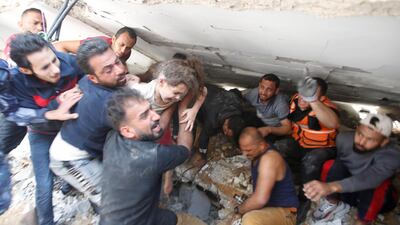
Rescuers pull a girl from the rubble at the site of Israeli air strikes in Gaza City. Reuters -
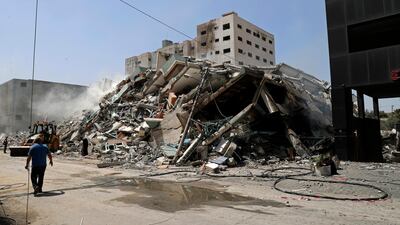
The building that was destroyed by an Israeli air strike on May 16, which housed The Associated Press and other media outlets in Gaza City. AP -
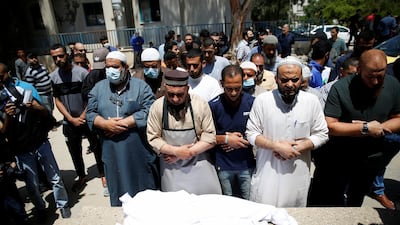
Palestinians mourn deceased relatives, at the site of Israeli air strikes, in Gaza City. Reuters -
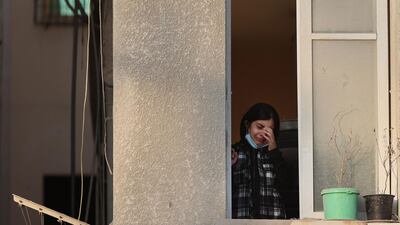
A Palestinian girl cries as she looks out from her home's window at destroyed neighbouring buildings in a residential area of Gaza City, following Israeli air strikes. AFP -
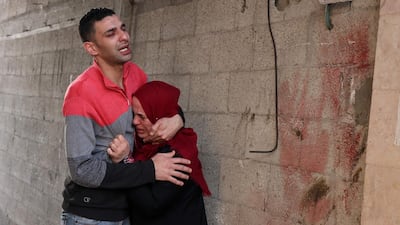
A man and woman cry outside their home after it was destroyed by Israeli air strikes in Gaza City. AFP -
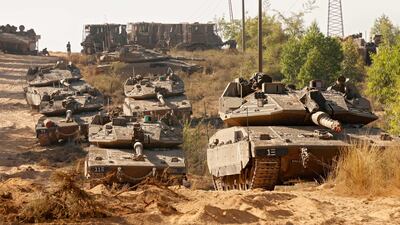
Israeli tanks stationed along the border with the Gaza Strip. AFP -
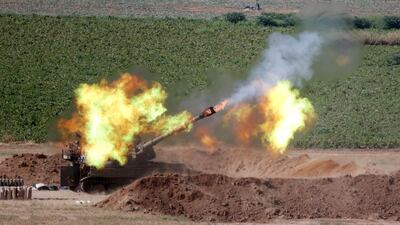
Israeli soldiers fire a 155mm Howitzer towards the Gaza Strip from their position along the border with the Palestinian enclave. AFP -

Palestinians carry a survivor from under the rubble of a building, after it was struck by Israeli strikes, in Gaza City. AFP -
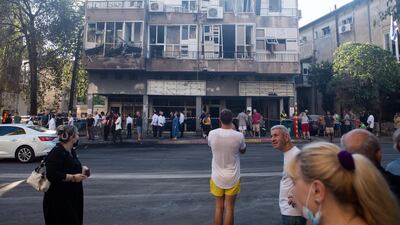
People look at the scene where a rocket fired from the Gaza Strip hit in Ramat Gan, Israel. Getty -
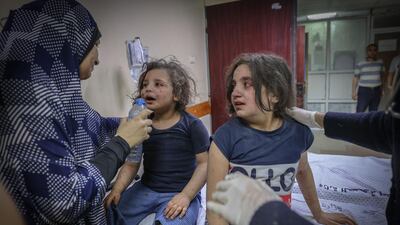
Palestinian children injured during Israeli air strikes on Gaza City are treated at Al Shifa hospital. AFP -
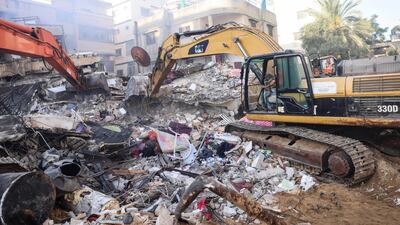
Excavators work to clear the rubble at the site of Israeli air strikes, in Gaza City May 16, 2021. REUTERS/Mohammed Salem -
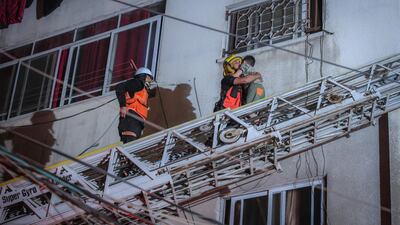
Firefighters move families from a building whose entrance was blocked by rubble after Israeli air strikes on Gaza City. AFP -
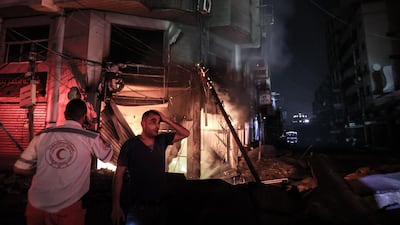
A Palestinian man watches as firefighters search for survivors and bodies under the rubble after Israeli air strikes on Gaza City. AFP -
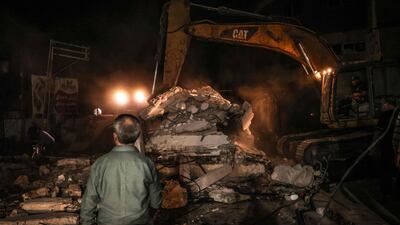
A man watches as a firefighter drives a bulldozer to clear rubble and search for survivors and bodies after the bombing of Gaza City. AFP -
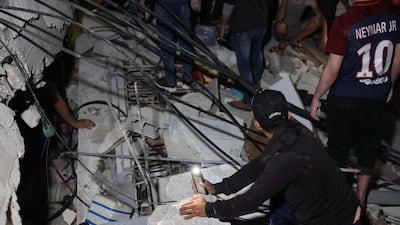
Palestinian firefighters search for survivors and bodies under the rubble. AFP -

Men watch as rescuers search for survivors and bodies in Gaza City. AFP -
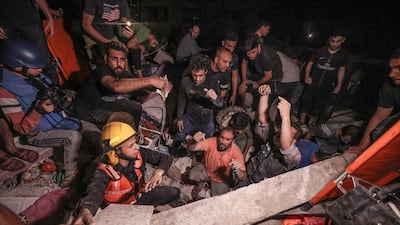
Firefighters race against time to find survivors. AFP -
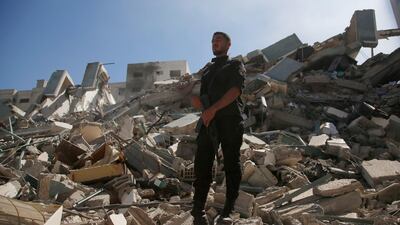
A policeman stands on rubble from a building that housed the office of the Associated Press and other media organisations in Gaza City, which was destroyed by Israeli air strikes. AP -
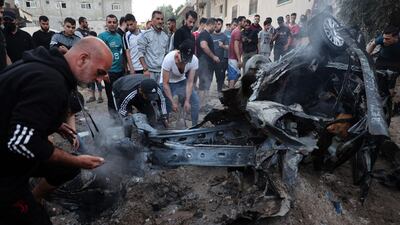
Palestinians gather around a car that burned after being hit by an Israeli missile in Gaza City. AFP -
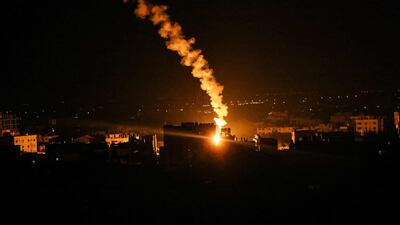
Israeli forces' flares light up the sky in Rafah in the southern Gaza Strip. AFP


The eastern sector of the city was ruled by Jordan from 1948 until 1967. It retains custodianship of holy Muslim and Christian sites in East Jerusalem, which Israel occupied in 1967.
The kingdom responded to the latest violence by increasing diplomatic contact with the US, Russia and other powers to try to curb what it regards as Israeli aggression.
The authorities also allowed anti-Israeli demonstrations across the kingdom in recent days.
Hundreds of mostly young demonstrators in Amman and other regions denounced Israel’s actions, demanding the expulsion of the Israeli ambassador and criticising the peace treaty with Israel.
On Friday, Jordanian security forces fired tear gas to disperse about 500 demonstrators who tried to penetrate a cordoned area near the border with the occupied West Bank.
No one was injured in the brief confrontation several kilometres away from the Allenby Bridge.
The 500 men broken off from a larger demonstration approved by the government in the nearby Karameh area.
Jordanian Foreign Minister Ayman Al Safadi told a meeting of the Organisation for Islamic Co-operation that Jordan will “take necessary steps” to support the Palestinians in the current war. He did not give details.
“Israel is pushing the whole region toward more tension and conflict,” Mr Al Safadi said.
On the seventh day of violence on Sunday, Israeli air strikes on Gaza killed 33 Palestinians, while Hamas and other Iranian-backed militants continued firing rockets at Israel.
Mr Al Safadi said curbing the escalation “requires halting all the illegitimate and provocative Israeli practices that caused it, and an immediate halt to the aggression on Gaza".

