Follow the latest updates as violence escalates in Israel and Palestine
Israel's much-vaunted Iron Dome missile defence system is intercepting a barrage of rockets fired by Hamas and other Palestinian militants from Gaza as bloody clashes escalate.
It is the cornerstone of Israel's aerial defence set-up, designed to shoot rockets out of the sky.
According to the Israeli military on Tuesday, 200 of the more than 480 rockets that were fired the day before had been intercepted by the system.

On Wednesday, the military updated the figure to more than 1,000 rockets launched towards Israel, of which 850 landed or were shot down.
Israeli authorities claimed that about 200 rockets fired from the Gaza Strip towards Israeli territory exploded inside the Gaza Strip.
-
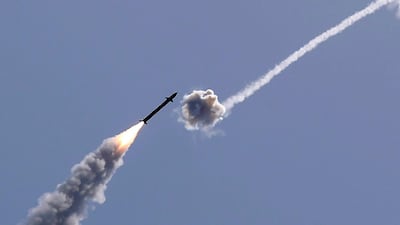
Israel's Iron Dome aerial defence system intercepts a rocket launched from the Gaza Strip, controlled by the Palestinian Hamas movement, above the southern Israeli city of Ashkelon. AFP -

Israel's Iron Dome aerial defence system intercepts a rocket launched from the Gaza Strip, controlled by the Palestinian Hamas movement, above the southern Israeli city of Ashkelon. AFP -

Israel's Iron Dome anti-missile system fires to intercept rockets launched from the Gaza Strip, as seen from Ashkelon, southern Israel. Reuters -
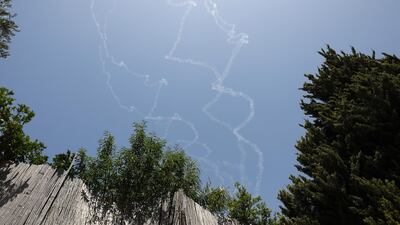
Trails of rockets fired by Israel's Iron Dome air defense system are seen in the sky over Ashdod, Israel. EPA -

Smoke trails are seen as Israel's Iron Dome anti-missile system intercepts rockets launched from the Gaza Strip, as seen from Ashkelon. Reuters -
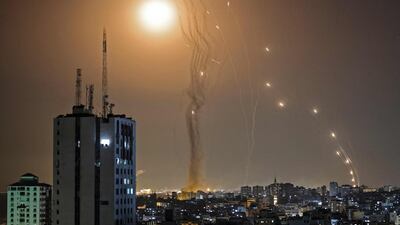
A rocket launched from Gaza city controlled by the Palestinian Hamas movement is intercepted by Israel's Iron Dome aerial defence system. AFP -
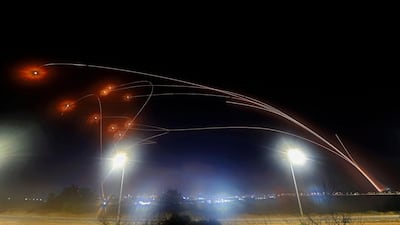
Israel's Iron Dome aerial defence system intercepts rockets launched from the Gaza Strip, controlled by the Palestinian Islamist movement Hamas, above the southern Israeli city of Ashkelon. AFP -

A streak of light is seen as Israel's Iron Dome anti-missile system intercepts rockets launched from the Gaza Strip towards Israel, as seen from Ashkelon. Reuters -
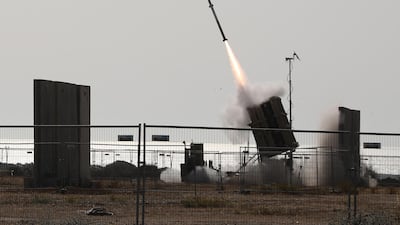
The Israeli Iron Dome anti-rocket defense system in action against a rocket fired from Gaza Strip, in the city of Ashkelon, Israel. EPA -
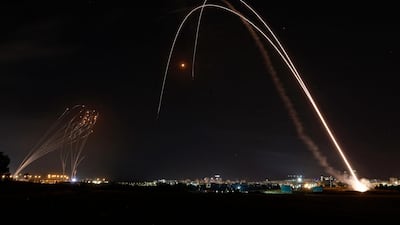
Israel's Iron Dome aerial defence system is launched to intercept a rocket launched from the Gaza Strip, controlled by the Palestinian Hamas movement, above the southern Israeli city of Ashdod. AFP -
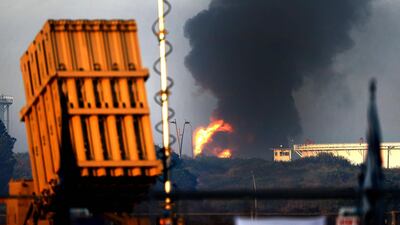
An Iron Dome aerial defence system battery is seen in the foreground as fire rages at Ashkelon's refinery. AFP -
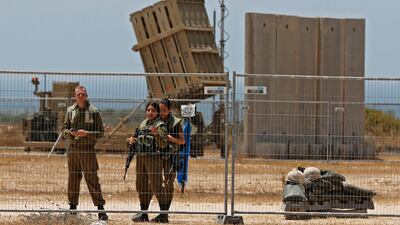
Israeli soldiers stand next to a Iron Dome aerial defence system set to intercept rockets launched from the Gaza Strip. AFP


The Israeli-designed Iron Dome system is meant to protect populated areas and critical assets by neutralising short-range aerial threats.
Each battery has a radar detection and tracking system, a firing control system and three launchers for 20 interceptor missiles. Each has a range of between four and 70 kilometres.
The head of the Israel Missile Defence Organisation, Moshe Patel, said that, as of January, the Iron Dome had intercepted more than 2,400 projectiles during the past decade.
An interceptor missile is meant to fire only if the trajectory of the rocket appears to be headed towards populated or important areas. With each launch reportedly costing almost $50,000, Mr Patel told the Times of Israel that it had "saved hundreds of lives".
The interceptors are fired vertically from the mobile or static Iron Dome sites and hit the incoming projectile, destroying the rocket mid-air. The trails from the winding interceptors and the blast smoke have become a common sight over Israeli cities near the Gaza Strip whenever there are outbreaks of violence.
Israeli military officials say that the system is 90 per cent effective at downing rockets, although analysts question the numbers.
One concern is that while the system may be capable of preventing sporadic salvos even if they number hundreds of rockets, they could be overwhelmed by a sustained massive bombardment.
Hamas in Gaza and Hezbollah on the Lebanese border possess hundreds of thousands of rockets.
The first battery was installed in March 2011 near the southern city of Beersheva – 40 kilometres from the Gaza Strip, and a favourite Hamas target – to combat Soviet-designed Grad rockets fired from the Palestinian territory.
Israel now has 10 such batteries.
Iron Dome was developed by Rafael Advanced Defence Systems, a state-owned arms company in the northern city of Haifa.
But it is also partly funded by the US, which committed $5 billion to its development costs in 2016.
It is one of the strategic pillars of the US-Israeli alliance that has been followed by successive Democratic and Republican administrations.
In August 2019, the US army signed a contract to purchase two Iron Dome batteries to enhance its own short-range missile defence capabilities.
-
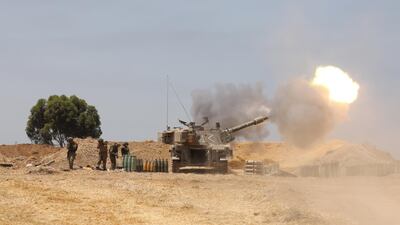
Israeli artillery in action as the escalation continues between the Israeli army and Hamas at the Gaza Border. EPA -
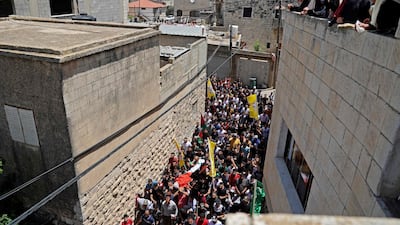
Mourners attend the funeral of Palestinian Rashid Abu Ara, 16, who was killed during clashes with Israeli troops in village of Aqaba near Nablus, north of the West Bank. AFP -
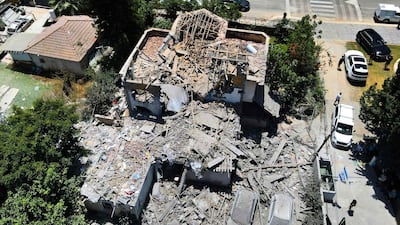
A heavily damaged house in a residential area in the city of Yehud, in central Israel. AFP -
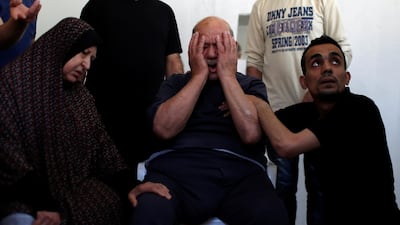
Parents of Palestinian man Abdulsalam Al-Ghazali, who was killed amid a flare-up of Israeli-Palestinian violence, react during their son funeral in Gaza City. Reuters -
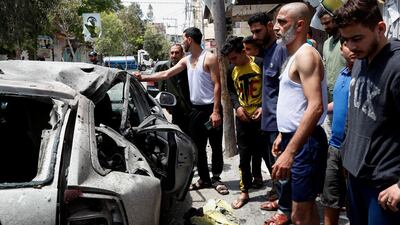
Residents look at a car that was hit in an Israeli air strike, on the main road in Gaza City. Three people who were in the vehicle died. AP -
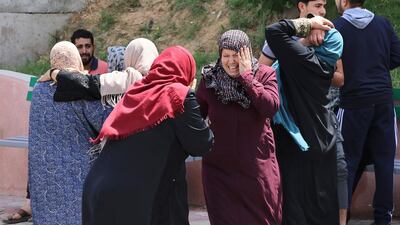
Palestinians mourn the death of relatives outside a hospital in Beit Lahia following a series of Israeli air strikes on the Hamas-controlled Gaza Strip. AFP -

Israeli Arabs treat a sheep that was wounded by a rocket fired from the Gaza Strip, where nearby a father and his daughter were killed, in the village of Dahmash near the Israeli city of Lod. AP -
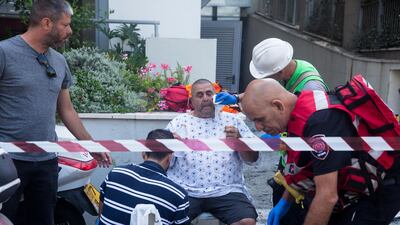
An injured man receives treatment at the scene after a rocket launched from the Gaza strip struck in Giv'atayim, Israel. Getty -
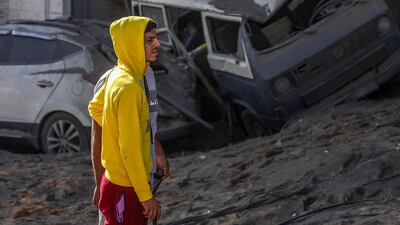
A man looks at the damage in the aftermath of overnight Israeli air strikes on Gaza. EPA -
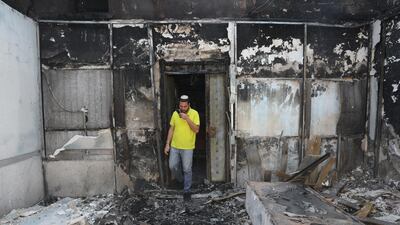
A Jewish man at a burnt-out synagogue after overnight riots between Arab and Jewish residents in Lod, Israel. EPA -

Relatives of Palestinian Rashid Abu Arra, 16, who was killed during clashes with Israeli troops in the village of Aqqaba near Nablus at the hospital morgue in Tubas in the occupied West Bank. AFP -
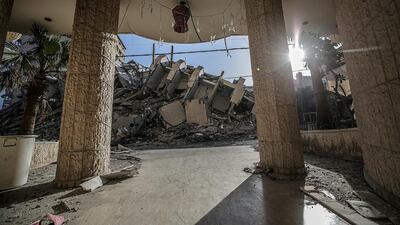
Rubble from the Hanadi tower after an Israeli air strike on Gaza City. EPA -
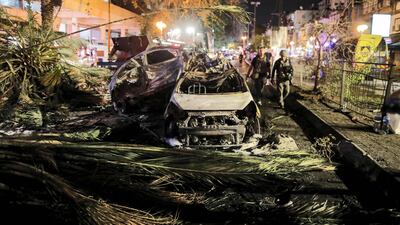
Israeli security forces pass burnt-out vehicles in Holon near Tel Aviv. AFP -
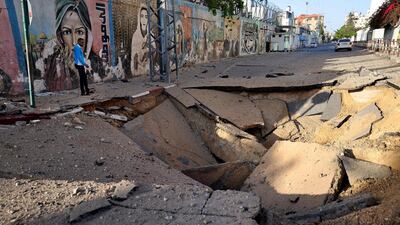
A huge crater in Gaza City caused by the Israeli air strikes. AFP -
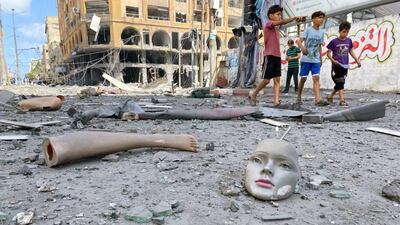
A broken mannequin near a tower building in Gaza City that was hit by Israeli air strikes during the flare-up of Israeli-Palestinian violence. Reuters -
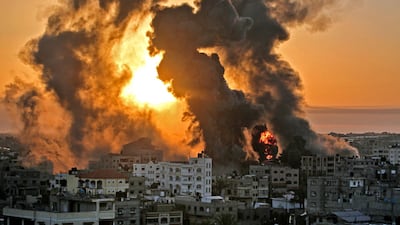
Fires at sunrise in Khan Yunish after an Israeli air strike on targets in the southern Gaza strip. AFP -
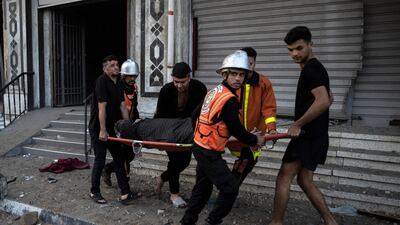
Palestinian rescuers move an elderly woman from a building in Gaza City after Israeli air strikes in the area. AP Photo -
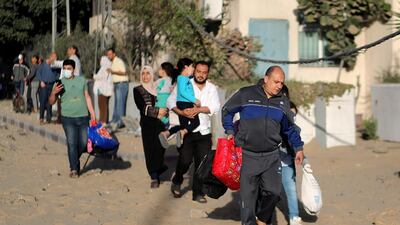
Palestinians evacuate after their tower building was hit by Israeli air strikes, in Gaza City. Reuters -
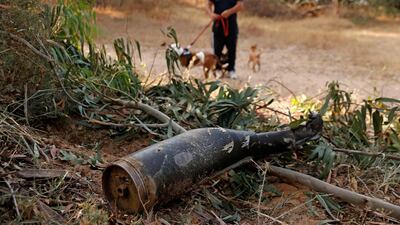
The remains of a rocket, destroyed by Israel's Iron Dome aerial defence system, which was fired by the Palestinian Islamist group Hamas from the Gaza strip. AFP -
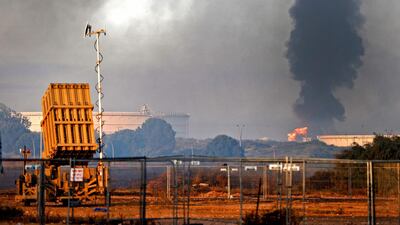
An Iron Dome aerial defence system battery is seen in the foreground as fire rages at Ashkelon's refinery, which was hit by Hamas rockets the previous day, in the southern Israeli city. AFP -
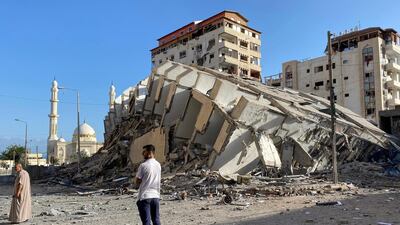
Palestinians stand next to the remains of a tower building which was destroyed in Israeli air strikes, in Gaza City. Reuters -

A Palestinian man holds an injured girl awaiting medical care at al-Shifa hospital, after an Israeli air strike in Gaza city. AFP -
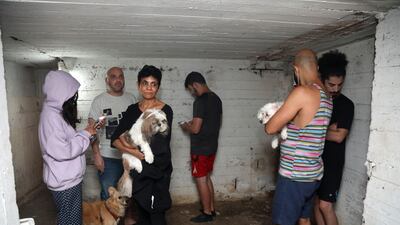
People take shelter in the basement of a building in the Israeli city of Tel Aviv as alarm sirens wailed after 3:00 a.m. after rockets were launched towards Israel from the Gaza Strip. AFP -
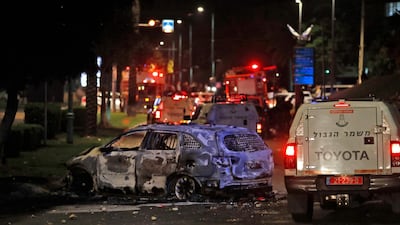
Israeli border police vehicles drive past an extinguished burnt vehicle in Lod near Tel Aviv, after rockets were launched towards Israel from the Gaza Strip controlled by the Palestinian Hamas movement. AFP -

An Israeli police officer gestures to a Palestinian woman and her daughter, frightened by clashes outside of the Damascus Gate to the Old City of Jerusalem. AP Photo -

Israeli firefighters walk by a car with a fallen tree on it after it was hit by a rocket fired from Gaza towards Holon, Israel. Reuters -
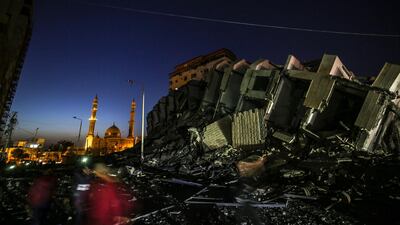
Palestinians inspect a destroyed Hanadi tower after Israeli airstrike in Gaza City. EPA -
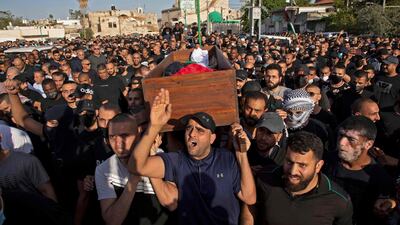
Arab Israelis gesture and wave Palestinian flags during the funeral of Mousa Hassouna in the central Israeli city of Lod near Tel Aviv. Hassouna was killed during clashes with Israeli security following an anti-Israel demonstration over tensions in Jerusalem. AFP -
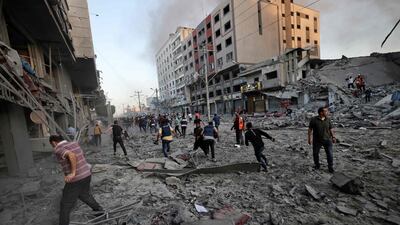
Rescuers rush to help among the rubble in front of Al Sharouk tower, that collapsed after being hit by an Israeli air strike, in Gaza city on Wednesday. AFP -
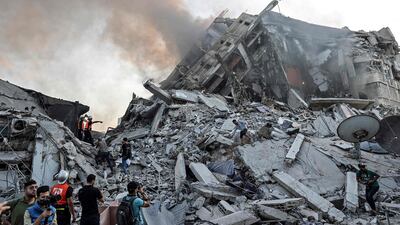
Palestinians view the smouldering remains of Al Sharouk tower, which collapsed after being hit by an Israeli air strike. AFP -
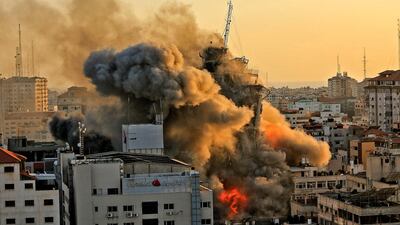
Smoke and flames rise from Al Sharouk tower, as it collapses after being hit by an Israeli air strike in Gaza City. AFP -
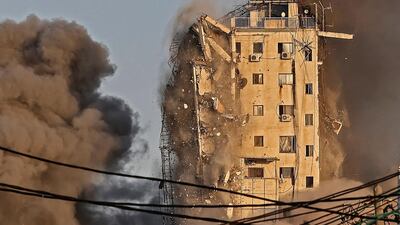
Al Sharouk tower block collapses after being hit by an Israeli air strike. AFP -
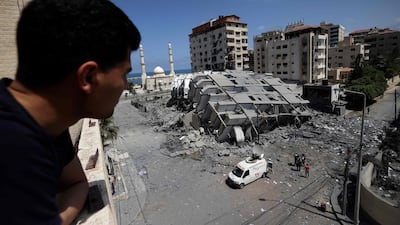
A man peers out to survey destroyed buildings in Gaza city, following Israeli air strikes. AFP -
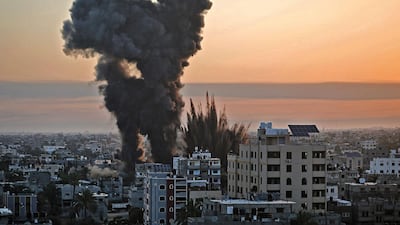
A plume of black smoke rises into the air in Khan Yunis, in the southern Gaza Strip, following an Israeli air strike on the area, which is controlled by the militant Hamas movement. AFP -
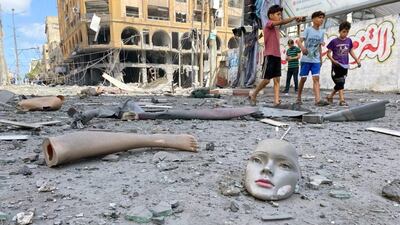
Parts of a broken mannequin lie scattered near a building that was hit by Israeli air strikes in Gaza city. Reuters -
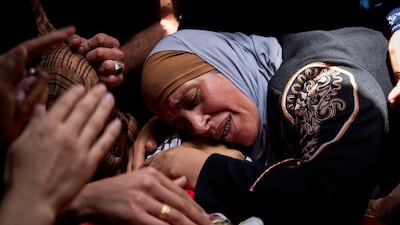
A Palestinian woman mourns her son Rasheed Abu Arra, who was killed during confrontations with Israeli forces, at his funeral in the village of Aqaba, near the West Bank town of Tubas. AP Photo -
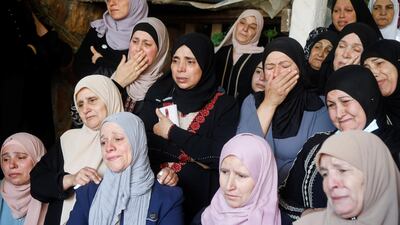
Women mourn at the funeral of Palestinian Rasheed Abu Arra, who was killed during confrontations with Israeli forces, in the town of Aqaba, near Tubas, in the West Bank. Reuters -
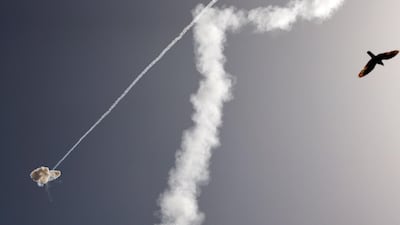
Israel's Iron Dome air defence system intercepts a rocket launched from the Gaza Strip, above the southern Israeli city of Ashdod. AFP


Israel has other missile defence systems such as the Arrow, to counter ballistic missiles, and David's Sling, for medium-range rocket or missile attacks.
The idea of the three systems is to create a protective bubble around Israel that can defend against short-range rockets, like those from Gaza, longer-range rockets, like those they fear could be fired from Syria, or even longer range threats posed by Iran or others farther away.
Military experts say 13 Iron Dome batteries are needed to be able to defend the whole of Israeli territory, with its tense border with Syria also particularly at risk of attack.

