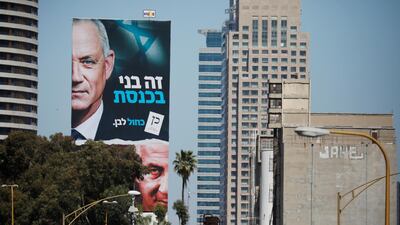

Israelis are braced for a fourth election in two years, with polls showing no clear end to the political chaos as Prime Minister Benjamin Netanyahu seeks to hold on to power.
Tuesday's vote takes place three months after the collapse of Mr Netanyahu's coalition government, an alliance launched in May with his former rival Benny Gantz.
Their coalition was intended to steer the country through the coronavirus pandemic and muster a sense of stability for the weary electorate after three inconclusive polls.
But such aspirations were shattered by infighting. As Mr Netanyahu’s administration failed to pass a budget, Israelis must vote once again under a shadow of uncertainty and the threat of yet another vote within months.
“It’s like we lost all direction and everyone is pulling in different directions,” said Amalia Sand, who for months has joined weekly protests outside Mr Netanyahu’s Jerusalem residence.
Speaking on Saturday among thousands of demonstrators, many blowing vuvuzelas or waving Israeli flags, the tattoo artist, 61, outlined why she joined the rally.
“Mainly the corruption of our government, which is disgusting. It’s so rotten that we must be here every weekend until we change it,” she said.
Mr Netanyahu appeared in court last month and pleaded not guilty to allegations of corruption in three cases in which he is accused of seeking positive media coverage and receiving lavish gifts.
Despite the hearing being accompanied by a rowdy demonstration outside the Jerusalem courthouse, Mr Netanyahu's corruption trial has failed to dent his popularity among his core supporters.
-

Leader of the Israeli Labor Party (HaAvoda) Merav Michaeli speaks at her party's election conference in the central Israeli town of Hod Hasharon near Tel Aviv. AFP -
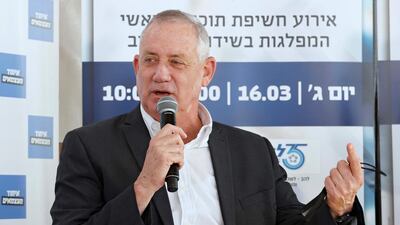
Israel's Blue and White opposition party leader Benny Gantz answers questions during a presser with the Chariman of the LAHAV (Israeli Federation of Small Business Organisations). AFP -
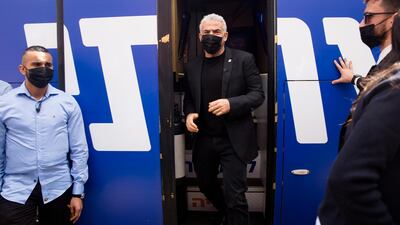
Yair Lapid, Yesh Atid party leader arrives at a campaign event in Hod HaSharon, Israel. Getty Images -

Leader of the right wing Religious Zionist Party Bezalel Smotrich speaks during the 'Influencers Conference' of the Israeli leading News Channel 12 in Jerusalem, Israel, 07 March 2021. EPA -
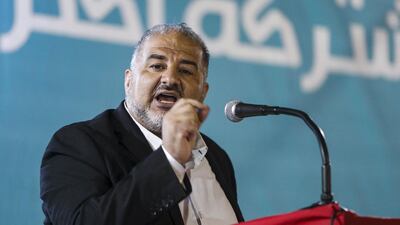
Mansour Abbas, Israeli Arab member of the United Arab List party, speaks during a campaign rally for the Joint List political alliance ahead of upcoming September parliamentary elections, in the Arab town of Kafr Yasif in northern Israel. AFP


Israel election candidates and party lists by current seats:
Benjamin Netanyahu, Likud (37 seats)
Yair Lapid, Yesh Atid (16 seats)
Benny Gantz, Blue and White (12 seats)
Ayman Odeh, Joint List (11 seats)
Aryeh Deri, Shas (9 seats)
Moshe Gafni, UTJ (7 seats)
Avigdor Lieberman, Yisrael Beiteinu (7 seats)
Mansour Abbas, Ra'am / United Arab List (4 seats)
Nitzan Horowitz, Meretz (4 seats)
Naftali Bennett, Yamina (3 seats)
Merav Michaeli, Labor (2 seats)
Bezalel Smotrich, Religious Zionism (2 seats)
Gideon Sa'ar, New Hope (2 seats)
Yaron Zelekha, New Economic Party (new)

Yair Lapid and Benny Gantz challenge Netanyahu’s Likud party
The final polls, published on Friday, show Mr Netanyahu’s Likud leading as the largest party, clinching between 30 and 32 spots in the 120-seat parliament.
His closest challenger, Yair Lapid of the Yesh Atid party, is forecast to pick up 18 or 19 seats, according to three television polls.
The centrist leader campaigned alongside Mr Gantz before last year’s election but chose to sit in opposition once his partner broke a key campaign promise and joined forces with Mr Netanyahu.
The decision effectively cost Mr Gantz his political career: the former military chief’s Blue and White party is expected to scrape past the electoral threshold and pick up four seats.
While the right-wing Likud is striding ahead of its rivals, Mr Netanyahu still needs the support of numerous smaller parties to gain a 61-seat parliamentary majority.
“It looks as if it’s the first time that there’s a real chance of taking Netanyahu out of power,” said Gayil Talshir, a political science professor at Hebrew University in Jerusalem.
She cautioned, however, that the premier is criss-crossing the country and campaigning like no other candidate.
“He knows that he’s fighting for his political life,” Ms Talshir said. “The main issue is whether Netanyahu can rally his supporters to go and vote.”
With Israel's longest-serving leader falling one seat short, intense negotiations are expected to follow Tuesday's vote as Mr Netanyahu and his opponents attempt to find a path to government.
Bezalel Smotrich and Itamar Ben-Gvir
The prime minister has already come under fire for a surplus vote-sharing deal agreed last month with the far-right Religious Zionism alliance, led by Bezalel Smotrich, which is expected to gain five seats.
The pact could give an influential voice to Itamar Ben-Gvir, a lawyer notorious for his anti-Palestinian statements. Mr Ben-Gvir is widely seen as a disciple of the late racist rabbi Meir Kahane.
While Mr Netanyahu has been courting far-right Jewish politicians, he has also taken his campaign to the Arab community, which makes up about 20 per cent of the population.
The approach marks a significant shift from April 2019, when the prime minister urged his supporters to vote in order to counter the Arab electorate which he claimed were heading to the polls “in droves”.
Two years on, however, he may gain two parliamentary seats from Arab voters, according to the Abraham Initiatives, which promote equality in Israel.
“A new generation is knocking on the doors of the Israeli government,” said Thabet Abu Rass, the organisation’s co-director.
“The young people are not enthusiastic to vote, but if they would like to vote, many of them would like to go for direct influence, to Likud, for example,” he said.
Arab parties have never been part of a government and, despite growing support for Likud, an Arab politician is not expected to be offered a ministerial post if Mr Netanyahu maintains the premiership.
The Joint List
The strongest Arab bloc remains the Joint List, which unites three parties and is forecast to win eight seats. The alliance currently has 15 members and has been weakened by the decision of a fourth party, Ra’am, to break away and run on its own ticket.
Tensions within the bloc emerged in recent months when Ra’am leader, Mansour Abbas, suggested he would be willing to co-operate with Mr Netanyahu.
Ra’am is currently polling at four seats, alongside other small parties such as the left-wing Meretz and Labour.
Leftist parties have been in decline in recent years and Merav Michaeli – the only woman to lead a party into the elections – has been trying to revitalise Labour with a platform promoting gender equality, civil liberties and the welfare state.
While right-wing parties dominate the agenda, the political deadlock has sparked the creation of the centrist New Economic Party.
“It’s the fourth time that we are going to elections, the economy is very bad, we don’t have a constitution,” said Osnat Akirav, an academic, of her decision to stand as a candidate despite polls showing the party falling short of the electoral threshold.

“We are professionals and we are trying to make fundamental change in the Israeli democracy, in the Israeli economy,” said Ms Akirav, who runs the political science department at Western Galilee College.
While the government has faced criticism for its handling of coronavirus and the economic fallout of the pandemic, the recent vaccination programme has been widely praised.
“Now many more people say at the end of the day Netanyahu saved Israel from Covid-19,” Ms Talshir said. Schools, shops and restaurants reopened in recent weeks.
“That was the whole idea of Netanyahu – there will be great hope,” she said.
Likud was hoping the vaccination drive will bring it votes, she said.
The response to the pandemic is unlikely to seriously shift the outcome of the vote, however, and after two years of electioneering many Israelis are disillusioned with the country’s divisive political climate.
“Let’s go back to behaving like human beings not like wild, destructive creatures,” Ms Sand said at the protest. “This is how I feel, that it’s all gone wrong.”
Read more:
Israel's Covid infections plummet 40 days after lifting lockdown but challenges remain
US confirms new security pact with Jordan
Comment: Biden's reset on the Palestine-Israel peace process

