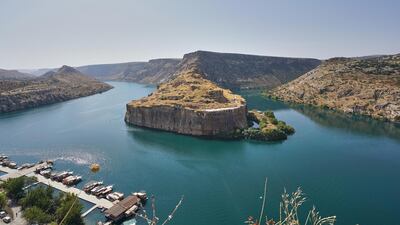
Turkey’s farmers are facing catastrophic levels of drought despite rains that initially staved off panic at the start of the year as reservoir levels shrunk to less than a quarter of their capacity.
Water levels around Istanbul – home to about a fifth of Turkey's population – fell to less than 25 per cent of their full capacity in January after months with no rain. Officials issued a warning at the time that the city would run out of water in 45 days.
TV bulletins switched between footage of people praying for rain and maps of the country coloured a deep red to indicate dire groundwater conditions.
The heavens later opened, soothing public fears, but groundwater levels were not sufficiently replenished, leading to the appearance of cavernous sinkholes across Turkey’s agricultural plains.
“Unfortunately, we only wake up when the water level of the dams that feed the cities drops and ask: ‘What’s happening?’” said Akgun Ilhan, a water management expert at Istanbul Policy Centre.
“When it rains for a few days and water collects in the dams, we go back to sleep.”
Experts said the country still faced a severe drought and farmers called on the government to declare a natural disaster.
The hardest-hit area, the South-eastern Anatolia region, recorded a 90 per cent drop in rainfall last month compared with April 2020, according to the Water Policy Association in Ankara. Across the country, there was half as much rain as the previous year.
The impending water crisis led President Recep Tayyip Erdogan to unveil a new water watchdog in March, along with $645 million in funding for new dams, water treatment plants and irrigation.
Agriculture Minister Bekir Pakdemirli had already told the public to treat water as a precious commodity “just like gold or a piece of jewellery".
Climate change plays a significant role. Turkey has faced several droughts since the 1980s owing to population growth, accompanied by rapid industrialisation and urbanisation.
Turkey’s water infrastructure has struggled to keep up, with 50 per cent of water lost to leaks before reaching the tap, the Water Policy Association said.
Data from the General Directorate of State Hydraulic Works shows available water levels steadily falling, from about 1,650 cubic metres a person in 2000 to less than 1,350 cubic metres last year.
The UN classes a country as “water scarce” at 1,000 cubic metres.
Mr Ilhan called for Turkey to reduce carbon emissions, which she said had increased by 135 per cent in the past 30 years. It is one of the few countries not to have ratified the 2015 Paris agreement on climate change.
To the south of Turkey, Iraq and Syria have long complained of water shortages caused by Turkey's extensive damming of the Euphrates and Tigris under the Southeast Anatolia Project, a $32 billion plan initiated in the 1970s that is focused on providing hydroelectric power and farm irrigation.
The project, known by its Turkish acronym GAP, was to provide irrigation for an additional 18,000 square kilometres but has only achieved about half that, according to Abdullah Melik, chairman of Sanliurfa province's Chamber of Agricultural Engineers.
“GAP has been 54 per cent effective in agricultural irrigation [but] the project was not completed,” he said.
Nearly three quarters of Turkey’s water consumption goes to agriculture and farmers say this year’s yield of crops such as wheat, barley and lentils have been reduced by at least a fifth.
“The state must immediately declare the region a disaster area,” said Mehmet Ali Dogru, chairman of the Chamber of Agriculture in Nusaybin, a town on the Syrian border.
“GAP needs to be completed as soon as possible so that we do not suffer from drought.”
Turkey has not shied from holding its control of the Tigris and Euphrates over Iraq and Syria, such as cutting off the Euphrates when Iraq invaded Kuwait and coercing Syria into halting support for Kurdish insurgents.
This year, Turkey has allegedly halved the flow of the Euphrates, primarily affecting areas controlled by the Syrian regime and the Kurdish-led authorities. Ankara denies the claims.
GAP has allowed Turkey to control "the most pivotal rivers in the Middle East and, for some, declare its hydro-hegemony", said Dr Arda Bilgen, water politics expert and visiting scholar at Clark University in the US.
“Syria and Iraq also worried that the project would severely impact the quality and quantity of their water.”
The outbreak of the civil war in Syria "further complicated efforts to co-ordinate and co-operate over water resources management", he said.
Dr Bilgen, who has extensively researched GAP, said its effect locally was “ephemeral, fragile and unsustainable rather than long-term, inclusive and sustainable".
While benefiting "those already possessing large amounts of land, capital, resources and power", GAP has cost small landholders and seasonal workers, and its dams have displaced up to 400,000 people, he said.

Where to buy art books in the UAE
There are a number of speciality art bookshops in the UAE.
In Dubai, The Lighthouse at Dubai Design District has a wonderfully curated selection of art and design books. Alserkal Avenue runs a pop-up shop at their A4 space, and host the art-book fair Fully Booked during Art Week in March. The Third Line, also in Alserkal Avenue, has a strong book-publishing arm and sells copies at its gallery. Kinokuniya, at Dubai Mall, has some good offerings within its broad selection, and you never know what you will find at the House of Prose in Jumeirah. Finally, all of Gulf Photo Plus’s photo books are available for sale at their show.
In Abu Dhabi, Louvre Abu Dhabi has a beautiful selection of catalogues and art books, and Magrudy’s – across the Emirates, but particularly at their NYU Abu Dhabi site – has a great selection in art, fiction and cultural theory.
In Sharjah, the Sharjah Art Museum sells catalogues and art books at its museum shop, and the Sharjah Art Foundation has a bookshop that offers reads on art, theory and cultural history.
RESULTS
Bantamweight:
Zia Mashwani (PAK) bt Chris Corton (PHI)
Super lightweight:
Flavio Serafin (BRA) bt Mohammad Al Khatib (JOR)
Super lightweight:
Dwight Brooks (USA) bt Alex Nacfur (BRA)
Bantamweight:
Tariq Ismail (CAN) bt Jalal Al Daaja (JOR)
Featherweight:
Abdullatip Magomedov (RUS) bt Sulaiman Al Modhyan (KUW)
Middleweight:
Mohammad Fakhreddine (LEB) bt Christofer Silva (BRA)
The internal combustion engine is facing a watershed moment – major manufacturer Volvo is to stop producing petroleum-powered vehicles by 2021 and countries in Europe, including the UK, have vowed to ban their sale before 2040. The National takes a look at the story of one of the most successful technologies of the last 100 years and how it has impacted life in the UAE.
British Grand Prix free practice times in the third and final session at Silverstone on Saturday (top five):
1. Lewis Hamilton (GBR/Mercedes) 1:28.063 (18 laps)
2. Sebastian Vettel (GER/Ferrari) 1:28.095 (14)
3. Valtteri Bottas (FIN/Mercedes) 1:28.137 (20)
4. Kimi Raikkonen (FIN/Ferrari) 1:28.732 (15)
5. Nico Hulkenberg (GER/Renault) 1:29.480 (14)
Islamophobia definition
A widely accepted definition was made by the All Party Parliamentary Group on British Muslims in 2019: “Islamophobia is rooted in racism and is a type of racism that targets expressions of Muslimness or perceived Muslimness.” It further defines it as “inciting hatred or violence against Muslims”.
How to apply for a drone permit
Individuals must register on UAE Drone app or website using their UAE Pass
Add all their personal details, including name, nationality, passport number, Emiratis ID, email and phone number
Upload the training certificate from a centre accredited by the GCAA
Submit their request
What are the regulations?
Fly it within visual line of sight
Never over populated areas
Ensure maximum flying height of 400 feet (122 metres) above ground level is not crossed
Users must avoid flying over restricted areas listed on the UAE Drone app
Only fly the drone during the day, and never at night
Should have a live feed of the drone flight
Drones must weigh 5 kg or less
New process leads to panic among jobseekers
As a UAE-based travel agent who processes tourist visas from the Philippines, Jennifer Pacia Gado is fielding a lot of calls from concerned travellers just now. And they are all asking the same question.
“My clients are mostly Filipinos, and they [all want to know] about good conduct certificates,” says the 34-year-old Filipina, who has lived in the UAE for five years.
Ms Gado contacted the Philippines Embassy to get more information on the certificate so she can share it with her clients. She says many are worried about the process and associated costs – which could be as high as Dh500 to obtain and attest a good conduct certificate from the Philippines for jobseekers already living in the UAE.
“They are worried about this because when they arrive here without the NBI [National Bureau of Investigation] clearance, it is a hassle because it takes time,” she says.
“They need to go first to the embassy to apply for the application of the NBI clearance. After that they have go to the police station [in the UAE] for the fingerprints. And then they will apply for the special power of attorney so that someone can finish the process in the Philippines. So it is a long process and more expensive if you are doing it from here.”
The specs: 2019 Jeep Wrangler
Price, base: Dh132,000
Engine: 3.6-litre V6
Gearbox: Eight-speed automatic
Power: 285hp @ 6,400rpm
Torque: 347Nm @ 4,100rpm
Fuel economy, combined: 9.6L to 10.3L / 100km
Fresh faces in UAE side
Khalifa Mubarak (24) An accomplished centre-back, the Al Nasr defender’s progress has been hampered in the past by injury. With not many options in central defence, he would bolster what can be a problem area.
Ali Salmeen (22) Has been superb at the heart of Al Wasl’s midfield these past two seasons, with the Dubai club flourishing under manager Rodolfo Arrubarrena. Would add workrate and composure to the centre of the park.
Mohammed Jamal (23) Enjoyed a stellar 2016/17 Arabian Gulf League campaign, proving integral to Al Jazira as the capital club sealed the championship for only a second time. A tenacious and disciplined central midfielder.
Khalfan Mubarak (22) One of the most exciting players in the UAE, the Al Jazira playmaker has been likened in style to Omar Abdulrahman. Has minimal international experience already, but there should be much more to come.
Jassim Yaqoub (20) Another incredibly exciting prospect, the Al Nasr winger is becoming a regular contributor at club level. Pacey, direct and with an eye for goal, he would provide the team’s attack an extra dimension.
Results
Light Flyweight (49kg): Mirzakhmedov Nodirjon (UZB) beat Daniyal Sabit (KAZ) by points 5-0.
Flyweight (52kg): Zoirov Shakhobidin (UZB) beat Amit Panghol (IND) 3-2.
