

Not long ago, regional heavyweights Turkey and Egypt were nearly at the brink of war over the conflict in Libya.
Last summer, Egyptian President Abdel Fatah El Sisi said he was prepared to deploy troops to Libya, where Turkey was backing the Government of National Accord, if the militias took the town of Sirte from the Cairo-supported Libyan National Army and moved towards Egypt’s borders in the east.
But fast forward to March 2021 and the situation is vastly altered.
There is a ceasefire holding in conflict-wracked Libya, a new unity government is in place and the Egyptians are moving ahead with reopening their embassy in Tripoli – the seat of the Ankara-backed Government of National Accord.
Meanwhile, Turkey is sending out a multitude of direct overtures to Egypt, speaking of the cultural and historic ties binding the two Muslim nations. Ankara has highlighted the geostrategic strength they could gain if they buried the hatchet, improved relations and concluded a maritime demarcation deal.
Cairo, however, has made it clear that it is looking for actions not words from Ankara if relations are to improve.
Experts say a Turkish-Egyptian thaw is possible, even if it remains distant for now.
The offer of an olive branch?
Turkish Foreign Minister Mevlut Cavusoglu said “intelligence” and “diplomatic” contacts with Egypt have resumed and praised Cairo for respecting Turkey’s exclusive maritime zone when it announced a tender last month for oil and gas exploration in the East Mediterranean. President Recep Erdogan said if such contacts produced results, they could move to a higher level.
Egypt’s Foreign Minister Sameh Shukry on Sunday confirmed contacts between Cairo and Ankara were taking place but said that dialogue was limited.
"[There is] no communication outside the normal diplomatic framework. If real actions from Turkey show alignment with Egyptian principles and goals then the groundwork will be laid for relations to return to normal," Mr Shoukry told Egyptian lawmakers on Sunday.
His comments echoed a terse but carefully phrased official statement at the weekend that quoted an unnamed “official source” as saying the contacts with Turkey did not amount to a resumption of diplomatic contacts.
For Egypt and Turkey to upgrade their relations, the other party must take note of diplomatic and legal frameworks based on the principle of sovereignty and national Arab security, said the statement.
Turkey must abide by international law and the principles of good neighbourliness and halt attempts at meddling in the domestic affairs of countries in the region in order to have normalised relations with Egypt, it added.
It ended on a somewhat conciliatory note.
“The source has at the same time emphasised the importance of the strong ties and bonds between the peoples of the two nations.”
A decade of animosity
Relations between Egypt and Turkey have been fraught since 2013, when the Egyptian military – then led by Mr El Sisi – removed Turkish ally and Islamist Mohammed Morsi from office amid a wave of street protests demanding an end to his one-year, divisive rule.
Egypt has since accused Turkey of supporting extremist Islamist groups across the region, fuelling instability.
Turkey has been a critic of Mr El Sisi’s government and the preferred home-in-exile for leaders and supporters of the Muslim Brotherhood, the Islamist group from which Morsi hailed and which has been declared a terrorist organisation by Egypt and a number of other countries.
It has also been home since Morsi’s ouster to several television networks that offer a generous dose of biting criticism of Mr El Sisi’s policies. The two countries have also been at loggerheads over what Cairo sees as Ankara’s attempts to muscle in on the natural gas project in the East Mediterranean.
-
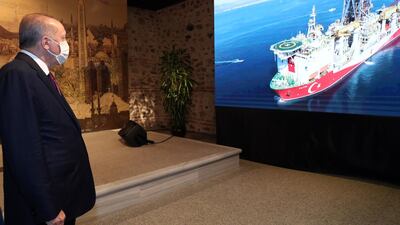
President Recep Tayyip Erdogan takes part in a video conference with Turkish drilling vessel 'Fatih' before announcing the biggest natural gas discovery in history, in Istanbul, Turkey. EPA -
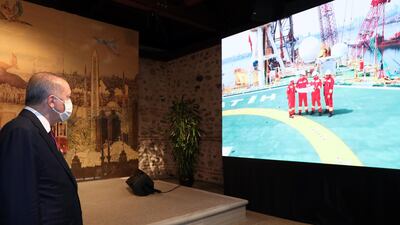
President Recep Tayyip Erdogan takes part in a video conference with Turkish drilling vessel 'Fatih' before announcing the biggest natural gas discovery in history, in Istanbul, Turkey. EPA -
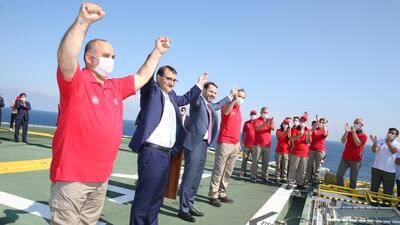
Turkish Finance Minister Berat Albayrak and Energy Minister Fatih Donmez pose with members of Turkish Petroleum (TPAO) on the deck of drilling vessel Fatih in the western Black Sea, off Turkey. REUTERS -
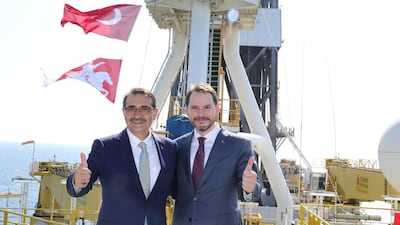
Turkish Finance Minister Berat Albayrak and Energy Minister Fatih Donmez pose on the deck of drilling vessel 'Fatih' in the western Black Sea, off Turkey. Reuters -
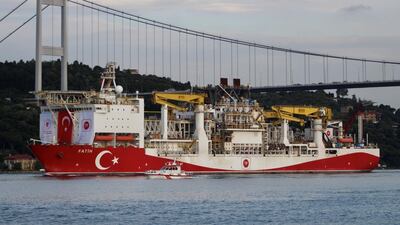
The Turkish drilling ship, 'Fatih', had been carrying out exploration operations in the Tuna-1 sector in the western Black Sea for the past month. Reuters -
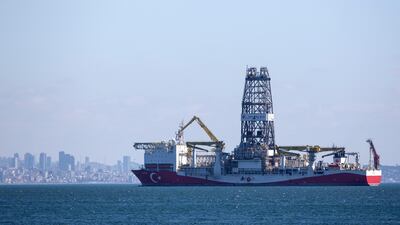
President Recep Tayyip Erdogan said the natural gas reserve, at 320 billion cubic metres, is the biggest in Turkish history. EPA -
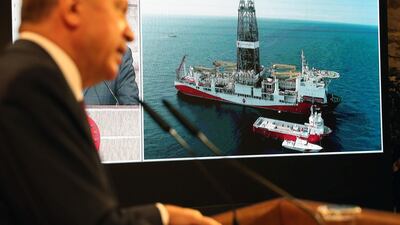
Turkey's President Tayyip Erdogan addresses the nation. Reuters -
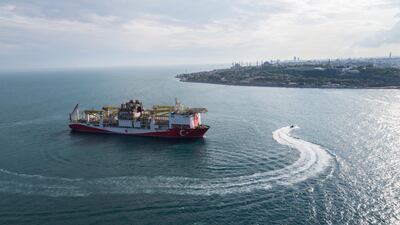
Turkey aims to bring the find to use in 2023 and to become a net energy exporter, Mr Erdogan said. EPA -
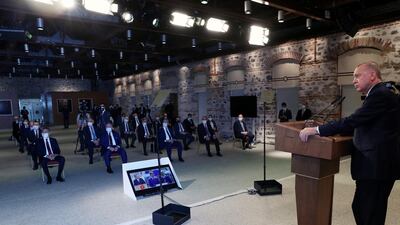
The announcement comes as tensions between Turkey and Greece, and EU nations, are running high over oil and gas exploration in disputed waters in the eastern Mediterranean. Reuters -
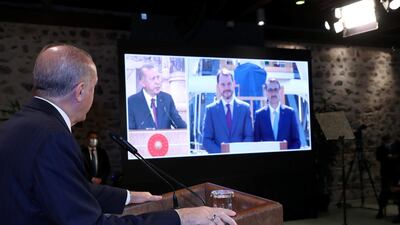
Mr Erdogan listens to Finance Minister Berat Albayrak and Energy Minister Fatih Donmez on a live video feed about the find. Reuters -
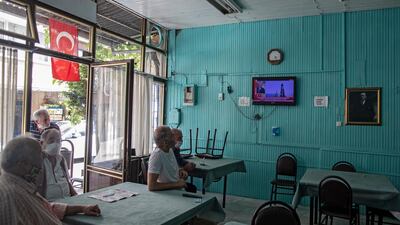
People watch the TV at a coffee house while Turkish President Recep Tayyip Erdogan announces the biggest natural gas discovery in history in Istanbul, Turkey. EPA -
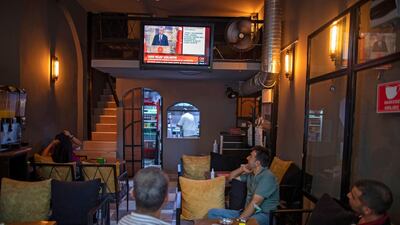
People watch the at a cafe TV while Turkish President Recep Tayyip Erdogan announces the biggest natural gas discovery in history in Istanbul, Turkey. EPA


Cairo took a dim view of what it saw as Ankara’s attempts to expand its sphere of influence in the region, partially to isolate Egypt.
It has aired its alarm that Turkish forces have, in recent years, been stationed or operated in Libya, Syria, Iraq, Qatar and Somalia.
Curiously, the two nations have not allowed their differences to impact their trade ties, which have steadily grown over the years.
The region, however, is undergoing a rapid shift in geopolitical dynamics that raises the prospect for a possible Egyptian-Turkish thaw that could have far-reaching repercussions in the Middle East.
The changes could also bring about an orderly and legitimate participation by Turkey in ambitious plans spearheaded by Egypt, Greece, Israel and Cyprus to create a lucrative energy hub in the East Mediterranean following massive natural gas finds.
When words don’t amount to much action
“There is a history of overtures from Turkey over recent years, but they don’t include the necessary conditionality,” said Mohamed Anis Salem, a former Egyptian ambassador and UN official.
“No self-respecting nation will stay silent while Turkey does what it does,” he said, referring to the Turkish-based television networks virtually dedicated to attacking Mr El Sisi’s policies or inciting unrest.
Other Egyptian commentators took an uncompromisingly hardline approach to the Turkish overtures.
“We should not fall for this Turkish ploy,” said Imad Adeeb, a veteran Egyptian analyst widely viewed as the pioneer of television talk shows in the Arab world. “Pick up the phone and call the [Cairo presidential] Ittihadiya Palace and say ‘my name is Recep Erdogan and I would like to have an appointment to speak to the president of the Arab Republic of Egypt … so I can apologise to him and start a new page’,” Mr Adeeb counselled the Turkish leader.
It is not likely that Mr Erdogan will make such a call.
“I regret to say that the chances of Ankara changing its policies towards Egypt are almost nil while President Erdogan is in office,” former Egyptian ambassador and analyst Ramzy Ezzeldin Ramzy wrote prophetically late last year.
“The animosity he feels towards Egypt has personal dimensions that are unrelated to Turkey’s real interests. But President Erdogan is known to be a pragmatic politician who’s ready to reconsider his policies when faced with challenges he cannot overcome.”

