


For someone credited with being an architect of the nation, the grave of British archaeologist, writer, diplomat and spy Gertrude Bell in the Iraqi capital Baghdad is hard to find.
Down an alley in the heart of the capital, through a heavy locked gate into the Protestant cemetery, and then amid a confusing maze of gravestones, caretaker Ali Mansour leads the way.
"Miss Bell", as the Iraqis call her, played a key role in forging modern Iraq a century ago.
She helped redraw the map of the Middle East as the Ottoman Empire was crumbling after defeat in the First World War, based on intelligence she gathered during extensive travels with Bedouin tribes.
The controversial role Britain and its rival France played in dividing the region by creating new borders and nations reverberates in conflicts and politics today.
But the role Bell played in the formation of the nation – especially remarkable back then as a woman in a very male-dominated world – is largely unknown by most Iraqis.
Scattered artificial flowers lie on her simple yellow-stone tomb.
"Those who do come leave real ones, but I take them off quickly because they wilt in the heat," said Mansour, the 77-year-old caretaker, who inherited his job from his stepfather, who was given it by the British more than 60 years ago.
Bell's role was crucial in expanding Iraq to include the vast northern regions of Kurdistan and Mosul, including valuable oilfields.
The inscriptions on her gravestone are weathered and hard to read, but record that she died in 1926, at the age of 57.
"I felt tremendously sad for this woman, who I feel had done so much for the country – not only in terms of being an author of its creation," said writer and historian Tamara Chalabi, a specialist on Bell.
"She was in a sense a 'mother of Iraq' if you like, for better or worse."
Fiercely intelligent and a masterful linguist fluent in Arabic and Farsi, the daring Bell carved out a unique place for herself in the male-dominated world of British colonial administration.
She was instrumental in Faisal I becoming the ruler of the new Kingdom of Iraq, founded in 1921, under the grip of British forces.
But her greatest pride was the construction of the Iraq Museum in Baghdad, a treasure trove of priceless items from some of the most ancient civilisations.
When Ms Chalabi, from an influential Iraqi family but who grew up in exile, returned to Iraq in 2005 after the US-led invasion toppled Saddam Hussein, she was surprised at how few knew about Bell.
For Ms Chalabi, it is "not only" because Bell was a woman that she has been largely forgotten.
"I think there is a problem with the way history has been taught in Iraq … people don't have good sense of their heritage, so it goes beyond Gertrude," Ms Chalabi told AFP.
"For me, it's a problem of Iraqi and Baghdadis' identity … when you talk about culture and heritage and history, it is a very monolithic story."
In a country that will celebrate its centenary next year, the history books have been modified by revolutions, coups, dictatorships and regime changes – and schooling disrupted by years of devastating war.
"I studied the modern history of my country between the ages of 12 and 15," said Heidi, a 23-year-old Iraqi student.
"You had to learn dates, but Gertrude Bell's name was never mentioned."
But there are critics too.
For Ali Al Nashmi, professor of history at Baghdad's Mustansiriyah University, Bell has faded from the country's story for a reason – her role benefited Britain and "only served the interests of the Crown, not those of the Iraqis".
In the West, on the other hand, Bell's role has been somewhat rehabilitated in popular memory in recent years, with new biographies and histories written, and Werner Herzog's 2015 film Queen of the Desert, in which Nicole Kidman played Bell.
Ms Chalabi helped to repair and clean Bell's grave, planting trees around it and attaching a small metal plaque beside it.
"In recognition of Gertrude Bell's historic contribution to Iraq," it reads.
To find a trace of Bell today, you have to go to the Iraq Museum.
In his office, Laith Hussein, the director of Iraq's state board of antiquities and heritage, shows a wooden board on the wall inscribed with the names of his predecessors.
Top of the list is Gertrude Bell, with her dates as director, 1922-1926.
"She has never been forgotten," Mr Hussein said. "She established the Iraq Museum and contributed to the country's first archaeological structure."
However, her statue, erected by Faisal I, disappeared during the looting of the museum amid the chaos that followed the US-led invasion of 2003.
"We still have not found it," Mr Hussein said.
-
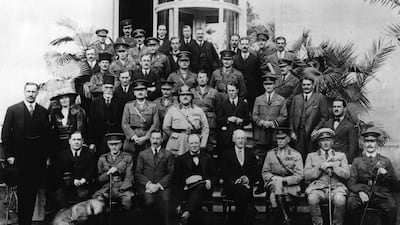
Members of the Mesopotamia Commission pose for a group photo at the Cairo Conference in 1921 in Egypt, where they discussed the future of the Middle East and divided up the countries. General Photographic Agency / Getty -
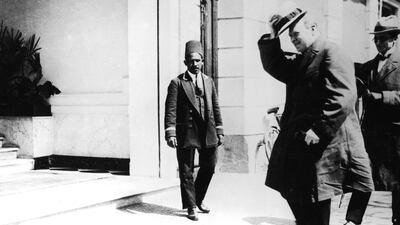
Winston Churchill, who was British Colonial Secretary at the time, in Cairo for the 1921 Cairo conference, at which he helped establish the borders of the modern Middle East. General Photographic Agency / Hulton Archive / Getty -
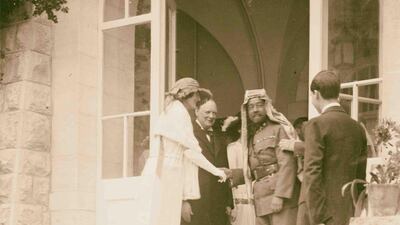
Emir Abdullah of TransJordan shakes hands with Clementine Churchill as Winston Churchill stands by her side at the entrance of Government House in Jerusalem. Alamy -
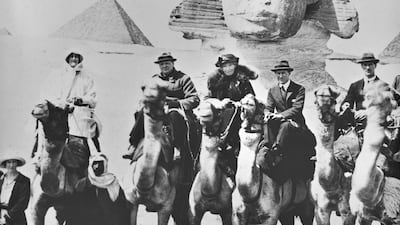
Winston and Clementine Churchill, T E Lawrence and Gertrude Bell on camels in front of the Sphinx in Cairo, Egypt on February 15, 1921. Alamy -

T E Lawrence shakes hands with Emir Abdullah, with other men gathered around behind them. Further meetings of British, Arab, and Bedouin officials were held in Amman, Jordan, in April. Courtesy: Library of Congress, Prints & Photographs Division -
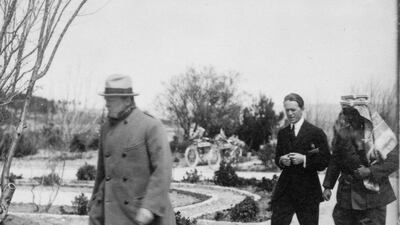
T E Lawrence walks with Emir Abdullah in the garden of Government House in Jerusalem, as Winston Churchill walks ahead, in early 1921. Courtesy: Library of Congress, Prints & Photographs Division -
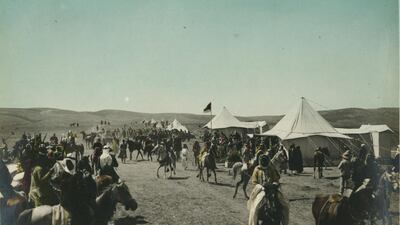
Arab men on horseback in line near tents at Emir Abdullah's camp in Amman. In April 1921, British, Arab and Bedouin officials met in Amman to continue talks. Courtesy: Library of Congress, Prints & Photographs Division -
![(1st Row) Sheikh Sultan ibn Ali Al Adwan of the Belka, Emir Abdullah, Sir Herbert Samuel, Amir Shaker meet in Amman in April, 1921 [Back row: Sir Wyndham Deedes, Albert Abramson, and Maj Somerset]. Courtesy: Library of Congress, Prints & Photographs Division](https://www.thenationalnews.com/resizer/v2/IR4XBAWTH2O7VI3DF2732WBNG4.jpg?auth=5a6fbcebc1a7bc0dd758316a8e8dde77850f0445c6b148654e4f5cddfba3b2b5&smart=true&width=400&height=225)
(1st Row) Sheikh Sultan ibn Ali Al Adwan of the Belka, Emir Abdullah, Sir Herbert Samuel, Amir Shaker meet in Amman in April, 1921 [Back row: Sir Wyndham Deedes, Albert Abramson, and Maj Somerset]. Courtesy: Library of Congress, Prints & Photographs Division -
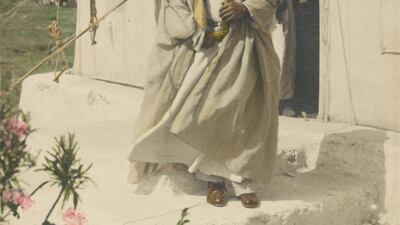
Emir Abdullah in front of his tent in Amman in April 1921, when meetings of British, Arab, and Bedouin officials were held. Courtesy: Library of Congress, Prints & Photographs Division -
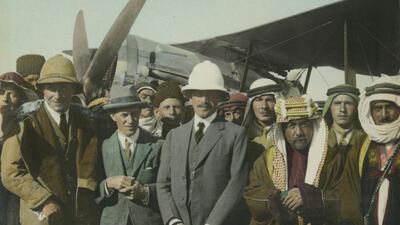
Col T W Lawrence, Sir Herbert Samuel, Emir Abdullah at the on the Aerodrome in Amman in April, 1921. Courtesy: Library of Congress, Prints & Photographs Division -
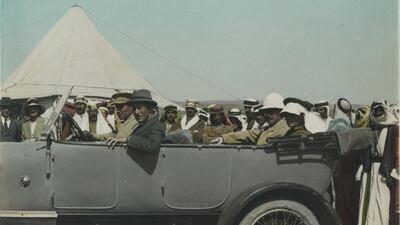
T E Lawrence, Sir Herbert Samuel, and others in an automobile. Meetings of British, Arab, and Bedouin officials in Amman in April 1921. Courtesy: Library of Congress, Prints & Photographs Division


![(1st Row) Sheikh Sultan ibn Ali Al Adwan of the Belka, Emir Abdullah, Sir Herbert Samuel, Amir Shaker meet in Amman in April, 1921 [Back row: Sir Wyndham Deedes, Albert Abramson, and Maj Somerset]. Courtesy: Library of Congress, Prints & Photographs Division](https://www.thenationalnews.com/resizer/v2/IR4XBAWTH2O7VI3DF2732WBNG4.jpg?auth=5a6fbcebc1a7bc0dd758316a8e8dde77850f0445c6b148654e4f5cddfba3b2b5&smart=true&width=800&height=450)



