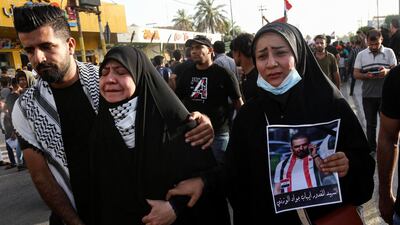
Mourners march in a funeral procession for Iraqi anti-government activist Ihab Al Wazni. AFP

Protesters set wall of Iranian consulate in Karbala on fire


  • English
  • Arabic

Protesters set fire to trailers belonging to Iran’s consulate in Karbala on Sunday, amid widespread anger over the killing of a prominent anti-government activist in the Iraqi city.

Ihab Al Wazni, who was active in the organization of anti-government protests that swept Iraq in October 2019, was shot overnight outside his home by unknown assailants.

His death sparked daylong protests in Karbala that saw demonstrators block roads and bridges with burning tyres.

On Sunday night, dozens of protesters gathered outside the Iranian consulate, burning tyres in front of the building and setting fire to several trailers parked outside, according to police officials and videos posted online.

Similar scenes played out in November 2019 during protests in Baghdad and Iraq’s majority-Shiite provinces in the south, with protesters on at least one occasion scaling concrete barriers ringing the Iranian consulate in Karbala to bring down Iran’s flag and replace it with the Iraqi flag.

The popular protests that began in October 2019 and lasted for months were directed at a postwar political system and a class of elite leaders that Iraqis accuse of pillaging Iraq’s wealth while the country grows poorer.

But protesters have also directed their rage at neighboring Iran and the powerful Iraqi Shiite militias tied to it.

The protests in Karbala, Baghdad and cities across southern Iraq often turned violent, with security forces opening fire and protesters torching government buildings and headquarters of Iran-backed militias. Hundreds were killed, including the assassination of activists.


The rules of the road keeping cyclists safe

Cyclists must wear a helmet, arm and knee pads

Have a white front-light and a back red-light on their bike

They must place a number plate with reflective light to the back of the bike to alert road-users

Avoid carrying weights that could cause the bike to lose balance

They must cycle on designated lanes and areas and ride safe on pavements to avoid bumping into pedestrians

How to avoid crypto fraud
  • Use unique usernames and passwords while enabling multi-factor authentication.
  • Use an offline private key, a physical device that requires manual activation, whenever you access your wallet.
  • Avoid suspicious social media ads promoting fraudulent schemes.
  • Only invest in crypto projects that you fully understand.
  • Critically assess whether a project’s promises or returns seem too good to be true.
  • Only use reputable platforms that have a track record of strong regulatory compliance.
  • Store funds in hardware wallets as opposed to online exchanges.


HER%20FIRST%20PALESTINIAN
%3Cp%3EAuthor%3A%20Saeed%20Teebi%3C%2Fp%3E%0A%3Cp%3EPages%3A%20256%3C%2Fp%3E%0A%3Cp%3EPublisher%3A%C2%A0House%20of%20Anansi%20Press%3C%2Fp%3E%0A
Four tips to secure IoT networks

Mohammed Abukhater, vice president at FireEye in the Middle East, said:

- Keep device software up-to-date. Most come with basic operating system, so users should ensure that they always have the latest version

- Besides a strong password, use two-step authentication. There should be a second log-in step like adding a code sent to your mobile number

- Usually smart devices come with many unnecessary features. Users should lock those features that are not required or used frequently

- Always create a different guest network for visitors

Mercer, the investment consulting arm of US services company Marsh & McLennan, expects its wealth division to at least double its assets under management (AUM) in the Middle East as wealth in the region continues to grow despite economic headwinds, a company official said.

Mercer Wealth, which globally has $160 billion in AUM, plans to boost its AUM in the region to $2-$3bn in the next 2-3 years from the present $1bn, said Yasir AbuShaban, a Dubai-based principal with Mercer Wealth.

Within the next two to three years, we are looking at reaching $2 to $3 billion as a conservative estimate and we do see an opportunity to do so,” said Mr AbuShaban.

Mercer does not directly make investments, but allocates clients’ money they have discretion to, to professional asset managers. They also provide advice to clients.

“We have buying power. We can negotiate on their (client’s) behalf with asset managers to provide them lower fees than they otherwise would have to get on their own,” he added.

Mercer Wealth’s clients include sovereign wealth funds, family offices, and insurance companies among others.

From its office in Dubai, Mercer also looks after Africa, India and Turkey, where they also see opportunity for growth.

Wealth creation in Middle East and Africa (MEA) grew 8.5 per cent to $8.1 trillion last year from $7.5tn in 2015, higher than last year’s global average of 6 per cent and the second-highest growth in a region after Asia-Pacific which grew 9.9 per cent, according to consultancy Boston Consulting Group (BCG). In the region, where wealth grew just 1.9 per cent in 2015 compared with 2014, a pickup in oil prices has helped in wealth generation.

BCG is forecasting MEA wealth will rise to $12tn by 2021, growing at an annual average of 8 per cent.

Drivers of wealth generation in the region will be split evenly between new wealth creation and growth of performance of existing assets, according to BCG.

Another general trend in the region is clients’ looking for a comprehensive approach to investing, according to Mr AbuShaban.

“Institutional investors or some of the families are seeing a slowdown in the available capital they have to invest and in that sense they are looking at optimizing the way they manage their portfolios and making sure they are not investing haphazardly and different parts of their investment are working together,” said Mr AbuShaban.

Some clients also have a higher appetite for risk, given the low interest-rate environment that does not provide enough yield for some institutional investors. These clients are keen to invest in illiquid assets, such as private equity and infrastructure.

“What we have seen is a desire for higher returns in what has been a low-return environment specifically in various fixed income or bonds,” he said.

“In this environment, we have seen a de facto increase in the risk that clients are taking in things like illiquid investments, private equity investments, infrastructure and private debt, those kind of investments were higher illiquidity results in incrementally higher returns.”

The Abu Dhabi Investment Authority, one of the largest sovereign wealth funds, said in its 2016 report that has gradually increased its exposure in direct private equity and private credit transactions, mainly in Asian markets and especially in China and India. The authority’s private equity department focused on structured equities owing to “their defensive characteristics.”

TUESDAY'S ORDER OF PLAY

Centre Court

Starting at 2pm:

Elina Svitolina (UKR) [3] v Jennifer Brady (USA)

Anastasia Pavlyuchenkova (RUS) v Belinda Bencic (SUI [4]

Not before 7pm:

Sofia Kenin (USA) [5] v Elena Rybakina (KAZ)

Maria Sakkari (GRE) v Aryna Sabalenka (BLR) [7]


Court One

Starting at midday:

Karolina Muchova (CZE) v Katerina Siniakova (CZE)

Kristina Mladenovic (FRA) v Aliaksandra Sasnovich (BLR)

Veronika Kudermetova (RUS) v Dayana Yastermska (UKR)

Petra Martic (CRO) [8] v Su-Wei Hsieh (TPE)

Sorana Cirstea (ROU) v Anett Kontaveit (EST)

Results

5pm: Maiden (PA) Dh80,000 (Turf) 1,200m, Winner: ES Rubban, Antonio Fresu (jockey), Ibrahim Aseel (trainer)

5.30pm: Handicap (PA) Dh85,000 (T) 1,200m, Winner: Al Mobher, Sczcepan Mazur, Ibrahim Al Hadhrami

6pm: Handicap (PA) Dh80,000 (T) 2,200m, Winner: Jabalini, Tadhg O’Shea, Ibrahim Al Hadhrami

6.30pm: Wathba Stallions Cup (PA) Dh70,000 (T) 2,200m, Winner: AF Abahe, Tadgh O’Shea, Ernst Oertel

7pm: Handicap (PA) Dh85,000 (T) 1,600m, Winner: AF Makerah, Tadhg O’Shea, Ernst Oertel

7.30pm: Maiden (TB) Dh80,000 (T) 1,600m, Winner: Law Of Peace, Tadhg O’Shea, Satish Seemar

PROFILE

Name: Enhance Fitness 

Year started: 2018 

Based: UAE 

Employees: 200 

Amount raised: $3m 

Investors: Global Ventures and angel investors 

Mia Man’s tips for fermentation

- Start with a simple recipe such as yogurt or sauerkraut

- Keep your hands and kitchen tools clean. Sanitize knives, cutting boards, tongs and storage jars with boiling water before you start.

- Mold is bad: the colour pink is a sign of mold. If yogurt turns pink as it ferments, you need to discard it and start again. For kraut, if you remove the top leaves and see any sign of mold, you should discard the batch.

- Always use clean, closed, airtight lids and containers such as mason jars when fermenting yogurt and kraut. Keep the lid closed to prevent insects and contaminants from getting in.