

The leader of the world's Roman Catholics, Pope Francis, is making a landmark visit to Iraq on March 5.
His trip is meant to send a message of encouragement not only to his 1.3 billion followers, but to Iraqis trying to recover from the war against ISIS while growing disillusioned with their own government.
During the four-day trip, the pontiff is expected to meet Iraq's prime minister, senior religious figures, and members of the Christian-Iraqi community that endured deadly persecution and oppression under ISIS in 2014.
Here is the full itinerary of the trip.
The Pope's schedule in Iraq, in summary:
- Friday, March 5: Arrives in Baghdad
- Saturday, March 6: Najaf, Nassiriya, Ur
- Sunday, March 7: Erbil, Mosul, Qaraqosh
- Monday, March 8: Farewell ceremony at Baghdad's airport
Friday, March 5: Baghdad
Pope Francis begins his four-day trip on Friday.
The pope will arrive at Iraq International Airport, where he will meet Prime Minister Mustafa Al Kadhimi, before a short ride to the Presidential Palace in Baghdad for an official welcoming ceremony.
He will then visit the Church of Our Lady of Salvation, the scene of a 2010 terror attack where six ISIS suicide bombers killed 58 people, including the church's priest.
-

Christians grieve during Mass at Our Lady of Salvation church in Baghdad, Iraq, December 10, 2010. AP Photo -

Iraq's Defence Minister General Abdel Qader Jassim speaks during a news conference outside the Our Lady of Salvation church in Baghdad October 31, 2010. At least seven Iraqi Catholics died on Sunday when police stormed the Baghdad church where gunmen were holding dozens of parishioners hostage, threatening to kill them if Al Qaeda prisoners were not released. Reuters -

Pictures of slain Iraqi Christians are displayed during Mass at Our Lady of Salvation church in Baghdad, Iraq, December 10, 2010. AP Photo -

Residents take part in a funeral for victims of an attack on the Our Lady of Salvation church, in Baghdad November 2, 2010. Reuters -

Residents carry coffins of victims killed in an attack on the Our Lady of Salvation Church, during a funeral at St. Joseph Chaldean Church in Baghdad November 2, 2010. Reuters -

In this mobile phone camera image obtained taken November 2, 2010, the interior of the Our Lady of Salvation church is seen after gunmen took the congregation hostage on Sunday Oct. 31, in Baghdad, Iraq. AP Photo


Saturday, March 6: Najaf, Nassiriya, Ur
Pope Francis will take off the following day to Najaf for a significant meeting with Shiite leader Grand Ayatollah Ali Al Sistani in a bold statement on interreligious tolerance and dialogue.
Mr Al Sistani is six years older than the 84 year-old pope and seen far less frequently. He rarely accepts visitors, although an exception has clearly been made to mark the historic occasion.
-

Shiites gather at the Imam Ali shrine, in the central Iraqi holy city of Najaf, during Ramadan. AFP -

Visitors walk in a hall at the Imam Ali shrine. AFP -
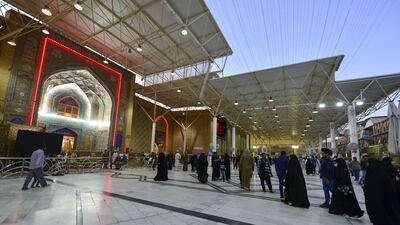
Pope Francis is expected to visit Najaf during his visit to Iraq in March 2021. AFP -

Visitors walk in an archway of the Imam Ali shrine. AFP -

Prayer time at the shrine. AFP -

The economy of the southern Iraqi city of Najaf is dependent on pilgrims. AFP -

A collective Quran reading session at the Imam Ali shrine during Ramadan. AFP -

People arrive at the shrine. After the 2003 US-led invasion that toppled Saddam Hussein's regime, the mosque was the site of several attacks. AFP -

A view of the golden dome of the Imam Ali shrine. It has undergone many renovations over the years. AFP


Emphasising his endorsement of religious tolerance, Pope Francis will next fly to Nassiriya for an interreligious meeting in the ancient Iraqi city of Ur, believed to be the birthplace of Abraham, the patriarch of the three great monotheistic religions.
He will head back to Baghdad on March 6 in time for Mass at the Chaldean Cathedral of Saint Joseph before another important day.
-
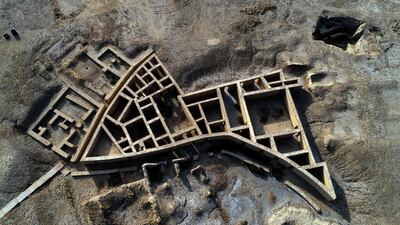
The site where Abraham, the father of three main monotheistic religions – Judaism, Christianity and Islam – is thought to have been born in the ancient city of Ur. Its ruins are in what is now Dhi Qar province, Iraq, about 375 kilometres southeast of Baghdad. AFP -
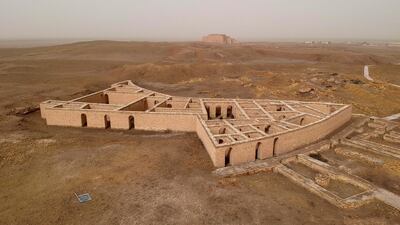
The ancient archaeological site of Ur, traditionally believed to be the birthplace of Abraham, before the planned visit of Pope Francis. Reuters -
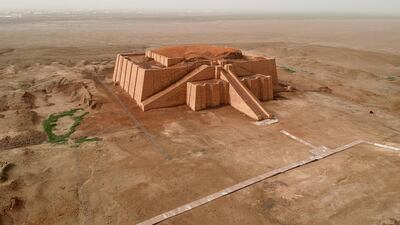
The ancient archaeological site of Ur, traditionally believed to be the birthplace of Abraham, before the planned visit of Pope Francis. Reuters -
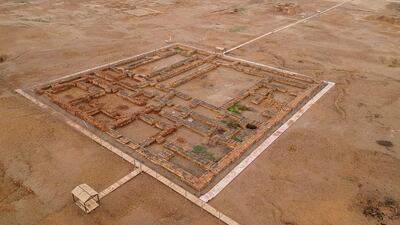
The ancient archaeological site of Ur, traditionally believed to be the birthplace of Abraham, before the planned visit of Pope Francis. Reuters -
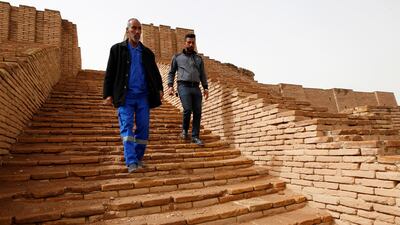
Men walk down the stairs of the Ziggurat of Ur ruins, near Nassiriya, Iraq. Reuters -

The ancient archaeological site of Ur, traditionally believed to be the birthplace of Abraham, near Nassiriya, Iraq. Reuters -
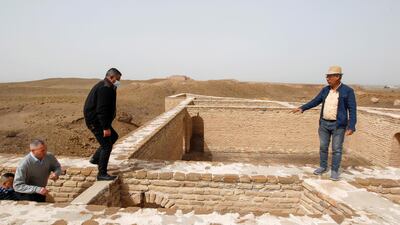
Officials inspect the ancient archaeological site of Ur, near Nassiriya, Iraq, before the planned arrival of Pope Francis. Reuters -
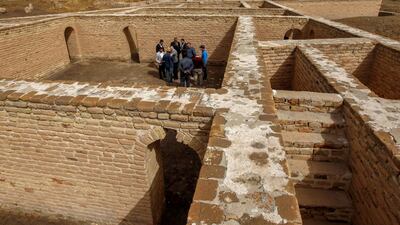
Officials inspect the ancient archaeological site of Ur, near Nassiriya, Iraq, before the planned arrival of Pope Francis. Reuters -
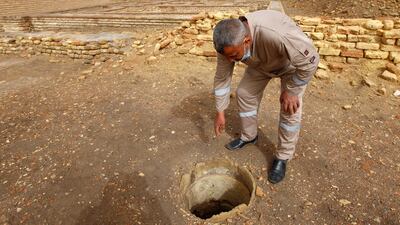
A man inspects the ancient archaeological site of Ur, near Nassiriya, Iraq, before the planned arrival of Pope Francis. Reuters -
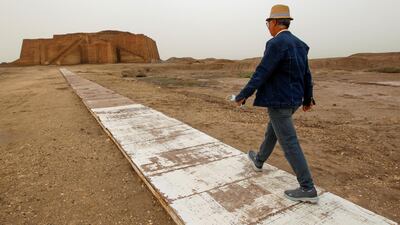
A man walks towards the ancient archaeological site of Ur, near Nassiriya, Iraq, before the planned arrival of Pope Francis. Reuters -
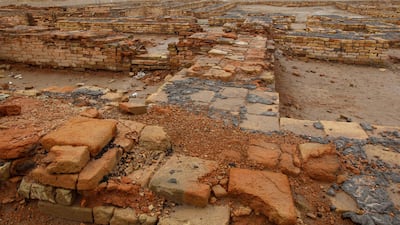
The Ziggurat of Ur ruins, near Nassiriya, Iraq. Reuters -
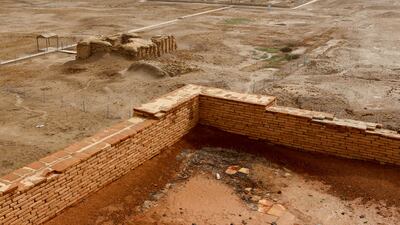
The Ziggurat of Ur ruins, near Nassiriya, Iraq. Reuters -
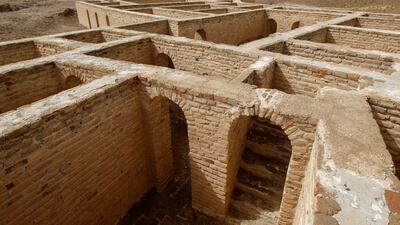
The Ziggurat of Ur ruins, near Nassiriya, Iraq. Reuters -
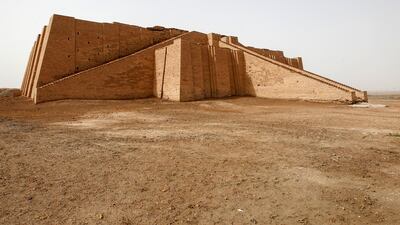
The Ziggurat of Ur ruins, near Nassiriya, Iraq. Reuters -
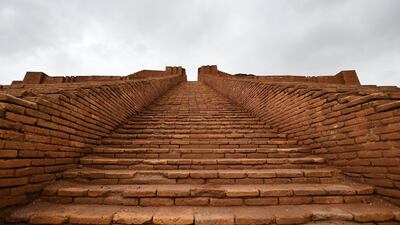
The Great Ziggurat temple, Ur, where Abraham, the father of three main monotheistic religions – Judaism, Christianity and Islam – is thought to have been born in the ancient city of Ur. Its ruins are in what is now Dhi Qar province, Iraq, about 375 kilometres southeast of Baghdad. AFP


Sunday, March 7: Erbil, Mosul, Qaraqosh
On Sunday, March 7, the pope flies to Erbil for a meeting with Kurdish authorities, including the president and prime minister of the Kurdistan Region, who rule over Iraq's largest ethnic minority.
Pope Francis will travel by helicopter to Mosul's Hosh Al Bieaa, which will resound with prayer for the victims of the war against ISIS.
The pope will then head to the heart of Iraqi Christianity in Qaraqosh, where his presence will most strongly resonate for the dwindling community that is at the core of the papal visit.
On his final night in Iraq, Erbil's Franso Hariri football stadium will echo with spirituality as the pope leads Holy Mass.
Monday, March 8: Farewell
Pope Francis will receive a farewell ceremony at Baghdad's airport on Monday morning, before he returns to Rome.
If all goes well, Pope Francis will have created a welcome break in the troubled recent history of a country once considered the beacon of enlightenment in the Middle East.

