Iran's next president will take charge of a country suffering from serious economic problems and bruised by the pandemic, a Chatham House online seminar has heard.
Voter turnout for the election next week is expected to be low, in part because the powerful Guardian Council disqualified many candidates.
In 2018, Donald Trump, then US president, withdrew his country from the 2015 nuclear deal Iran agreed to with world powers.
Iran’s economy suffered and its currency plummeted after Mr Trump imposed heavy sanctions.
The reasons for the disillusionment among people were obvious, said Nazila Fathi, a non-resident fellow at the Middle East Institute.
“Of course, we’ve had the suppressions of 2018, 2019," Ms Fathi said.
"The government has used extreme force and violence to crack down on any kind of dissent.
"People are just fed up. People don’t feel there is a reason for them to take part in the elections or in any other political event that would show support for the regime."
A survey by the government-linked Iranian Students Polling Agency suggested a turnout of only 38 per cent, compared to 73 per cent in 2017, when President Hassan Rouhani was re-elected for his second and final term.
Hardliner Ebrahim Raisi, the head of the Iranian judiciary, is widely regarded as the front-runner.
“Unfortunately, none of the candidates, including Raisi, have been able to offer a policy, a road map or any kind agenda that would describe how they would address these very, very serious concerns that people have,” Ms Fathi said.
Kenneth Katzman, an Iran expert at the Congressional Research Service in Washington, said the debate in America over human rights in Iran would be reignited if Mr Raisi were elected.
Mr Katzman said US factions would regard Mr Raisi's election as justification for American caution in re-entering a nuclear deal with Iran.
Mr Raisi has been accused by Amnesty International of being a leading figure in the state-backed executions of thousands of political prisoners in Iran in 1988.
“If Raisi is elected, that’s going to bring the human rights issue to the fore in the US debate," Mr Katzman said.
"Human rights have not been really at the forefront until now in the debate about whether the US should rejoin the nuclear deal or not.
"It’s mostly focused on Iran’s support for regional armed factions."
Talks in Vienna, Austria, were launched in early April to draw Iran back into compliance. Tehran has repeatedly breached terms of the accord since the renewal of US sanctions.
-

An Iranian vendor watches candidate Saeed Jalili speaking during the first televised debate between Iran presidential candidates, at a shop in Tehran on June 5, 2021. AFP -
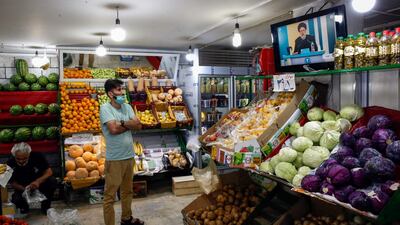
An Iranian man watches candidate Ebrahim Raisi speaking during the first televised debate between presidential candidates, at a fresh produce shop in the capital Tehran, on June 5, 2021. AFP -
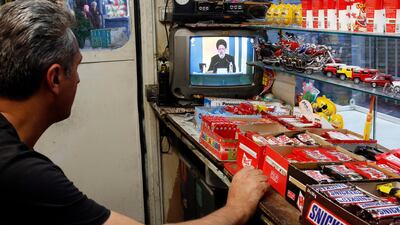
An Iranian man watches the first presidential candidates TV debate as candidate Ebrahim Raisi is speaking, in his shop in Tehran. EPA -
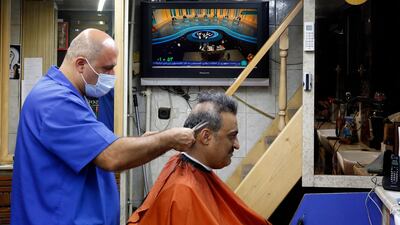
An Iranian hairdresser works as the first presidential candidates' TV debate shows presidential candidate Ebrahim Raisi speaking. EPA -
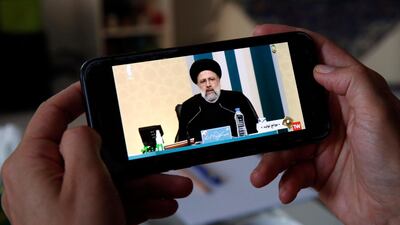
An Iranian woman watches the first presidential candidates TV debate on her phone. EPA -
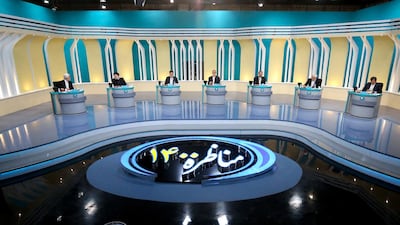
Iranian presidential candidates, Saeed Jalili, Ebrahim Raisi, Amirhossein Ghazizade, Alireza Zakani, Mohsen Rezaie, Mohsen Mehralizadeh, and Abdol Naser Hemati, during the first televised debate between Iran presidential candidates at the Iran State television studio in Tehran. AFP PHOTO /Iranian Young Journalist Club -

Iranian presidential candidate Ebrahim Raisi during the first televised debate between Iran presidential candidates. AFP PHOTO /Iranian Young Journalist Club -
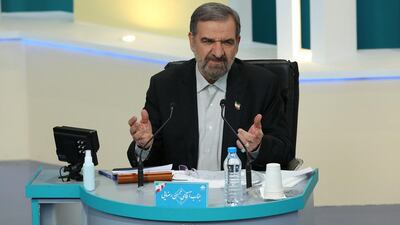
Iranian presidential candidate Mohsen Rezaie during the first televised debate between Iran presidential candidates. AFP PHOTO /Iranian Young Journalist Club -
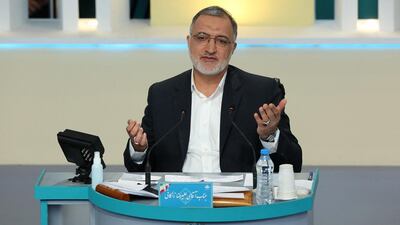
Iranian presidential candidate Alireza Zakani during the first televised debate between Iran presidential candidates. AFP PHOTO /Iranian Young Journalist Club -
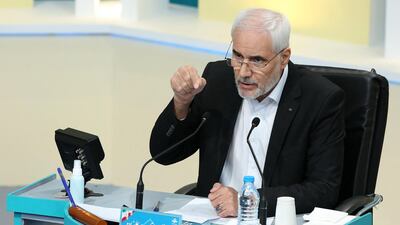
Iranian presidential candidate Mohsen Mehralizadeh during the first televised debate between Iran presidential candidates. AFP PHOTO /Iranian Young Journalist Club -
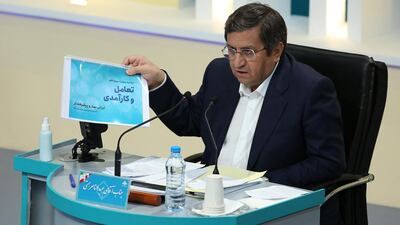
Iranian presidential candidate Abdolnaser Hemati during the first televised debate between Iran presidential candidates. AFP PHOTO /Iranian Young Journalist Club -
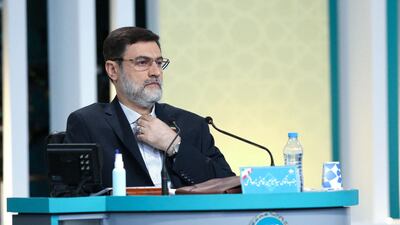
Iranian presidential candidate Amirhossein Ghazizade during the first televised debate between Iran presidential candidates. AFP PHOTO /Iranian Young Journalist Club -

Iranian presidential candidate Said Jalili during the first televised debate between Iran presidential candidates. AFP PHOTO /Iranian Young Journalist Club
Mr Trump’s successor, Joe Biden, wants to return to the deal but only if Iran is compliant. Tehran insists that the sanctions are lifted first.
Mr Katzman said that in Washington, the Iranian elections were not considered a game changer.
Victory for Mr Raisi would not "dramatically" alter Iran’s negotiating position amid continuing talks.
“I point out to people around town, these elections are not for the leader of Iran," Mr Katzman said.
"The leader of Iran is supreme leader Ayatollah Ali Khamenei. He is the leader in practice, as well as in title.
“He is Commander in Chief of the armed forces. He is not shy about stating his positions.
"He has clearly indicated that if the US comes back into compliance with the nuclear deal, Iran would do so. I think we have to take him at his word.”

Mia Man’s tips for fermentation
- Start with a simple recipe such as yogurt or sauerkraut
- Keep your hands and kitchen tools clean. Sanitize knives, cutting boards, tongs and storage jars with boiling water before you start.
- Mold is bad: the colour pink is a sign of mold. If yogurt turns pink as it ferments, you need to discard it and start again. For kraut, if you remove the top leaves and see any sign of mold, you should discard the batch.
- Always use clean, closed, airtight lids and containers such as mason jars when fermenting yogurt and kraut. Keep the lid closed to prevent insects and contaminants from getting in.
History's medical milestones
1799 - First small pox vaccine administered
1846 - First public demonstration of anaesthesia in surgery
1861 - Louis Pasteur published his germ theory which proved that bacteria caused diseases
1895 - Discovery of x-rays
1923 - Heart valve surgery performed successfully for first time
1928 - Alexander Fleming discovers penicillin
1953 - Structure of DNA discovered
1952 - First organ transplant - a kidney - takes place
1954 - Clinical trials of birth control pill
1979 - MRI, or magnetic resonance imaging, scanned used to diagnose illness and injury.
1998 - The first adult live-donor liver transplant is carried out
The specs
Engine: 2.0-litre 4-cyl turbo
Power: 247hp at 6,500rpm
Torque: 370Nm from 1,500-3,500rpm
Transmission: 10-speed auto
Fuel consumption: 7.8L/100km
Price: from Dh94,900
On sale: now
The National's picks
4.35pm: Tilal Al Khalediah
5.10pm: Continous
5.45pm: Raging Torrent
6.20pm: West Acre
7pm: Flood Zone
7.40pm: Straight No Chaser
8.15pm: Romantic Warrior
8.50pm: Calandogan
9.30pm: Forever Young
Brief scores:
Toss: South Africa, chose to field
Pakistan: 177 & 294
South Africa: 431 & 43-1
Man of the Match: Faf du Plessis (South Africa)
Series: South Africa lead three-match series 2-0
Emergency
Director: Kangana Ranaut
Stars: Kangana Ranaut, Anupam Kher, Shreyas Talpade, Milind Soman, Mahima Chaudhry
Rating: 2/5
Racecard
6.35pm: The Madjani Stakes – Group 2 (PA) Dh97,500 (Dirt) 1,900m
7.10pm: Evidenza – Handicap (TB) Dh87,500 (D) 1,200m
7.45pm: The Longines Conquest – Maiden (TB) Dh82,500 (D) 2,000m
8.20: The Longines Elegant – Conditions (TB) Dh82,500 (D)
8.35pm: The Dubai Creek Mile – Listed (TB) Dh132,500 (D) 1,600m
9.30pm: Mirdif Stakes – Conditions (TB) Dh120,000 (D) 1,400m
10.05pm: The Longines Record – Handicap (TB) Dh87,500 (D) 1,900m
'Jurassic%20World%20Dominion'
Brown/Black belt finals
3pm: 49kg female: Mayssa Bastos (BRA) v Thamires Aquino (BRA)
3.07pm: 56kg male: Hiago George (BRA) v Carlos Alberto da Silva (BRA)
3.14pm: 55kg female: Amal Amjahid (BEL) v Bianca Basilio (BRA)
3.21pm: 62kg male: Gabriel de Sousa (BRA) v Joao Miyao (BRA)
3.28pm: 62kg female: Beatriz Mesquita (BRA) v Ffion Davies (GBR)
3.35pm: 69kg male: Isaac Doederlein (BRA) v Paulo Miyao (BRA)
3.42pm: 70kg female: Thamara Silva (BRA) v Alessandra Moss (AUS)
3.49pm: 77kg male: Oliver Lovell (GBR) v Tommy Langarkar (NOR)
3.56pm: 85kg male: Faisal Al Ketbi (UAE) v Rudson Mateus Teles (BRA)
4.03pm: 90kg female: Claire-France Thevenon (FRA) v Gabreili Passanha (BRA)
4.10pm: 94kg male: Adam Wardzinski (POL) v Kaynan Duarte (BRA)
4.17pm: 110kg male: Yahia Mansoor Al Hammadi (UAE) v Joao Rocha (BRA
Who's who in Yemen conflict
Houthis: Iran-backed rebels who occupy Sanaa and run unrecognised government
Yemeni government: Exiled government in Aden led by eight-member Presidential Leadership Council
Southern Transitional Council: Faction in Yemeni government that seeks autonomy for the south
Habrish 'rebels': Tribal-backed forces feuding with STC over control of oil in government territory
Mercer, the investment consulting arm of US services company Marsh & McLennan, expects its wealth division to at least double its assets under management (AUM) in the Middle East as wealth in the region continues to grow despite economic headwinds, a company official said.
Mercer Wealth, which globally has $160 billion in AUM, plans to boost its AUM in the region to $2-$3bn in the next 2-3 years from the present $1bn, said Yasir AbuShaban, a Dubai-based principal with Mercer Wealth.
“Within the next two to three years, we are looking at reaching $2 to $3 billion as a conservative estimate and we do see an opportunity to do so,” said Mr AbuShaban.
Mercer does not directly make investments, but allocates clients’ money they have discretion to, to professional asset managers. They also provide advice to clients.
“We have buying power. We can negotiate on their (client’s) behalf with asset managers to provide them lower fees than they otherwise would have to get on their own,” he added.
Mercer Wealth’s clients include sovereign wealth funds, family offices, and insurance companies among others.
From its office in Dubai, Mercer also looks after Africa, India and Turkey, where they also see opportunity for growth.
Wealth creation in Middle East and Africa (MEA) grew 8.5 per cent to $8.1 trillion last year from $7.5tn in 2015, higher than last year’s global average of 6 per cent and the second-highest growth in a region after Asia-Pacific which grew 9.9 per cent, according to consultancy Boston Consulting Group (BCG). In the region, where wealth grew just 1.9 per cent in 2015 compared with 2014, a pickup in oil prices has helped in wealth generation.
BCG is forecasting MEA wealth will rise to $12tn by 2021, growing at an annual average of 8 per cent.
Drivers of wealth generation in the region will be split evenly between new wealth creation and growth of performance of existing assets, according to BCG.
Another general trend in the region is clients’ looking for a comprehensive approach to investing, according to Mr AbuShaban.
“Institutional investors or some of the families are seeing a slowdown in the available capital they have to invest and in that sense they are looking at optimizing the way they manage their portfolios and making sure they are not investing haphazardly and different parts of their investment are working together,” said Mr AbuShaban.
Some clients also have a higher appetite for risk, given the low interest-rate environment that does not provide enough yield for some institutional investors. These clients are keen to invest in illiquid assets, such as private equity and infrastructure.
“What we have seen is a desire for higher returns in what has been a low-return environment specifically in various fixed income or bonds,” he said.
“In this environment, we have seen a de facto increase in the risk that clients are taking in things like illiquid investments, private equity investments, infrastructure and private debt, those kind of investments were higher illiquidity results in incrementally higher returns.”
The Abu Dhabi Investment Authority, one of the largest sovereign wealth funds, said in its 2016 report that has gradually increased its exposure in direct private equity and private credit transactions, mainly in Asian markets and especially in China and India. The authority’s private equity department focused on structured equities owing to “their defensive characteristics.”
While you're here
The National editorial: Turkey's soft power weighs heavy on Europe's Muslims
Con Coughlin: How extremists use Zoom and other tools to exploit pandemic
Nicky Harley: Peace TV preacher Zakir Naik prompts UK hate laws review
Mobile phone packages comparison
Most sought after workplace benefits in the UAE
- Flexible work arrangements
- Pension support
- Mental well-being assistance
- Insurance coverage for optical, dental, alternative medicine, cancer screening
- Financial well-being incentives
• Remittance charges will be tackled by blockchain
• UAE's monumental and risky Mars Mission to inspire future generations, says minister
• Could the UAE drive India's economy?
• News has a bright future and the UAE is at the heart of it
• Architecture is over - here's cybertecture
• The National announces Future of News journalism competition
• Round up: Experts share their visions of the world to come
HIV on the rise in the region
A 2019 United Nations special analysis on Aids reveals 37 per cent of new HIV infections in the Mena region are from people injecting drugs.
New HIV infections have also risen by 29 per cent in western Europe and Asia, and by 7 per cent in Latin America, but declined elsewhere.
Egypt has shown the highest increase in recorded cases of HIV since 2010, up by 196 per cent.
Access to HIV testing, treatment and care in the region is well below the global average.
Few statistics have been published on the number of cases in the UAE, although a UNAIDS report said 1.5 per cent of the prison population has the virus.
The specs
Team Angel Wolf Beach Blast takes place every Wednesday between 4:30pm and 5:30pm
While you're here
Hussein Ibish: America's attitude to Palestine and Israel has subtly shifted
Con Coughlin: With every missile fired in Israel-Gaza, Biden's clout reduces
Anwar Mhajne: The moral burden of being a Palestinian citizen of Israel
While you're here
Damien McElroy: It's too early to say who will win the vaccine hurdle race
Mustafa Alrawi: To get the 'jab' done, governments must show patience and empathy
Editorial: The fight against Covid-19 should be guided by science
While you're here
Why your domicile status is important
Your UK residence status is assessed using the statutory residence test. While your residence status – ie where you live - is assessed every year, your domicile status is assessed over your lifetime.
Your domicile of origin generally comes from your parents and if your parents were not married, then it is decided by your father. Your domicile is generally the country your father considered his permanent home when you were born.
UK residents who have their permanent home ("domicile") outside the UK may not have to pay UK tax on foreign income. For example, they do not pay tax on foreign income or gains if they are less than £2,000 in the tax year and do not transfer that gain to a UK bank account.
A UK-domiciled person, however, is liable for UK tax on their worldwide income and gains when they are resident in the UK.
Iran's dirty tricks to dodge sanctions
There’s increased scrutiny on the tricks being used to keep commodities flowing to and from blacklisted countries. Here’s a description of how some work.
1 Going Dark
A common method to transport Iranian oil with stealth is to turn off the Automatic Identification System, an electronic device that pinpoints a ship’s location. Known as going dark, a vessel flicks the switch before berthing and typically reappears days later, masking the location of its load or discharge port.
2. Ship-to-Ship Transfers
A first vessel will take its clandestine cargo away from the country in question before transferring it to a waiting ship, all of this happening out of sight. The vessels will then sail in different directions. For about a third of Iranian exports, more than one tanker typically handles a load before it’s delivered to its final destination, analysts say.
3. Fake Destinations
Signaling the wrong destination to load or unload is another technique. Ships that intend to take cargo from Iran may indicate their loading ports in sanction-free places like Iraq. Ships can keep changing their destinations and end up not berthing at any of them.
4. Rebranded Barrels
Iranian barrels can also be rebranded as oil from a nation free from sanctions such as Iraq. The countries share fields along their border and the crude has similar characteristics. Oil from these deposits can be trucked out to another port and documents forged to hide Iran as the origin.
* Bloomberg
Bangladesh tour of Pakistan
January 24 – First T20, Lahore
January 25 – Second T20, Lahore
January 27 – Third T20, Lahore
February 7-11 – First Test, Rawalpindi
April 3 – One-off ODI, Karachi
April 5-9 – Second Test, Karachi
COMPANY%20PROFILE
Company%20profile
Dhadak
Director: Shashank Khaitan
Starring: Janhvi Kapoor, Ishaan Khattar, Ashutosh Rana
Stars: 3
While you're here
Richard Heydarian: Across Asia there are crowds who can't get enough of Donald Trump
C Uday Bhaskar: The 'Asian Century' depends on China and India working together
Sholto Byrnes: Asia's bumpy trade routes are by no means dead-end streets
More from this story
Panipat
Director Ashutosh Gowariker
Produced Ashutosh Gowariker, Rohit Shelatkar, Reliance Entertainment
Cast Arjun Kapoor, Sanjay Dutt, Kriti Sanon, Mohnish Behl, Padmini Kolhapure, Zeenat Aman
Rating 3 /5 stars
MATCH INFO
Rajasthan Royals 158-8 (20 ovs)
Kings XI Punjab 143/7 (20 ovs)
Rajasthan Royals won by 15 runs
More about Middle East geopolitics
Guardians%20of%20the%20Galaxy%20Vol%203
While you're here
Gavin Esler: The Good Friday Agreement teaches us some important lessons
Damien McElroy: Boris must listen to Churchill's comments on Irish divisions
Janine di Giovanni: Track 2 diplomacy key to lasting peace in 21st century
88 Video's most popular rentals
Avengers 3: Infinity War: an American superhero film released in 2018 and based on the Marvel Comics story.
Sholay: a 1975 Indian action-adventure film. It follows the adventures of two criminals hired by police to catch a vagabond. The film was panned on release but is now considered a classic.
Lucifer: is a 2019 Malayalam-language action film. It dives into the gritty world of Kerala’s politics and has become one of the highest-grossing Malayalam films of all time.
War
Director: Siddharth Anand
Cast: Hrithik Roshan, Tiger Shroff, Ashutosh Rana, Vaani Kapoor
Rating: Two out of five stars
TYPES%20OF%20ONLINE%20GIG%20WORK
Global state-owned investor ranking by size
|
1. |
United States |
|
2. |
China |
|
3. |
UAE |
|
4. |
Japan |
|
5 |
Norway |
|
6. |
Canada |
|
7. |
Singapore |
|
8. |
Australia |
|
9. |
Saudi Arabia |
|
10. |
South Korea |
Real estate tokenisation project
Dubai launched the pilot phase of its real estate tokenisation project last month.
The initiative focuses on converting real estate assets into digital tokens recorded on blockchain technology and helps in streamlining the process of buying, selling and investing, the Dubai Land Department said.
Dubai’s real estate tokenisation market is projected to reach Dh60 billion ($16.33 billion) by 2033, representing 7 per cent of the emirate’s total property transactions, according to the DLD.
COMPANY PROFILE
Name: Cofe
Year started: 2018
Based: UAE
Employees: 80-100
Amount raised: $13m
Investors: KISP ventures, Cedar Mundi, Towell Holding International, Takamul Capital, Dividend Gate Capital, Nizar AlNusif Sons Holding, Arab Investment Company and Al Imtiaz Investment Group
The%20Witcher%20-%20season%20three
Read more from Aya Iskandarani
While you're here
While you're here
Con Coughlin: To survive, Nato must renew its sense of common purpose
Gavin Esler: Nato summit failed for making news more than it made deals
Simon Waldman: Nato continues to be Ankara’s best security guarantor
New UK refugee system
- A new “core protection” for refugees moving from permanent to a more basic, temporary protection
- Shortened leave to remain - refugees will receive 30 months instead of five years
- A longer path to settlement with no indefinite settled status until a refugee has spent 20 years in Britain
- To encourage refugees to integrate the government will encourage them to out of the core protection route wherever possible.
- Under core protection there will be no automatic right to family reunion
- Refugees will have a reduced right to public funds
AUSTRALIA SQUAD
Aaron Finch, Matt Renshaw, Brendan Doggett, Michael Neser, Usman Khawaja, Shaun Marsh, Mitchell Marsh, Tim Paine (captain), Travis Head, Marnus Labuschagne, Nathan Lyon, Jon Holland, Ashton Agar, Mitchell Starc, Peter Siddle


