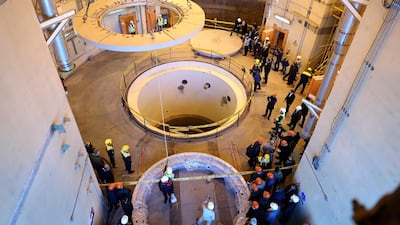
Secretary General of the Arab League Ahmed Aboul Gheit said Iran’s enrichment of uranium to 60 per cent was a clear step towards a nuclear bomb. EPA, Russian Foreign Affairs Ministry

Iran’s 60% enrichment a ‘clear step to a bomb,’ says Arab League head


James Haines-Young
  • English
  • Arabic

Iran’s plans to enrich uranium to 60 per cent is a clear step towards developing nuclear weapons and an extension of Tehran’s destabilising actions in the Middle East, Arab League Secretary General Ahmed Aboul Gheit said.

In response to an attack on an underground Iranian nuclear enrichment facility at Natanz on Sunday, Iran said it would start developing 60 per cent enriched uranium – the highest enrichment the country has ever produced but still short of the 90 per cent needed for a bomb.

“The Secretary General sees a dangerous development in this resolution and a clear and sure step towards developing a nuclear weapon,” the Arab League said late on Wednesday.

“It contributes to increasing doubts about the real goals of the Iranian nuclear program, especially in the absence of need for highly enriched uranium for peaceful uses.”

The step to enrich to 60 per cent is just the latest breach of the 2015 nuclear agreement with world powers, called the Joint Comprehensive Plan of Action, since the US exited the deal and imposed sanctions on Tehran under former president Donald Trump.

  • Iranian President Hassan Rouhani, right, and the head of Atomic Energy Organization of Iran Ali Akbar Salehi inspect the nuclear technology on the occasion of Iran National Nuclear Technology Day in Tehran in 2019. EPA
    Iranian President Hassan Rouhani, right, and the head of Atomic Energy Organization of Iran Ali Akbar Salehi inspect the nuclear technology on the occasion of Iran National Nuclear Technology Day in Tehran in 2019. EPA
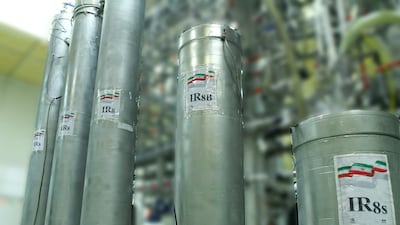
  • IR-8 centrifuges at Natanz nuclear power plant, some 300 kilometres south of capital Tehran. AFP
    IR-8 centrifuges at Natanz nuclear power plant, some 300 kilometres south of capital Tehran. AFP
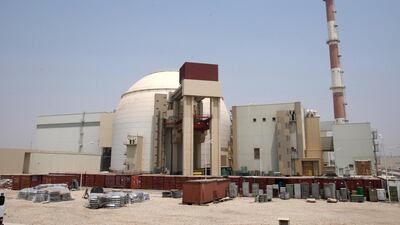
  • The Iranian nuclear power plant in Bushehr in 2010. EPA
    The Iranian nuclear power plant in Bushehr in 2010. EPA
  • Salehi speaks with media while visiting Natanz enrichment facility, in central Iran in 2019. Atomic Energy Organization of Iran via AP
    Salehi speaks with media while visiting Natanz enrichment facility, in central Iran in 2019. Atomic Energy Organization of Iran via AP
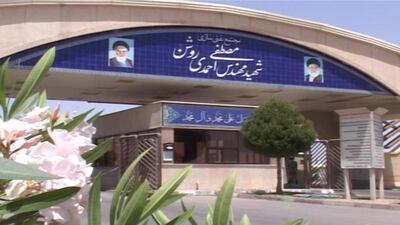
  • The gate of Natanz nuclear power plant in Natanz , Isfahan province, in 2019. EPA
    The gate of Natanz nuclear power plant in Natanz , Isfahan province, in 2019. EPA
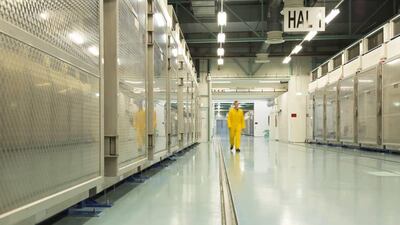
  • Inside of the Iran's Fordow nuclear facility, in Fordow, Qom province in 2019. EPA
    Inside of the Iran's Fordow nuclear facility, in Fordow, Qom province in 2019. EPA
  • Technicians work at the Arak heavy water reactor's secondary circuit, as officials and media visit the site, near Arak, Iran in 2019. Atomic Energy Organization of Iran via AP
    Technicians work at the Arak heavy water reactor's secondary circuit, as officials and media visit the site, near Arak, Iran in 2019. Atomic Energy Organization of Iran via AP
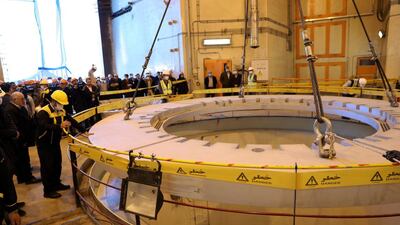
  • Members of the media and officials tour the water nuclear reactor at Arak in 2019. WANA via Reuters
    Members of the media and officials tour the water nuclear reactor at Arak in 2019. WANA via Reuters
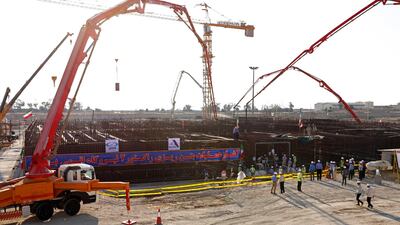
  • Concrete is poured for the base of the second nuclear power reactor at Bushehr plant in 2019. Atomic Energy Organization of Iran via AP
    Concrete is poured for the base of the second nuclear power reactor at Bushehr plant in 2019. Atomic Energy Organization of Iran via AP

The Arab League also said that the move illustrates the importance of including Arab countries in the dialogue process around the nuclear deal and sharing the region’s concerns about “Iran's destabilising policies and ongoing intervention in the internal affairs of the Arab countries.”

Iranian President Hassan Rouhani said on Thursday that the country was capable of enriching uranium to a weapons-grade 90 per cent but that they were not seeking a bomb.

"Our nuclear programme is peaceful and we are not looking for a bomb," he said, adding that the US are the ones with a history of using atomic bombs, referencing US actions in Japan in 1945.

Iran has long denied seeking to make an atomic weapon and a US intelligence report on Tuesday maintained Washington’s assessment that “Iran is not currently undertaking the key nuclear weapons-development activities that we judge would be necessary to produce a nuclear device.”

However, Washington has blasted the Iranian move to enrich up to 60 per cent.

Iran previously said it could use uranium enriched up to 60 per cent for nuclear-powered ships – something it doesn’t currently possess.

Europe has called signatories to the JCPOA to Vienna to mediate between Tehran and Washington on how to return to the terms of the agreement that curtails Iran’s enrichment with strict oversight in exchange for sanctions relief.

Iran demands that the US lift all sanctions before it will return to the agreement, which limits stockpiles and prevents enrichment over 3.76 per cent. Washington, on the other hand, demands Iran return to the deal before it lifts sanctions.


Ten tax points to be aware of in 2026

1. Domestic VAT refund amendments: request your refund within five years

If a business does not apply for the refund on time, they lose their credit.

2. E-invoicing in the UAE

Businesses should continue preparing for the implementation of e-invoicing in the UAE, with 2026 a preparation and transition period ahead of phased mandatory adoption. 

3. More tax audits

Tax authorities are increasingly using data already available across multiple filings to identify audit risks. 

4. More beneficial VAT and excise tax penalty regime

Tax disputes are expected to become more frequent and more structured, with clearer administrative objection and appeal processes. The UAE has adopted a new penalty regime for VAT and excise disputes, which now mirrors the penalty regime for corporate tax.

5. Greater emphasis on statutory audit

There is a greater need for the accuracy of financial statements. The International Financial Reporting Standards standards need to be strictly adhered to and, as a result, the quality of the audits will need to increase.

6. Further transfer pricing enforcement

Transfer pricing enforcement, which refers to the practice of establishing prices for internal transactions between related entities, is expected to broaden in scope. The UAE will shortly open the possibility to negotiate advance pricing agreements, or essentially rulings for transfer pricing purposes. 

7. Limited time periods for audits

Recent amendments also introduce a default five-year limitation period for tax audits and assessments, subject to specific statutory exceptions. While the standard audit and assessment period is five years, this may be extended to up to 15 years in cases involving fraud or tax evasion. 

8. Pillar 2 implementation 

Many multinational groups will begin to feel the practical effect of the Domestic Minimum Top-Up Tax (DMTT), the UAE's implementation of the OECD’s global minimum tax under Pillar 2. While the rules apply for financial years starting on or after January 1, 2025, it is 2026 that marks the transition to an operational phase.

9. Reduced compliance obligations for imported goods and services

Businesses that apply the reverse-charge mechanism for VAT purposes in the UAE may benefit from reduced compliance obligations. 

10. Substance and CbC reporting focus

Tax authorities are expected to continue strengthening the enforcement of economic substance and Country-by-Country (CbC) reporting frameworks. In the UAE, these regimes are increasingly being used as risk-assessment tools, providing tax authorities with a comprehensive view of multinational groups’ global footprints and enabling them to assess whether profits are aligned with real economic activity. 

Contributed by Thomas Vanhee and Hend Rashwan, Aurifer

MATCH INFO

Uefa Champions League semi-final, first leg
Bayern Munich v Real Madrid

When: April 25, 10.45pm kick-off (UAE)
Where: Allianz Arena, Munich
Live: BeIN Sports HD
Second leg: May 1, Santiago Bernabeu, Madrid

The Perfect Couple

Starring: Nicole Kidman, Liev Schreiber, Jack Reynor

Creator: Jenna Lamia

Rating: 3/5

Jetour T1 specs

Engine: 2-litre turbocharged

Power: 254hp

Torque: 390Nm

Price: From Dh126,000

Available: Now

The five pillars of Islam

1. Fasting

2. Prayer

3. Hajj

4. Shahada

5. Zakat 

COMPANY PROFILE
Name: HyperSpace
 
Started: 2020
 
Founders: Alexander Heller, Rama Allen and Desi Gonzalez
 
Based: Dubai, UAE
 
Sector: Entertainment 
 
Number of staff: 210 
 
Investment raised: $75 million from investors including Galaxy Interactive, Riyadh Season, Sega Ventures and Apis Venture Partners
Who's who in Yemen conflict

Houthis: Iran-backed rebels who occupy Sanaa and run unrecognised government

Yemeni government: Exiled government in Aden led by eight-member Presidential Leadership Council

Southern Transitional Council: Faction in Yemeni government that seeks autonomy for the south

Habrish 'rebels': Tribal-backed forces feuding with STC over control of oil in government territory

ARGYLLE
%3Cp%3EDirector%3A%20Matthew%20Vaughn%3C%2Fp%3E%0A%3Cp%3EStarring%3A%20Bryce%20Dallas%20Howard%2C%20Sam%20Rockwell%2C%20John%20Cena%3C%2Fp%3E%0A%3Cp%3ERating%3A%203%2F5%3C%2Fp%3E%0A
The years Ramadan fell in May

1987

1954

1921

1888

Try out the test yourself

Q1 Suppose you had $100 in a savings account and the interest rate was 2 per cent per year. After five years, how much do you think you would have in the account if you left the money to grow?
a) More than $102
b) Exactly $102
c) Less than $102
d) Do not know
e) Refuse to answer

Q2 Imagine that the interest rate on your savings account was 1 per cent per year and inflation was 2 per cent per year. After one year, how much would you be able to buy with the money in this account?
a) More than today
b) Exactly the same as today
c) Less than today
d) Do not know
e) Refuse to answer

Q4 Do you think that the following statement is true or false? “Buying a single company stock usually provides a safer return than a stock mutual fund.”
a) True
b) False
d) Do not know
e) Refuse to answer

The “Big Three” financial literacy questions were created by Professors Annamaria Lusardi of the George Washington School of Business and Olivia Mitchell, of the Wharton School of the University of Pennsylvania. 

Answers: Q1 More than $102 (compound interest). Q2 Less than today (inflation). Q3 False (diversification).