
Iran now has two cascades of advanced centrifuges with almost four times the enrichment capacity of earlier ones running at its Natanz nuclear site, its envoy to the UN's atomic watchdog said on Tuesday.
"Thanks to our diligent nuclear scientists, two cascades of 348 IR2m centrifuges with almost four times the capacity of IR1 are now running ... successfully in Natanz," Kazem Gharibabadi said on Twitter. "Installation of two cascades of IR6 centrifuges has also been started in Fordow. There's more to come soon."
-
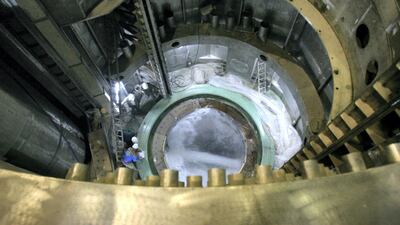
Russian contractors work at the Bushehr nuclear reactor site in 2007. The plant opened four years later. Bloomberg -
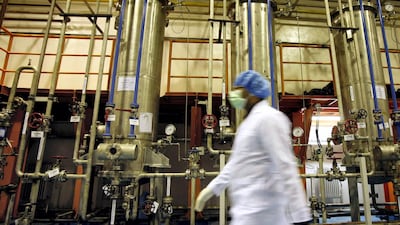
An Iranian technician at the International Atomic Energy Agency inspects the country's Isfahan plant in 2007. Tehran is no longer co-operating with the agency at nuclear sites across the country. EPA -

Workers wait to begin constructing a second reactor at the Bushehr nuclear power plant in 2019. AFP -
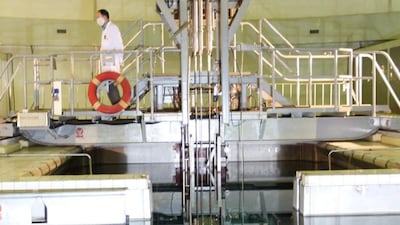
A metal-encased rod with 20 per cent enriched nuclear fuel is inserted into a reactor in Tehran in 2012. AFP -
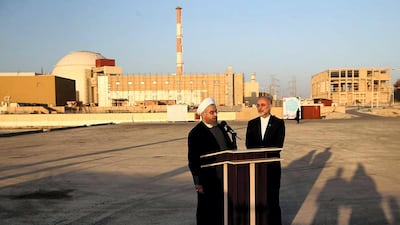
Fomer Iranian President Hassan Rouhani and the country's Atomic Energy Organisation chief Ali Akbar Salehi speak at the Bushehr nuclear site in 2015. AFP -
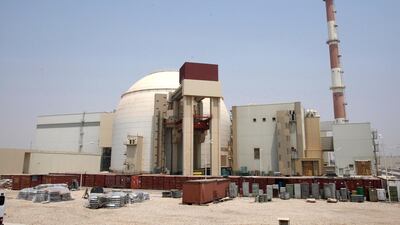
Iran's Bushehr nuclear plant has been restarted. EPA -
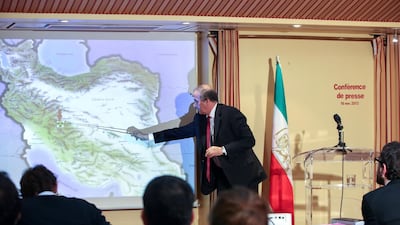
Mehdi Abrichamtchi, chairman of the Peace and Security Committee at the National Council of Resistance of Iran, shows journalists the location of a secret nuclear site in Iran in 2013. AFP -
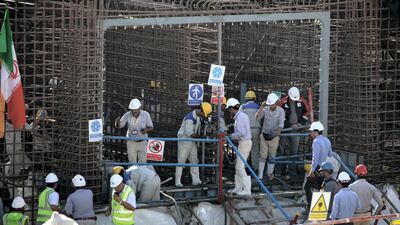
Workers prepare to begin the construction of a second reactor at the Bushehr site. AFP


The announcement, likely intended to accelerate talks on a potential nuclear deal, could backfire on Tehran if Washington perceives the move as tantamount to blackmail, something the former administration of Donald Trump said was one of the goals of the Iranian regime.
The move to accelerate uranium enrichment has been some time in the making.
In 2019, the IAEA said Iran had begun enrichment with advanced centrifuges at an above-ground pilot plant at Natanz. A part of that site was destroyed in July, an act of sabotage that analysts and the Iranian government was conducted by Israel.
By the time of the sabotage, Iran had already started moving three cascades, or clusters, of advanced centrifuges to the underground plant. In November, the IAEA said Iran had fed uranium hexafluoride gas feedstock into the first of those underground cascades.
Iran’s Parliament also passed legislation in November mandating the accelerated enrichment of uranium to 20 per cent purity. A larger stockpile of this uranium would be required for Iran to obtain a nuclear weapon, by converting it into "weapons grade" purity. This development subsequently triggered warnings from Israel.
On January 27, Israeli General Aviv Kohavi warned that because of Iran's accelerated enrichment plans, Israel was prepared to take military action to stop further nuclear development.
"In light of this fundamental analysis, I have instructed the Israeli [military] to prepare a number of operational plans, in addition to those already in place," he said, in a speech at the Tel Aviv University Institute for National Security Studies.

