• A boy rides his bicycle amid the rubble of destroyed homes in Beit Hanoun, Gaza. Getty
    A boy rides his bicycle amid the rubble of destroyed homes in Beit Hanoun, Gaza. Getty
  • Life resumes amid the rubble of destroyed homes in Beit Hanoun, Gaza. Getty
    Life resumes amid the rubble of destroyed homes in Beit Hanoun, Gaza. Getty
  • A Palestinian man tries to put his home back in order after Israeli air strikes on Beit Hanoun, Gaza. Getty
    A Palestinian man tries to put his home back in order after Israeli air strikes on Beit Hanoun, Gaza. Getty
  • A Palestinian girl stands amid the rubble of her destroyed home in Beit Hanoun, Gaza. Getty
    A Palestinian girl stands amid the rubble of her destroyed home in Beit Hanoun, Gaza. Getty
  • A Palestinian woman puts her house back in order after Israeli aerial raids over the past couple of weeks in Beit Hanoun, Gaza. Getty
    A Palestinian woman puts her house back in order after Israeli aerial raids over the past couple of weeks in Beit Hanoun, Gaza. Getty
  • Life resumes amid the rubble of destroyed homes in Beit Hanoun, Gaza. Getty
    Life resumes amid the rubble of destroyed homes in Beit Hanoun, Gaza. Getty
  • Palestinian children resume life amid the rubble of destroyed homes in Beit Hanoun, Gaza. Getty
    Palestinian children resume life amid the rubble of destroyed homes in Beit Hanoun, Gaza. Getty
  • Palestinians in Gaza city sit in a tent set up on top of the ruins of a building destroyed in Israeli air strikes. Getty
    Palestinians in Gaza city sit in a tent set up on top of the ruins of a building destroyed in Israeli air strikes. Getty
  • Palestinians sit in a tent that has been set up on top of the ruins of a building destroyed in recent Israeli air strikes, in Gaza city. AFP
    Palestinians sit in a tent that has been set up on top of the ruins of a building destroyed in recent Israeli air strikes, in Gaza city. AFP
  • A Palestinian child attends a rally in Gaza city amid the ruins of houses destroyed by Israeli strikes. AFP
    A Palestinian child attends a rally in Gaza city amid the ruins of houses destroyed by Israeli strikes. AFP

Humanitarian assistance alone cannot stop the next Gaza war, says UNRWA head


James Haines-Young
  • English
  • Arabic

After the latest Gaza war, the international community needs to engage in concerted efforts to revive the Arab-Israeli peace process, UNRWA head Philippe Lazzarini said on Tuesday.

It must help to break the cycle of violence for good, he told The National.

“We have to show to the people that there can be a different future than the one to just expect the fifth round of a deadly conflict,” he said.

“I genuinely believe that providing humanitarian assistance will not be enough to prevent a new cycle of violence in Gaza.”

The head of the UN agency for Palestinians was on the ground in Gaza as soon as the ceasefire halted 11 days of rocket fire and air strikes on May 21 to assess the damage and look at deploying emergency assistance.

The fourth conflict between Hamas and Israel since 2006 left at least 248 dead in Gaza – mostly civilians including at least 66 children – and 12 dead in Israel, including two children.

“I have really been struck by how deeply, deeply shaken the people in Gaza have been after this 11 days of bombardment – they all basically described hell on earth and they were eloquently expressing their constant, gripping fear during these 11 days of relentless bombardment,” he said.

“All the people I met – whether the staff at the hospital or in the camps or in the schools – we're all having stories about how they were handling this feeling of terror. [They were] constantly wondering if they would survive, constantly wondering if their children would survive, people trying to … make this kind of choices at night, whether they should all sleep together or if they should be scattered,” Mr Lazzarini added.

Mr Lazzarini said the agency’s 13,000 Palestinian staff in Gaza were working to get the provision of government level services from education to healthcare to basic provisions running again as quickly as possible.

During the conflict, more than 70,000 people displaced from their homes by the fighting sought refuge in UNRWA schools in the strip. Only a few hundred whose homes were damaged or are unable to go back remain but Mr Lazzarini said that work was needed to turn spaces back into classrooms and get children back to school before the summer holiday.

“In Gaza, we have multiple priorities right now – the damage assessment has to go ahead and we have also to prepare our school to allow kids to come back. … The Covid response will be a top priority also and the assessment of the damages on the shelters and home of the Palestinian refugees.”

UNRWA will also try, Mr Lazzarini said, to provide “psychosocial support, not only to the population, and to the refugees, but also to our 13,000 staff who will also play an important role in supporting the community.”

Mr Lazzarini also warned that even as the focus was on the immediacy of the war, Covid-19 remained “omnipresent” in Gaza while a new surge in cases was likely with both prevention measures and vaccinations “put on hold”.

Gaza’s lab to processes PCR tests is operational again after being damaged in the fighting, Mr Lazzarini said, but time would tell if the displacement centres and people sheltering from air strikes led to super spreader events.

“We need to increase the availability and the accessibility of vaccine in the Gaza Strip … There is no doubt the vaccination coverage right now is far too low, to prevent the new surges of Covid,” he said.

For years, UNRWA has faced an acute shortage of funds to run day-to-day operations for Palestinians not just in Gaza and the West Bank but across the Middle East.

Mr Lazzarini said that the financial situation today was better than just a few months ago when basic salaries were at risk and an emergency appeal is looking to fill the gap from the new acute needs.

“The backbone of UNRWA is our staff – our health workers, our doctors, our teacher, our engineers. So, whenever there is an emergency, they are our front-liners, hence the importance to have our core budget fully supported,” he said.

“Then, obviously, in emergencies like this one, you have additional order needs emerging – we were talking about the psychosocial support, we were talking about shelter and houses being damaged. Palestine refugees having lost their livelihood, all this needs to be restored,” he said.

“It goes two-prong – the importance of fully funding our core budget so that … our assets (being primarily our human resources) can continue to play this front-line role and after that this emergency appeal came out to cover the additional needs triggered by this last cycle of violence.”

Mr Lazzarini said that the agency is still assessing the reconstruction needs in the strip, with early assessments expected later this week, and there is no word yet on a dedicated emergency donor summit.

But, he said, there are “already a number of countries indicating the willingness to support the appeal of UNRWA”.

Israel has been clear that it wants to ensure that Hamas, which controls the Gaza Strip, has no hand in reconstruction and is not able to siphon off resources for military use. Asked about this, Mr Lazzarini said, “UNRWA is a director implementer and, basically, whatever UNRWA provides in the Gaza Strip is being provided to the Palestinian refugees directly.”

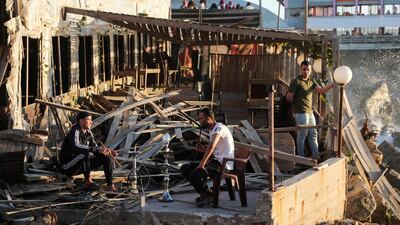
  • Palestinians smoke a shisha pipe at the site of an Israeli air strike in the Gaza Strip. A ceasefire was announced on Friday. Reuters
    Palestinians smoke a shisha pipe at the site of an Israeli air strike in the Gaza Strip. A ceasefire was announced on Friday. Reuters
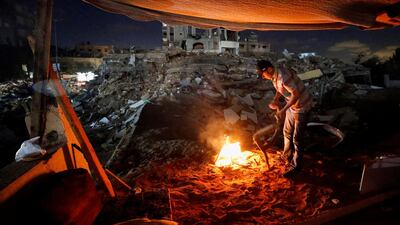
  • A Palestinian man lights a fire amid the rubble of his house in the Gaza Strip, which was destroyed by an Israeli air attack. Reuters
    A Palestinian man lights a fire amid the rubble of his house in the Gaza Strip, which was destroyed by an Israeli air attack. Reuters
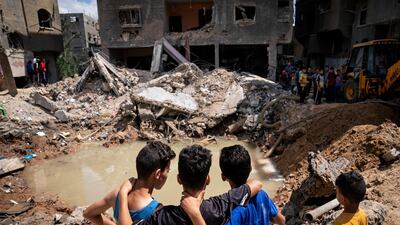
  • Children survey a water-filled crater where a home was destroyed by an Israeli air strike in the northern Gaza Strip. AP Photo
    Children survey a water-filled crater where a home was destroyed by an Israeli air strike in the northern Gaza Strip. AP Photo
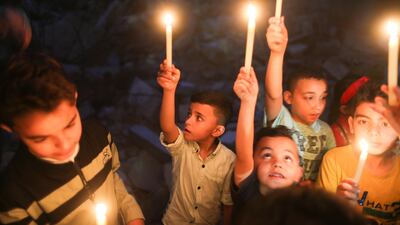
  • Children hold candles at the site of a house that was destroyed by Israeli air strikes during the recent Israeli-Palestinian fighting, in Gaza. Reuters
    Children hold candles at the site of a house that was destroyed by Israeli air strikes during the recent Israeli-Palestinian fighting, in Gaza. Reuters
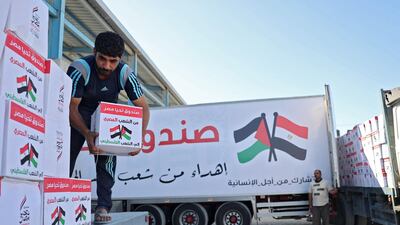
  • A Palestinian man unloads boxes of aid from an Egyptian lorry at the Rafah border crossing, which connects the Gaza Strip to Egypt. AFP
    A Palestinian man unloads boxes of aid from an Egyptian lorry at the Rafah border crossing, which connects the Gaza Strip to Egypt. AFP
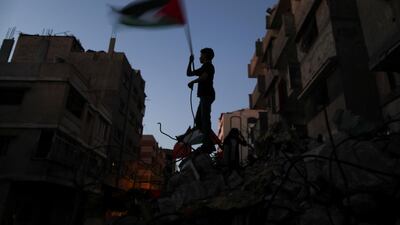
  • A boy waves a Palestinian flag at a site damaged by Israeli air strikes in Gaza. Reuters
    A boy waves a Palestinian flag at a site damaged by Israeli air strikes in Gaza. Reuters
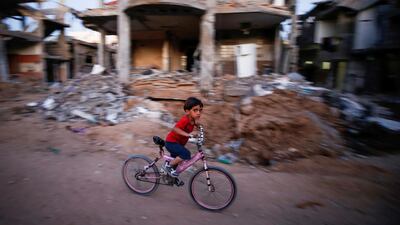
  • A bicycle ride near the rubble of a house in Gaza that was destroyed during the Israeli-Palestinian conflict. Reuters
    A bicycle ride near the rubble of a house in Gaza that was destroyed during the Israeli-Palestinian conflict. Reuters
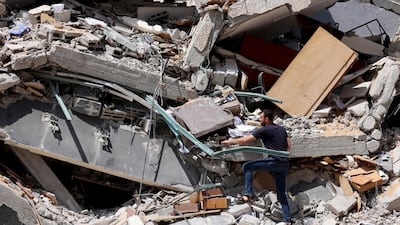
  • A Palestinian man sifts through the debris of the Al Jalaa tower, which housed media organisations and was destroyed by Israeli air strikes in Gaza city. AFP
    A Palestinian man sifts through the debris of the Al Jalaa tower, which housed media organisations and was destroyed by Israeli air strikes in Gaza city. AFP
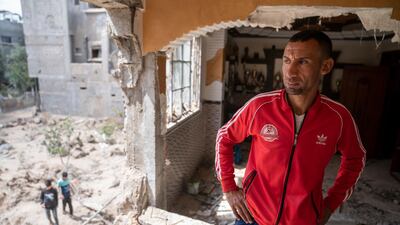
  • Nader Al Masri, a Palestinian long-distance runner who competed in the 2008 Olympics. His home in the northern Gaza Strip was severely damaged in an Israeli air strike. AP Photo
    Nader Al Masri, a Palestinian long-distance runner who competed in the 2008 Olympics. His home in the northern Gaza Strip was severely damaged in an Israeli air strike. AP Photo
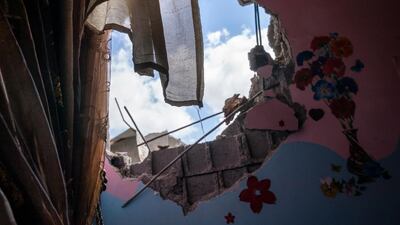
  • An Israeli air strike blew this hole in the wall of a child's room in Beit Hanoun, the northern Gaza Strip. AP Photo
    An Israeli air strike blew this hole in the wall of a child's room in Beit Hanoun, the northern Gaza Strip. AP Photo

Through the agency’s local staff, UNRWA is trying to ensure that the basic needs of nearly 2 million people in Gaza are met.

But, he said, the broader aspirations could only be addressed with a political agreement – on such matters as the 14-year blockade on Gaza.

“I think the blockade definitely needs to be addressed and lifted, you cannot have a normal life if your life is limited in such a narrow geographical space for such a dense population, normal life and normal economic activities requires the lifting of the blockade,” he said.

“I heard people saying ‘but we want nothing else than normal life, we don't understand any more what is going on? … Our dreams are not different than anyone else anywhere else in the world.’ And I think this is quite fundamental and central on the issue of dealing and healing this deeper psychological trauma which has really affected, in a very widespread way, the population in Gaza.”


Ten tax points to be aware of in 2026

1. Domestic VAT refund amendments: request your refund within five years

If a business does not apply for the refund on time, they lose their credit.

2. E-invoicing in the UAE

Businesses should continue preparing for the implementation of e-invoicing in the UAE, with 2026 a preparation and transition period ahead of phased mandatory adoption. 

3. More tax audits

Tax authorities are increasingly using data already available across multiple filings to identify audit risks. 

4. More beneficial VAT and excise tax penalty regime

Tax disputes are expected to become more frequent and more structured, with clearer administrative objection and appeal processes. The UAE has adopted a new penalty regime for VAT and excise disputes, which now mirrors the penalty regime for corporate tax.

5. Greater emphasis on statutory audit

There is a greater need for the accuracy of financial statements. The International Financial Reporting Standards standards need to be strictly adhered to and, as a result, the quality of the audits will need to increase.

6. Further transfer pricing enforcement

Transfer pricing enforcement, which refers to the practice of establishing prices for internal transactions between related entities, is expected to broaden in scope. The UAE will shortly open the possibility to negotiate advance pricing agreements, or essentially rulings for transfer pricing purposes. 

7. Limited time periods for audits

Recent amendments also introduce a default five-year limitation period for tax audits and assessments, subject to specific statutory exceptions. While the standard audit and assessment period is five years, this may be extended to up to 15 years in cases involving fraud or tax evasion. 

8. Pillar 2 implementation 

Many multinational groups will begin to feel the practical effect of the Domestic Minimum Top-Up Tax (DMTT), the UAE's implementation of the OECD’s global minimum tax under Pillar 2. While the rules apply for financial years starting on or after January 1, 2025, it is 2026 that marks the transition to an operational phase.

9. Reduced compliance obligations for imported goods and services

Businesses that apply the reverse-charge mechanism for VAT purposes in the UAE may benefit from reduced compliance obligations. 

10. Substance and CbC reporting focus

Tax authorities are expected to continue strengthening the enforcement of economic substance and Country-by-Country (CbC) reporting frameworks. In the UAE, these regimes are increasingly being used as risk-assessment tools, providing tax authorities with a comprehensive view of multinational groups’ global footprints and enabling them to assess whether profits are aligned with real economic activity. 

Contributed by Thomas Vanhee and Hend Rashwan, Aurifer

Ain Dubai in numbers

126: The length in metres of the legs supporting the structure

1 football pitch: The length of each permanent spoke is longer than a professional soccer pitch

16 A380 Airbuses: The equivalent weight of the wheel rim.

9,000 tonnes: The amount of steel used to construct the project.

5 tonnes: The weight of each permanent spoke that is holding the wheel rim in place

192: The amount of cable wires used to create the wheel. They measure a distance of 2,4000km in total, the equivalent of the distance between Dubai and Cairo.

Winners

Ballon d’Or (Men’s)
Ousmane Dembélé (Paris Saint-Germain / France)

Ballon d’Or Féminin (Women’s)
Aitana Bonmatí (Barcelona / Spain)

Kopa Trophy (Best player under 21 – Men’s)
Lamine Yamal (Barcelona / Spain)

Best Young Women’s Player
Vicky López (Barcelona / Spain)

Yashin Trophy (Best Goalkeeper – Men’s)
Gianluigi Donnarumma (Paris Saint-Germain and Manchester City / Italy)

Best Women’s Goalkeeper
Hannah Hampton (England / Aston Villa and Chelsea)

Men’s Coach of the Year
Luis Enrique (Paris Saint-Germain)

Women’s Coach of the Year
Sarina Wiegman (England)

Avatar: Fire and Ash

Director: James Cameron

Starring: Sam Worthington, Sigourney Weaver, Zoe Saldana

Rating: 4.5/5

APPLE IPAD MINI (A17 PRO)

Display: 21cm Liquid Retina Display, 2266 x 1488, 326ppi, 500 nits

Chip: Apple A17 Pro, 6-core CPU, 5-core GPU, 16-core Neural Engine

Storage: 128/256/512GB

Main camera: 12MP wide, f/1.8, digital zoom up to 5x, Smart HDR 4

Front camera: 12MP ultra-wide, f/2.4, Smart HDR 4, full-HD @ 25/30/60fps

Biometrics: Touch ID, Face ID

Colours: Blue, purple, space grey, starlight

In the box: iPad mini, USB-C cable, 20W USB-C power adapter

Price: From Dh2,099

Sly%20Cooper%20and%20the%20Thievius%20Raccoonus
%3Cp%3E%3Cstrong%3EDeveloper%3A%3C%2Fstrong%3E%20Sucker%20Punch%20Productions%3Cbr%3E%3Cstrong%3EPublisher%3A%3C%2Fstrong%3E%20Sony%20Computer%20Entertainment%3Cbr%3E%3Cstrong%3EConsole%3A%3C%2Fstrong%3E%20PlayStation%202%20to%205%3Cbr%3E%3Cstrong%3ERating%3A%3C%2Fstrong%3E%205%2F5%3C%2Fp%3E%0A
Results

6.30pm: Mazrat Al Ruwayah – Group 2 (PA) $36,000 (Dirt) 1,600m, Winner: RB Money To Burn, Tadhg O’Shea (jockey), Eric Lemartinel (trainer)

7.05pm: Handicap (TB) $68,000 (Turf) 2,410m, Winner: Star Safari, William Buick, Charlie Appleby

7.40pm: Meydan Trophy – Conditions (TB) $50,000 (T) 1,900m, Winner: Secret Protector, William Buick, Charlie Appleby

8.15pm: Al Maktoum Challenge Round 2 - Group 2 (TB) $293,000 (D) 1,900m, Winner: Salute The Soldier, Adrie de Vries, Fawzi Nass

8.50pm: Al Rashidiya – Group 2 (TB) $163,000 (T) 1,800m, Winner: Zakouski, William Buick, Charlie Appleby

9.25pm: Handicap (TB) $65,000 (T) 1,000m, Winner: Motafaawit, Sam Hitchcock, Doug Watson

Dubai works towards better air quality by 2021

Dubai is on a mission to record good air quality for 90 per cent of the year – up from 86 per cent annually today – by 2021.

The municipality plans to have seven mobile air-monitoring stations by 2020 to capture more accurate data in hourly and daily trends of pollution.

These will be on the Palm Jumeirah, Al Qusais, Muhaisnah, Rashidiyah, Al Wasl, Al Quoz and Dubai Investment Park.

“It will allow real-time responding for emergency cases,” said Khaldoon Al Daraji, first environment safety officer at the municipality.

“We’re in a good position except for the cases that are out of our hands, such as sandstorms.

“Sandstorms are our main concern because the UAE is just a receiver.

“The hotspots are Iran, Saudi Arabia and southern Iraq, but we’re working hard with the region to reduce the cycle of sandstorm generation.”

Mr Al Daraji said monitoring as it stood covered 47 per cent of Dubai.

There are 12 fixed stations in the emirate, but Dubai also receives information from monitors belonging to other entities.

“There are 25 stations in total,” Mr Al Daraji said.

“We added new technology and equipment used for the first time for the detection of heavy metals.

“A hundred parameters can be detected but we want to expand it to make sure that the data captured can allow a baseline study in some areas to ensure they are well positioned.”