


Hamas leader Ismail Haniyah arrived in Egypt on Tuesday for talks with Egyptian government officials on Cairo’s ongoing efforts to negotiate a permanent ceasefire between his Gaza-based militant group and Israel, as well as reconcile rival Palestinian groups.
Mr Haniyah’s visit to Cairo follows an Egypt-brokered, May 21 truce between Hamas and Israel that ended a ruinous, 11-day war that killed about 250 Palestinians, 10 Israelis and destroyed large swathes of Gaza.
It was their fourth war since Hamas, which fired hundreds of rockets at Israel during the war, became Gaza’s sole ruler 14 years ago.
It was not immediately known whether the Hamas leader will be directly involved in Egypt-sponsored talks to reconcile the Islamic group with Fatah, the dominant faction in the West Bank-based Palestinian Authority led by President Mahmoud Abbas.
The talks will reportedly begin early next week in Cairo and involve more than two dozen groups.
Egypt’s successful mediation to end the Hamas-Israel war last month has emboldened it to assume a high-profile role in the Palestinian-Israeli conflict, and in Gaza in particular.
Besides getting Israel and Hamas to agree on the terms of a long-term truce and reconcile Hamas and Fatah, Egypt’s list of goals include an exchange of prisoners, resurrecting the long-abandoned peace negotiations between the two and the reconstruction of Gaza.
However, Egypt’s chances of success are far from certain.
Egypt has in the past persuaded Hamas and Fatah to sign reconciliation deals only to see them unravel soon after. Resuming negotiations on a comprehensive resolution of the conflict plunges Egypt into the intractability of the issues involved.
Moreover, that effort would stand a slim chance of success without an active US role, something Washington seems reluctant to undertake at this time.
Egypt has pledged $500 million for the reconstruction of Gaza, but it is difficult to see Cairo making good on its promise without first seeing a long-term truce between the two sides in place.
-
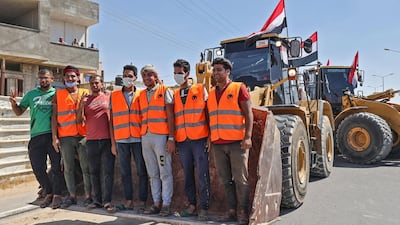
Egyptian workers pose on the shovel of a bulldozer provided by their country, after crossing into Palestinian enclave the Gaza Strip. AFP -

Egyptian workers celebrate after crossing over to Gaza at Rafah border post to help rebuild the enclave following Israeli air strikes. AFP -
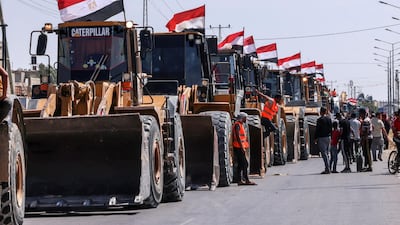
A convoy of around 50 construction vehicles flying the Egyptian flag crossed over to Gaza at Rafah. AFP -
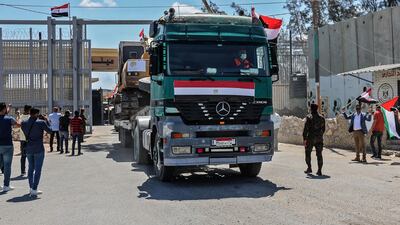
An excavator provided by Egypt arrives on a trailer at Rafah. The convoy also brought engineers. AFP -

More than 250 people, mostly civilians, were killed in Israeli bombardments on Gaza in the 11-day conflict in May. Rockets fired from Gaza killed 13 people in Israel. Reuters -

A woman watches as an Egyptian crew celebrates arriving in Gaza. At least 3,000 homes were destroyed or damaged beyond repair, authorities said. Reuters -
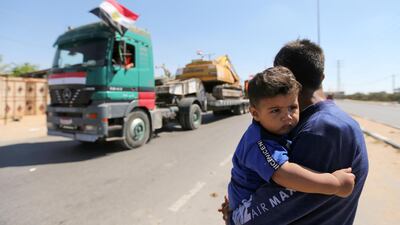
A man carrying a boy watches the convoy arrive in southern Gaza. Another 17,000 homes were damaged in the air strikes. Reuters -

Palestinian women and girls pose near an Egyptian crane arriving in Gaza. Rebuilding work in the enclave will cost an estimated $150 billion. AFP


Dozens of Egyptian bulldozers, forklifts and earthmovers bearing Egypt’s red, black and white flags moved into Gaza earlier this week to begin clearing the rubble of buildings bombed in Israeli air strikes during the war with Hamas.
Egypt administered the neighbouring Gaza Strip between 1948 and 1967, when it lost the coastal enclave to Israel in the Arab-Israeli war. It has had a rocky relationship with Hamas since 2007, when the militant group expelled Fatah from the strip in a brief civil war. It has ruled Gaza alone since.
Relations between Egypt and Hamas rapidly deteriorated in 2013, when the military, then led by President Abdel Fattah El Sisi, removed a Hamas-backed Islamist president from office amid mass protests against his one-year, divisive rule. Egypt has repeatedly accused Hamas of supporting Islamic militants fighting its security forces in the north of its Sinai Peninsula.
It has also moved to destroy an elaborate, Hamas-supervised network of tunnels running under the border with Gaza and that had for years been used to smuggle a wide range of goods into the enclave.
Already, the May 21 ceasefire is showing signs of fragility.
Last week, senior Hamas official Osama Hamdan told The National in Beirut that a repeat of violence at Jerusalem's Al Aqsa Mosque could trigger a new conflict.
He said violence at the mosque, Islam's third holiest site, hours after the May 21 truce went into force was an ominous sign and that Hamas was "watching the situation" and would act if there were more incidents.
Egypt has, meanwhile, been trying to persuade Israel to allow Jordan an effective level of guardianship over Islamic sites in Jerusalem, honouring Amman's traditional role there.
Jordan administered Jerusalem along with the rest of the West Bank for decades before Israel captured the area in the 1967 Arab-Israeli war.
Egyptian security sources told The National that they had warned Israel a repeat of the storming of Al Aqsa Mosque, one of the triggers of the latest round of fighting, would likely shatter its chances of normalising relations with more Arab nations.

