

For years, commentators and experts lamented Egypt's fading relevance in the region, blaming the policies of autocratic ruler Hosni Mubarak and the political turmoil and economic woes that followed his ousting in 2011.
Change did not come overnight, but Egypt's successful mediation, credited with ending this month's violence between Israel and Hamas, the militant Palestinian group, was a milestone in Cairo's journey back to its former place as a key regional player.
“There’s certainly a comeback by Egypt on the regional stage but it’s different from how things used to be in the past,” said Gehad Auda, a political science professor from Cairo’s Helwan University.
"There are no ideological motives behind Egypt’s regional policies now, like Arab nationalism or Arabism, but rather a manifestation of slow and consistent accumulation of experiences and actions.”
Accolades from world leaders, including US President Joe Biden, quickly poured in after an Egyptian-brokered ceasefire took hold on May 21, ending 11 days of rocket barrages fired at Israel by militants in Gaza and devastating Israeli air strikes on the coastal enclave.
Pro-government TV talk show hosts and social media users celebrated Cairo’s newly acquired standing and the leadership of President Abdel Fattah El Sisi.
-
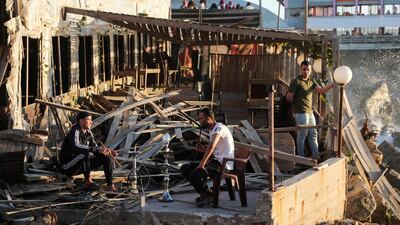
Palestinians smoke a shisha pipe at the site of an Israeli air strike in the Gaza Strip. A ceasefire was announced on Friday. Reuters -
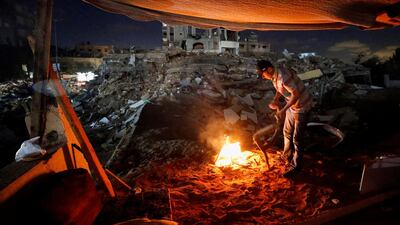
A Palestinian man lights a fire amid the rubble of his house in the Gaza Strip, which was destroyed by an Israeli air attack. Reuters -
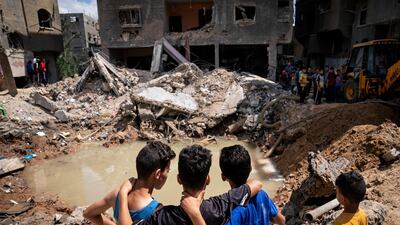
Children survey a water-filled crater where a home was destroyed by an Israeli air strike in the northern Gaza Strip. AP Photo -
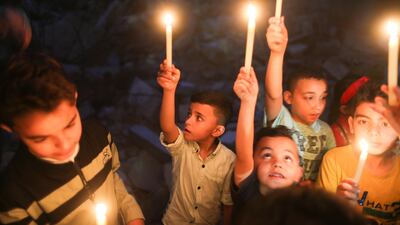
Children hold candles at the site of a house that was destroyed by Israeli air strikes during the recent Israeli-Palestinian fighting, in Gaza. Reuters -
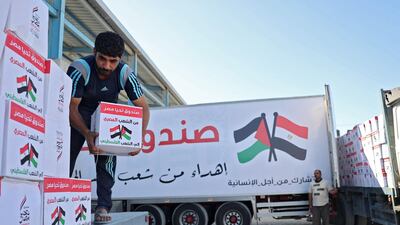
A Palestinian man unloads boxes of aid from an Egyptian lorry at the Rafah border crossing, which connects the Gaza Strip to Egypt. AFP -
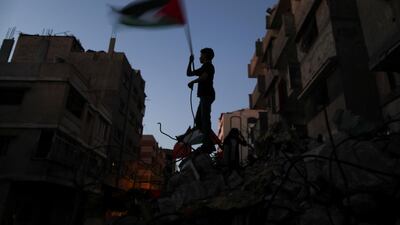
A boy waves a Palestinian flag at a site damaged by Israeli air strikes in Gaza. Reuters -
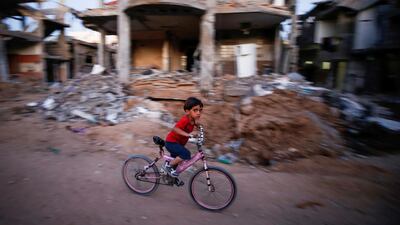
A bicycle ride near the rubble of a house in Gaza that was destroyed during the Israeli-Palestinian conflict. Reuters -
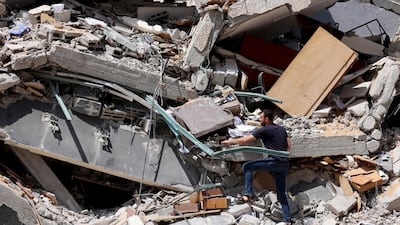
A Palestinian man sifts through the debris of the Al Jalaa tower, which housed media organisations and was destroyed by Israeli air strikes in Gaza city. AFP -
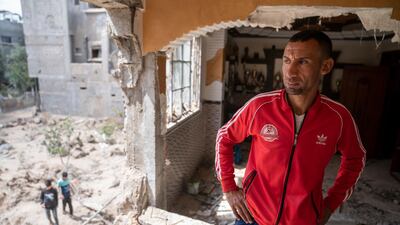
Nader Al Masri, a Palestinian long-distance runner who competed in the 2008 Olympics. His home in the northern Gaza Strip was severely damaged in an Israeli air strike. AP Photo -
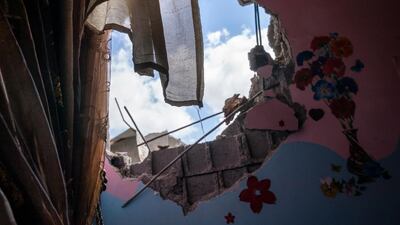
An Israeli air strike blew this hole in the wall of a child's room in Beit Hanoun, the northern Gaza Strip. AP Photo


For Egypt, the return to regional relevance has been a long process involving rebuilding an army that now ranks among the world’s top 10 and introducing economic reforms once thought to be politically impossible.
Egypt also succeeded in restoring security after years of turmoil, containing an insurgency by ISIS-linked extremists in the Sinai Peninsula and eliminating the danger posed by similarly minded groups lurking in Libya near Egypt’s border.
Following this diplomatic victory, Egypt is feeling emboldened enough to move from de-escalation between Israel and Hamas to the broader Israeli-Palestinian conflict, setting an agenda of ambitious and challenging goals.
It is an undertaking likely to test Cairo's diplomatic leverage to the limit, taking on one of the world's most intractable conflicts.
"What is urgently required now is to build on, support and reinforce Egypt's standing," wrote Imad Hussein, editor of Cairo's independent daily Al Shorouk.
“This development could open the door for co-ordination by Egypt at the highest level to discuss a final and just resolution of the Palestinian issue.”
Egyptian delegations, for example, are in the Gaza Strip and Tel Aviv trying to cement the May 21 ceasefire.
Beyond that, according to Egyptian security sources, the delegations are trying to get the two sides to agree to a one-year truce.
If agreed, Cairo hopes to use the time to try to resolve some of the most daunting dilemmas it has faced when dealing with the Palestinian-Israeli conflict.
The Egyptians, the sources said, were counting on the vast experience and knowledge gained over many years of in-depth contacts with the Palestinians and Israel, with whom it signed a peace treaty 42 years ago.
Also on Cairo’s to-do list is to try to reconcile Hamas and its rival Fatah, the dominant faction in the West Bank-based Palestinian Authority.
The two have been sharply at odds since they fought a brief civil war in 2007 that ended with Hamas expelling Fatah from the Gaza Strip, where it has since ruled alone.
“We want them to bury their differences, hold elections and be ready to resume negotiations with Israel,” said one of the Egyptian security sources.
There is also an economic side to what Egypt aspires to do. Foremost on that front is securing agreement from relevant parties to allow the Palestinian Authority and Hamas to jointly invite energy companies to drill for natural gas off the enclave's coast on the East Mediterranean, where huge reserves have been discovered.
If that proves fruitful, there will be a financial windfall that would reduce the Palestinians' dependence on foreign aid.
Egypt's attempt to build on last week's ceasefire, said the sources, is backed by several of Cairo's closest European allies, including France and Germany.
But US support for renewed Palestinian-Israeli negotiations is far from guaranteed, a major drawback given Washington’s traditional role as the chief sponsor of the Middle East peace process.
“The Americans have other priorities that they would not easily abandon,” said Mohamed Anis Salem, a former ambassador and member of the Egyptian Council for Foreign Affairs.
“Besides, there isn’t really a Palestinian or an Israeli government in office that can deliver. My assessment is that the Americans will pursue stabilisation, not a comprehensive solution.”
Egypt, according to the sources, intends to involve Jordan in the process and is hoping to bolster its weakened guardianship over Islamic religious sites in Jerusalem to serve as a deterrent to Israel's transgressions in the city.
Part of Egypt’s plan is also to secure guarantees from Israel to exercise restraint when it comes to Jerusalem’s Al Aqsa Mosque, Islam’s third holiest site, and suspend the possible eviction of Palestinians from the city’s Arab district of Sheikh Jarrah.
Attempting to pressure Israel into making concessions, Egypt is citing the growing sophistication and range of Hamas’s arsenal of rockets, according to the sources.
It has also warned the Israelis that a repeat of the storming of the Al Aqsa Mosque during Ramadan could dangerously undermine its pursuit of normalised relations with more Arab states.

