
The shock announcement that billionaire philanthropists Bill and Melinda Gates are to divorce after 27 years of marriage has raised questions about the future of their hugely influential foundation.
The couple say the idea for the foundation came to them as young parents when they read a newspaper article about millions of children in developing countries dying from easily treatable illnesses such as diarrhoea and pneumonia.
In 2000, the Bill & Melinda Gates Foundation was launched to fight disease and poverty around the world. In the US, an initial focus on providing access to computers and the internet was expanded to improving education in general.
With 1,600 staff members in offices around the world, the Gates Foundation donates about $5 billion each year in areas such as global public health and development.
The foundation says it has spent $54.8bn since its inception.
More than $2bn has gone towards fighting malaria alone, with the aim of eradicating the mosquito-borne disease "within a generation".
Burkina Faso is a country that benefited from those efforts, where its GRAS scientific research institute received $1.5 million in support.
It is researching how the Covid-19 virus affects patients with malaria as well as reports that anti-malaria drugs may fend off coronavirus infections.
The institute's director says it is concerned about future financial support by the Gates Foundation, but the couple said in their announcement they "will continue our work together at the foundation".
The charity has also contributed several billion dollars towards a global campaign to end polio through the widespread immunisation of children. It donated more than $50m during the Ebola outbreak in 2014.
Dozens of other programmes it funds include nutrition, sanitation, maternal and newborn child health and agricultural development.
Last year, the foundation pledged about $250m to help fight the pandemic, with some of the funds channelled to the distribution of life-saving doses of Covid-19 vaccines to parts of Sub-Saharan Africa and South Asia.
The money also went to testing, personal protective equipment and support of health services, particularly in developing countries.
It was also key in forming Covax, a global programme to help supply vaccines to the poorest countries.
In total, the foundation says it has spent about $1.75bn fighting Covid-19 since the start of the pandemic.
It found itself embroiled in controversy though after it was accused of pushing Oxford University to sign an exclusive agreement with AstraZeneca for its vaccine rather than donate the rights to any drugmaker.
Who runs the foundation?
Bill, 65, and Melinda, 56, are co-chairs of the charity while Warren Buffett is a trustee. The chief executive is Mark Suzman.
In its early years, when Bill still ran Microsoft on a daily basis, Melinda was seen as leading the foundation.
In 2008, Bill moved to a part-time role at Microsoft to devote himself to the foundation. Last year, he left his board positions at Microsoft and Berkshire Hathaway for the same reason.
It's hard to say which, if either of them, is more influential.
In her 2019 memoir The Moment of Lift, Melinda wrote that they argued over who would write the foundation's annual letter, which Bill had typically done.
"I thought we were going to kill each other," she said. They have been writing it jointly since 2014.
-
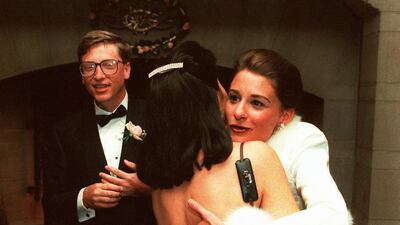
In this Jan. 9, 1994, file photo, computer mogul Bill Gates III and bride Melinda French greet guests in a reception line at a private estate in Seattle. The couple was married in Hawaii the week prior. AP Photo -
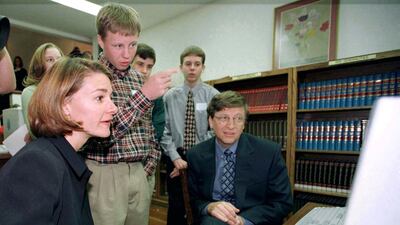
Bill Gates Chairman and CEO of Microsoft and his wife Melinda listens to Josh Stack, 15, explaining the Demopolis, Alabama web site on a computer at the Demopolis Public library, February 24, 1998. Reuters. -

Bill Gates contends with an ill-fitting hard hat while his wife, Melinda Gates, looks on in Seattle at the groundbreaking of the University of Washington's new law school facility, William H. Gates Hall, May 4, 2001. AP Photo -
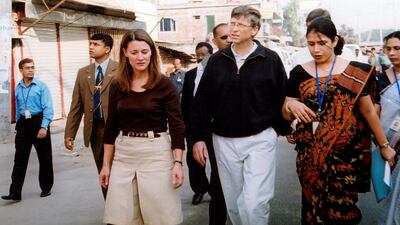
Bill Gates and his wife Melinda, left, walk on a street in Dhaka, Bangladesh, Dec. 5, 2005. AP Photo -
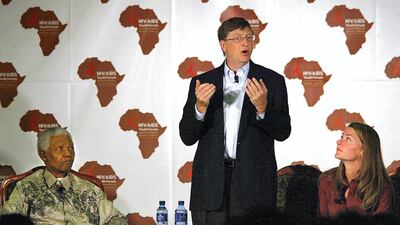
US Microsoft owner Bill Gates addresses a youth forum on HIV/AIDS at the University of Witwatersrand in Johannesburg, 22 September 2003, as his wife Melinda Gates and former South African President Nelson Mandela listen to him. AFP Photo -
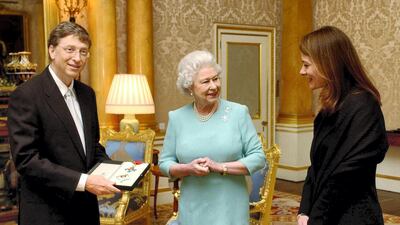
Britain's Queen Elizabeth II presents Microsoft tycoon Bill Gates with his honorary knighthood at Buckingham Palace, London, Wednesday March 2, 2005 watched by his wife Melinda. AFP -
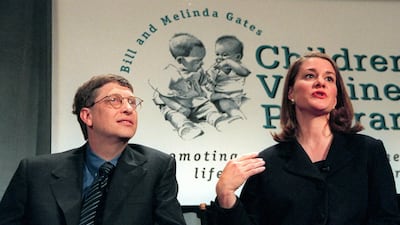
Bill Gates and his wife Melinda hold a press conference in New York 02 December to announce a 100 million USD gift to establish the Bill and Melinda Gates Children's Vaccine Program. AFP -

Melinda Gates smiles at her husband Bill Gates during the opening news conference for AIDS 2006, the XVI International AIDS conference in Toronto, August 13, 2006. Reuters -
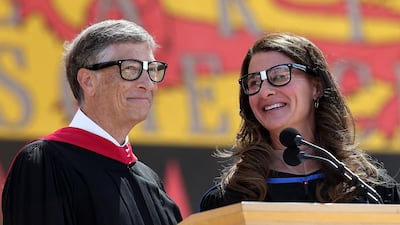
Bill Gates shares the stage with his wife Melinda during the 123rd Stanford commencement ceremony in Stanford, California. AFP -
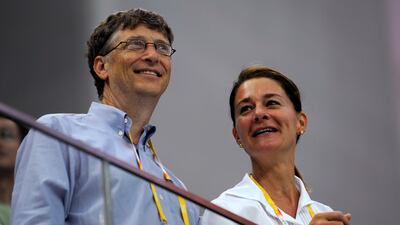
Microsoft Corp co-founder Bill Gates and his wife Melinda Gates watch the swimming events at the National Aquatics Center during the Beijing 2008 Olympic Games, in Beijing, China August 10, 2008. Reuters -
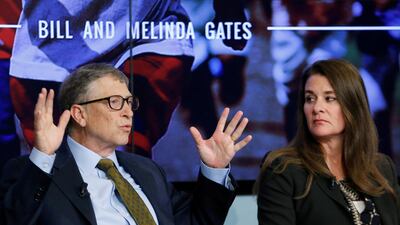
Bill and Melinda Gates attend a debate on the 2030 Sustainable Development Goals in Brussels January 22, 2015. Reuters -
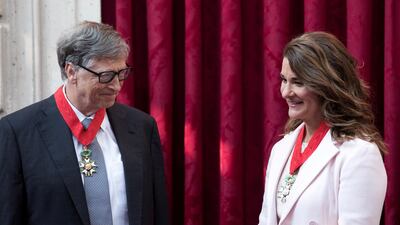
Philanthropist and co-founder of Microsoft, Bill Gates and his wife Melinda talk, after being awarded Commanders of the Legion of Honor at the Elysee Palace in Paris, France, April 21, 2017. Reuters -
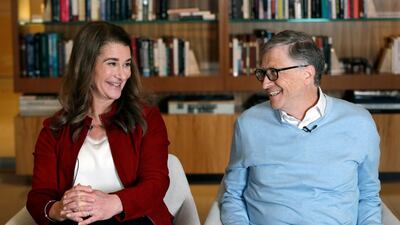
Bill and Melinda Gates smile at each other during an interview in Kirkland, Washington, Feb. 1, 2019. AP Photo


Where does the money come from?
The Gates transferred about $20bn in Microsoft stock to the foundation in its early days.
In 2006, Buffett announced that he would donate the bulk of his fortune to the foundation in the form of shares in his company, Berkshire Hathaway.
Four years later, Bill and Buffett launched the Giving Pledge initiative, which encouraged the rich to donate at least 50 per cent of their wealth to charitable causes, including the Gates Foundation.
More than 200 wealthy people have made the pledge to date.
The foundation has an endowment of more than $46bn.
At the end of last year, it had a vast portfolio of stocks, dominated by Berkshire Hathaway, and also including Walmart, Caterpillar, US company Waste Management and the Canadian National Railway Company, according to Investopedia.
Bill, the fourth richest man in the world with a fortune valued by Forbes at $130bn, and Melinda, have pledged to continue working together for the foundation.
But their divorce could create new questions about their wealth, most of which has yet to be donated to the foundation, despite co-creating the Giving Pledge.
The future of the Gates Foundation could depend on the financial terms of the divorce, which are still unknown.

