
Could Saudi Arabia be set to introduce tourism visas in the coming days? If you were to go off a slick new tourism video for the kingdom currently doing the rounds on social media, it would certainly seem so.
The kingdom's ambitious new campaign showcases various locations across Saudi Arabia, likening them to more famed destinations around the world: Al Ula looks like Petra in Jordan, the desert of Tabuk looks like Utah and the Red Sea looks the like the Caribbean.

Clips show parts of Saudi Arabia that look like the lush rice terraces of Bali, the snowy plains of Siberia and the craggy, green mountains of Switzerland.
"Be the first to visit an exciting, new destination. Get ready to see the unseen," the campaign says. It also features a countdown clock, which at the time of writing, had 12 days and 13 hours remaining – suggesting tourism visas will start from next weekend, around Friday, September 27.
Talk about the imminent release of tourist visas has reached fever pitch recently, after they were first announced in 2017.

Previously, most visitors to Saudi Arabia were Muslims visiting to perform the annual Hajj pilgrimage, or those on business trips. Tourist visas were only issued on an intermittent basis, and only for select group tours. It was particularly difficult for single women to visit the kingdom.
Saudi Arabia first unveiled its plans to welcome tourists to the kingdom in December 2017, but in the years since, there had been little news – until recently.

Late last week, the head of the Saudi Commission for Tourism and National Heritage, Ahmad Al Khatib, said Saudi Arabia would open its doors to international tourists before the end of this year.
Mr Al Khatib made the announcement during a meeting of the World Tourism Organisation in Russia.
It expands on the initial announcement in 2017, when Prince Sultan bin Salman said "all government approvals" were in place for the launch of electronic visas to "all nationals whose countries allow their citizens to visit" Saudi Arabia.

The proposal to issue the visas was then outlined in a report for the Arabian Travel Market 2018.
It highlighted the kingdom's target of 30 million visitors annually by 2030, and announced its intent to allow women older than 24 to visit the country without a male guardian.
Female tourists below that age will still need to be accompanied by a family member.
The kingdom announced several leisure projects in 2018, including a Six Flags-style theme park in Riyadh to be built by 2021. The theme park is set to have many record-breaking rides – including the world's fastest roller coaster.
A much-publicised Red Sea Project was also set to boost the luxury tourism market in Saudi, and is being marketed as an "equivalent to the Maldives".
Located between the coastal cities of Umluj and Al Wajh, the project is being built in a region spanning 30,000 square kilometres and will comprise a natural archipelago of pristine islands and a vast desert landscape filled with mountain peaks, historical and archaeological treasures and a dormant volcano. The project will be the first fully integrated, luxury, mixed-use resort in the Middle East and is expected to attract visitors all year round. It has been designed with a strong focus on heritage, culture and conservation and will provide 8,000 new hotel rooms once completed.

Check out our pick of the top ten tourist sites in Saudi Arabia below:
-
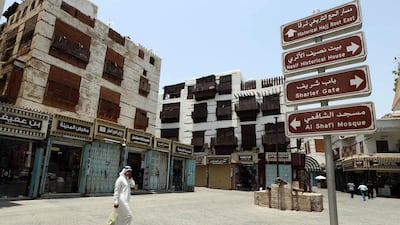
JEDDAH: UNESCO's World Heritage Committee inscribed the old city of Jeddah and the Gate of Makkah on the World Heritage List in 2014. Pictured: windows covered with wooden screens known as "mashrabaiya" adorn traditional buildings in the old city of Jeddah. AFP Photo. -
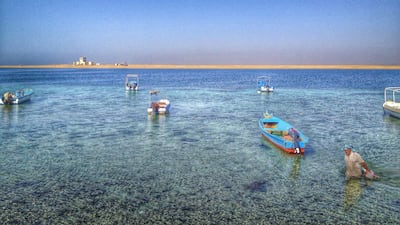
YANBU: A popular jumping-off point for diving in the Red Sea, and famed for its white, sandy beaches, Yanbu's star is on the rise. While it's also known for its refineries and petrochemical plants - the city boasts plenty of private beaches, and resorts geared towards families. John Fraser / Stockimo. -
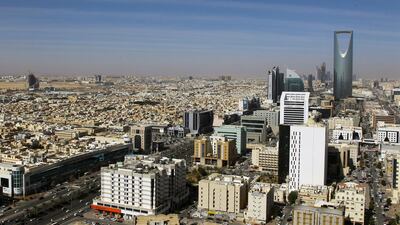
RIYADH: The capital and most populous city of Saudi Arabia is primarily considered a business destination. But, financial hub or not, the 6 million-strong city boasts some impressive skyscrapers - including the 302m-high Kingdom Centre, with a sky bridge connecting 2 towers, and the 267m-high Al Faisaliah Centre, with a glass-globe summit. The historic Deira suburb, and the Masmak Fort, is worth a wander around too. Faisal Al Nasser / Reuters. -

TABUK: Steeped in ancient history, Tabuk is an agricultural-rich area on the Red Sea. It's known for a wealth of aspects, most notably it's diving, the Tabuk Castle which dates back to 1559, and the Hisma mountain range. Getty Images -
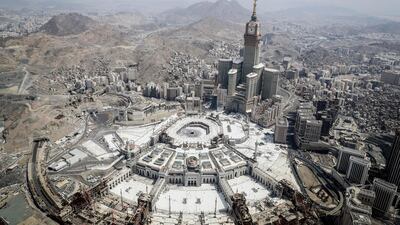
MAKKAH: Located in western Saudi Arabia, this is considered the holiest site in Islam. Non-Muslims are strictly forbidden to enter the city. A pilgrimage to Makkah, known as the Hajj, is one of the Five Pillars of Islam, and is compulsory for all Muslims who are able. Each year, over three million Muslims visit the city during the month of Dhu'l-Hijjah. The Great Mosque of Makkah (pictured) is considered the holiest site in the city, and in Islam. The Kaaba, which it is built around, is a building said to have been built by Prophet Abraham himself and his son, Prophet Ishmael. Mast Irham / EPA. -

MADINA: Considered the second holiest city in Islam after Makkah, this is said to be where the prophet Mohammed was buried. Pictured: the burial place is at the city's heart, at al-Masjid an-Nabawi (the Prophet's Mosque). Getty Images -
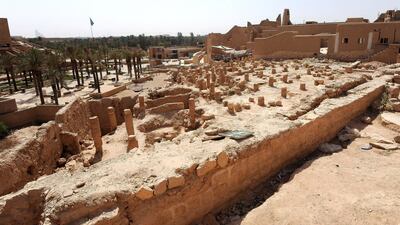
DIR'IYAH: Another UNESCO site, this was once the home of the Saudi royal family, and served as the capital of the emirate of the same name from 1744 to 1818, under the first Saudi dynasty. The At-Turaif district in ad-Dir'iyah on the outskirts of Riyadh, is part of a major development project shepherded by Saudi King Salman. The heart of the 750 million riyal ($200 million/179 million euro) project is the restoration of At-Turaif, but it also includes the creation of the adjacent Abdul Wahhab Foundation which is designed to is designed to honour Sheikh Mohammed bin Abdul Wahhab, the 18th-century fundamentalist preacher who co-founded the Saudi state. Fayez Nureldine / AFP Photo. -
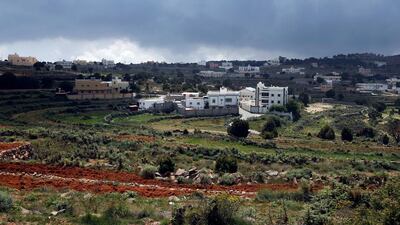
ABHA: This mountainous area is known for its national parks, forests and mud-built castles and buildings. Its mild climate, and lush, green countryside make it a popular destination for domestic travellers throughout the year. Faisal Al Nasser / Reuters. -
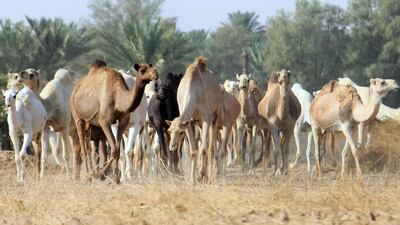
QASSIM: The Qassim region, 350 kms north of Riyadh is supposedly the richest region per capita in Saudi Arabia. Primarily a desert climate, its dotted with archaeological sites and is well-known for its traditional textiles. It's sliced through the middle by the Wadi Al Rummah, the longest valley in the Arabian peninsula, stretching for about 600 km from Madina to the Thuayrat Dunes. Hassan Ammar / AFP Photo.



