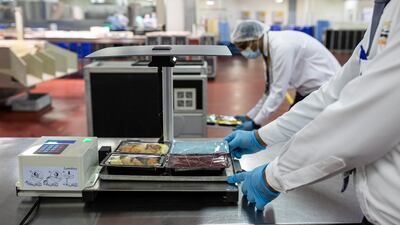
Etihad is turning to technology to reduce food waste on flights.

Etihad will use AI to reduce food waste on flights


Hayley Skirka
  • English
  • Arabic

Etihad Airways is to use machine learning to help tackle the problem of food wase on its flights.

The national airline of the UAE started a project that makes use of computer vision and machine learning to cut down on the volume of food wasted on flights. The project is in partnership with Lumitics, a Singapore food technology start-up.

Using AI and image recognition, unconsumed meals from flights will be tracked when Etihad jets land at airports. Courtesy Etihad

Economy-class meals served on Etihad flights will be tracked to record food consumption patterns and waste levels across the airline's network. This will be done using Lumitics' Insight Lite product, which will monitor the number of uneaten meals on a plane when it reaches an airport.

The programme uses artificial intelligence and image recognition to identify the types and quantity of unconsumed food, without the need for human interaction.

This data will be used by Etihad in plans to reduce food waste, improve meal planning on a granular level and lower operating costs. So, for instance, if X amount of chicken dishes are always left uneaten on flights from Chicago, they will reduce that meal on that service.

1.14 million tonnes wasted every year

About 20 per cent of all food produced by in-flight catering teams is wasted every year. Unsplash

In 2017, the International Air Transport Association found that 1.14 million tonnes of food was wasted from in-flight catering and about 20 per cent of all food produced by in-flight catering teams is wasted every year.

The problem is something airlines are aware of and Etihad began its partnership with Lumitics this year, before aviation was widely affected by the coronavirus pandemic. With many routes now restarting, Etihad is keen to move forward with the project.

“As the airline scales up the flight operations again, it is exciting to restart the project and continue the work that had begun," said Mohammad Al Bulooki, chief operating officer at Etihad Aviation Group.

Rayner Loi, co-founder of Lumitics, said "tackling food waste is one of the largest cost-saving opportunities for any business producing and serving food".

"Not only does it make business sense, it is also good for the environment. We are excited to be working with Etihad Airways to help achieve its goals in reducing food waste," he said.

Sustainable flying

Etihad has introduced several sustainable initiatives including participation in Boeing's EcoDemonstrator programme. Courtesy Etihad

Etihad's food waste programme is one of several sustainability focused initiatives the airline is undertaking.

Last year, the Abu Dhabi airline operated a single-use-plastic-free flight from the UAE to Australia and introduced its Etihad Greenliner programme to help improve operating efficiency and sustainable practice in aviation.

Most recently, Etihad partnered with Boeing and Nasa to use its newest Dreamliner as a test bed for technologies that can help reduce fuel consumption, noise pollution and carbon dioxide emissions.


Countries recognising Palestine

France, UK, Canada, Australia, Portugal, Belgium, Malta, Luxembourg, San Marino and Andorra


Ten tax points to be aware of in 2026

1. Domestic VAT refund amendments: request your refund within five years

If a business does not apply for the refund on time, they lose their credit.

2. E-invoicing in the UAE

Businesses should continue preparing for the implementation of e-invoicing in the UAE, with 2026 a preparation and transition period ahead of phased mandatory adoption. 

3. More tax audits

Tax authorities are increasingly using data already available across multiple filings to identify audit risks. 

4. More beneficial VAT and excise tax penalty regime

Tax disputes are expected to become more frequent and more structured, with clearer administrative objection and appeal processes. The UAE has adopted a new penalty regime for VAT and excise disputes, which now mirrors the penalty regime for corporate tax.

5. Greater emphasis on statutory audit

There is a greater need for the accuracy of financial statements. The International Financial Reporting Standards standards need to be strictly adhered to and, as a result, the quality of the audits will need to increase.

6. Further transfer pricing enforcement

Transfer pricing enforcement, which refers to the practice of establishing prices for internal transactions between related entities, is expected to broaden in scope. The UAE will shortly open the possibility to negotiate advance pricing agreements, or essentially rulings for transfer pricing purposes. 

7. Limited time periods for audits

Recent amendments also introduce a default five-year limitation period for tax audits and assessments, subject to specific statutory exceptions. While the standard audit and assessment period is five years, this may be extended to up to 15 years in cases involving fraud or tax evasion. 

8. Pillar 2 implementation 

Many multinational groups will begin to feel the practical effect of the Domestic Minimum Top-Up Tax (DMTT), the UAE's implementation of the OECD’s global minimum tax under Pillar 2. While the rules apply for financial years starting on or after January 1, 2025, it is 2026 that marks the transition to an operational phase.

9. Reduced compliance obligations for imported goods and services

Businesses that apply the reverse-charge mechanism for VAT purposes in the UAE may benefit from reduced compliance obligations. 

10. Substance and CbC reporting focus

Tax authorities are expected to continue strengthening the enforcement of economic substance and Country-by-Country (CbC) reporting frameworks. In the UAE, these regimes are increasingly being used as risk-assessment tools, providing tax authorities with a comprehensive view of multinational groups’ global footprints and enabling them to assess whether profits are aligned with real economic activity. 

Contributed by Thomas Vanhee and Hend Rashwan, Aurifer

In numbers: PKK’s money network in Europe

Germany: PKK collectors typically bring in $18 million in cash a year – amount has trebled since 2010

Revolutionary tax: Investigators say about $2 million a year raised from ‘tax collection’ around Marseille

Extortion: Gunman convicted in 2023 of demanding $10,000 from Kurdish businessman in Stockholm

Drug trade: PKK income claimed by Turkish anti-drugs force in 2024 to be as high as $500 million a year

Denmark: PKK one of two terrorist groups along with Iranian separatists ASMLA to raise “two-digit million amounts”

Contributions: Hundreds of euros expected from typical Kurdish families and thousands from business owners

TV channel: Kurdish Roj TV accounts frozen and went bankrupt after Denmark fined it more than $1 million over PKK links in 2013 

'Cheb%20Khaled'
%3Cp%3E%3Cstrong%3EArtist%3A%20%3C%2Fstrong%3EKhaled%3Cbr%3E%3Cstrong%3ELabel%3A%20%3C%2Fstrong%3EBelieve%3Cbr%3E%3Cstrong%3ERating%3A%3C%2Fstrong%3E%204%2F5%3C%2Fp%3E%0A
Who's who in Yemen conflict

Houthis: Iran-backed rebels who occupy Sanaa and run unrecognised government

Yemeni government: Exiled government in Aden led by eight-member Presidential Leadership Council

Southern Transitional Council: Faction in Yemeni government that seeks autonomy for the south

Habrish 'rebels': Tribal-backed forces feuding with STC over control of oil in government territory

The%C2%A0specs%20
%3Cp%3E%0D%3Cstrong%3EEngine%3A%20%3C%2Fstrong%3E6-cylinder%2C%204.8-litre%20%0D%3Cbr%3E%3Cstrong%3ETransmission%3A%20%3C%2Fstrong%3E5-speed%20automatic%20and%20manual%0D%3Cbr%3E%3Cstrong%3EPower%3A%20%3C%2Fstrong%3E280%20brake%20horsepower%20%0D%3Cbr%3E%3Cstrong%3ETorque%3A%20%3C%2Fstrong%3E451Nm%20%0D%3Cbr%3E%3Cstrong%3EPrice%3A%20%3C%2Fstrong%3Efrom%20Dh153%2C00%0D%3Cbr%3E%3Cstrong%3EOn%20sale%3A%20%3C%2Fstrong%3Enow%3C%2Fp%3E%0A
The%20specs
%3Cp%3E%3Cstrong%3EPowertrain%3A%20%3C%2Fstrong%3ESingle%20electric%20motor%0D%3Cbr%3E%3Cstrong%3EPower%3A%20%3C%2Fstrong%3E201hp%0D%3Cbr%3E%3Cstrong%3ETorque%3A%20%3C%2Fstrong%3E310Nm%0D%3Cbr%3E%3Cstrong%3ETransmission%3A%20%3C%2Fstrong%3ESingle-speed%20auto%0D%3Cbr%3E%3Cstrong%3EBattery%3A%20%3C%2Fstrong%3E53kWh%20lithium-ion%20battery%20pack%20(GS%20base%20model)%3B%2070kWh%20battery%20pack%20(GF)%0D%3Cbr%3E%3Cstrong%3ETouring%20range%3A%20%3C%2Fstrong%3E350km%20(GS)%3B%20480km%20(GF)%0D%3Cbr%3E%3Cstrong%3EPrice%3A%20%3C%2Fstrong%3EFrom%20Dh129%2C900%20(GS)%3B%20Dh149%2C000%20(GF)%0D%3Cbr%3E%3Cstrong%3EOn%20sale%3A%3C%2Fstrong%3E%20Now%3C%2Fp%3E%0A
The White Lotus: Season three

Creator: Mike White

Starring: Walton Goggins, Jason Isaacs, Natasha Rothwell

Rating: 4.5/5