
Four metres below the surface of the sea, I take a deep breath and remove my mask.
“It’s only for one minute,” I tell myself. “You can do anything for a minute.”
My eyes are squeezed shut to stop salt water going in them and my regulator is firmly in my mouth. I feel my lungs fill with air, but can’t seem to shake the sensation that I’m not quite breathing properly.
Seawater is pushing its way up my nose and my throat is starting to burn. I reach out to try to get my instructor's attention – Ahmed's watching me but doesn't seem worried. Another shoot of water finds its way up my nostrils and I know I need to get out of there.
Forgetting my coaching, I start swimming upward. I can feel the water getting warmer as I inch closer to the surface and as soon as I break through the waves I open my eyes and spit out the regulator. Gasping for air, I feel like I've swallowed about 100 litres of seawater.
A moment later, Ahmed and my dive buddy surface alongside me, both wearing slightly puzzled expressions. Thankfully, having been at a depth of only four metres, I don't need to worry about decompression sickness, which could have been an issue if I'd come up that fast from a greater depth.
It appears that the only real damage done is to my ego, and I’m thankful that my burning cheeks could be attributed to the sun’s stinging rays, rather than my own embarrassment.

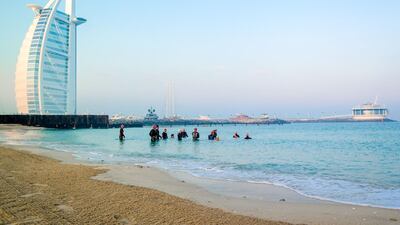
Having spent more than three weeks completing the e-learning portion of my Professional Association of Diving Instructors (Padi) Open Water Diver certification, I’m determined that the practical side of things won’t be my downfall. Which is why, early the next morning, I’m back in the water at the Ocean Dive Centre in Abu Dhabi to try again.
Starting with the same skill – mask removal underwater – I make my way under the surface, kneeling a few centimetres in front of Ahmed. Once more, I take off my mask and hold it to the side. I breathe, concentrating harder than I have ever done before on using only my mouth. I tip my head slightly to the side, letting the air bubbles float past my nostrils rather than directly into them. I try not to think about it, instead humming the first tune that pops into my head.
“We got no troubles, life is the bubbles, under the sea, under the sea …”
I'm about to launch into the next verse when I feel a tap on my arm. Yanking my mask back on to my face, I clear the water out from inside it by blowing through my nose and open my eyes, blinking to clear the remaining droplets. I can't believe it when Ahmed holds his hand up and curls his fingers towards one another – flashing me the universal scuba signal for OK.
I've done it, and I can't believe how easy it was the second time around. Buzzing with adrenalin, we continue – after all, there are about 30 skills I need to master before Padi will certify me as a new diver.
When I do get there, my certification will allow me to dive to a depth of 18 metres almost anywhere in the world.
It's something I've been meaning to do for a while, but kept putting off because life, time or money always seemed to get in the way. Then, last year, I got the chance to meet and interview renowned oceanographer Jean Michel Cousteau – one of the first divers in the world to be Padi certified. His encouragement was (almost) the final push I needed to follow suit.
The impact of the pandemic

I say almost, because it took a pandemic for me to get in the water. And I'm not the only person to use Covid-19 as a reason to take up diving.
July has been the strongest dive season in the GCC for the past 10 years, says Jonas Samuelsson, Padi's director for Europe, the Middle East and Africa.
"We're looking at the Middle East as one of the success stories," he says. "The region had the best year last month, in terms of people taking diving courses, in over 10 years, which is remarkable."
Although Covid-19 has had much of the world in lockdown, it has also shone a spotlight on activities that people can do in their own backyards.
"Opportunities for dive travel remain limited for many parts of the world," says Kristin Valette-Wirth, chief brand officer for Padi worldwide. "But, with this, we're noticing a trend of increased local diving and dive certifications across regions globally, including the UAE."
Dave Griffiths, a British diver who also found his love of diving through the Cousteau family, operates Divers Down in Dubai and Fujairah. The centre is the only Padi career development facility in the Middle East and has had one of its busiest months, largely owing to people holidaying locally.
"We think it's been down to families, who would usually travel home for summer, instead moving to staycationing due to the uncertain times, and allocating their travel budget to an activity," Griffiths says.
Troubled waters
Despite the boom, the pandemic has created its own problems for the diving industry. In countries such as Egypt and Tunisia that rely on tourists, the situation is bleak; many dive schools are having to close, while others struggle to stay afloat because of limited domestic interest.
"These centres have been affected because many of them are simply not able to offer diving," says Ahmed Sayed, Padi regional manager for the Middle East. "But what Padi has done is to give permission for instructors to teach many of the theory parts of courses online or via Zoom, and that has really helped."

This rule change has allowed many schools to stay in business and has kept up the hope of strong bookings when diving returns.
Padi has also created new diver guidelines specific to Covid-19. These adaptations ensure that the sport meets social-distancing measures and hygiene requirements as recommended by local authorities.
"There are a lot of skills that previously involved contact between students or between the student and an instructor, like sharing air, for example," Sayed says. "Where possible, we have adapted these skills to suit the current situation."
Having completed my training during the pandemic, I can safely say that other than face masks and reduced capacity on the boats, the only rule change I noticed was the need to get my own mask and snorkel from day one, rather than using hired gear.
"The changes don't impact the diver experience at all," Sayed says. "People can still have a lot of fun. The guidelines are aimed at dive schools to help protect themselves and protect their customer – students aren't likely to notice much change."
As some regions around the world begin to ease out of lockdown, Padi has also created an interactive Covid-19 scuba-diving status map that makes it easy to identify where the sport is accessible. This hefty project involved daily co-ordination with all 6,000 Padi dive centres across the world, but the visual representation is super-helpful, especially as a newly qualified diver daydreaming of my first scuba holiday and wondering where I can go.
Blossoming corals and thriving marine life

No matter where I choose, Sayed promises there’s treasure waiting for me below the waves.
"Right now, the water is absolutely amazing because the environment had a little break to recover. It is remarkable what a three-month break can do for the coral and for the environment.
"Only last week there were sightings of dolphins coming to the beach in Dahab – that's not happened in Egypt for many years. In Sharks Bay in Sharm El Sheikh, dolphins and a whale shark were spotted in the same week. This is an area where it's usually busy with boats, people and traffic and now the marine life has started to come back."
Of course, Covid-19 has not been all good news for the marine world. Plastic pollution – a subject that until recently was firmly in the public forum – has taken a back seat during the pandemic as people turn to disposable face masks and plastic gloves to protect themselves from the virus.
"Just the sheer number of plastic masks being produced is going to have an effect unfortunately," Samuelsson says. "When this pandemic started, we realised immediately that it was going to be a problem."
To try to help, Padi created a line of reusable face masks crafted from recycled fishing nets. While this is a drop in the ocean in the scale of the global pollution crisis, every reusable non-plastic mask sold is a ripple in the right direction.
The future of scuba

For now, the scuba-diving industry continues to tread water. In countries with strong domestic markets, the industry has already bounced back. In others such as Morocco, Thailand, Egypt and Indonesia, where tourism drives the demand for diving, recovery will be much slower.
"The resort markets are all down. In the short run, there will be a massive growth of domestic markets and I think it'll take a couple of years for most resort areas to fully recover," Samuelsson says.
“But by 2022, so long as nothing else happens, hopefully we’ll see some form of normality. The tourists will come back. We do not know exactly when, but they will because it is such a special sport. I’ve been diving since I was a kid and it’s just such a unique activity. Even if it takes a slightly different form for a while, it will all be OK.”
A week later, as I’m given my Padi open-water certificate and join hundreds of others who have used the coronavirus movement restrictions as an opportunity to learn to dive, I can only hope that he’s right.

