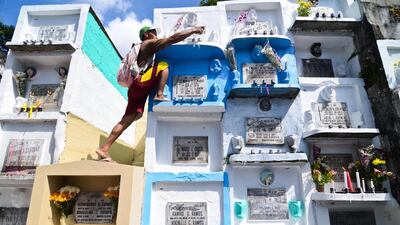
Today, in the Philippines, thousands of dishes will be cooked affectionately for people who cannot eat them. Every November 1, on All Saints Day, cemeteries across the country are inundated with people carrying the favourite foods of their deceased loved ones. Family and friends of those buried in the graveyards then share these dishes in a charming display of how Filipinos use food to honour the dead. It has been this way for centuries.
This year, however, things will be different. Most public cemeteries in the Philippines will be closed on All Saints Day, also known as Undas, to protect against further coronavirus outbreaks. The nation recorded 380,000 Covid-19 cases as of Sunday, November 1, according to the John Hopkins University's global data. In response, the government ordered most cemeteries to be shut for a week starting from October 29.
A holiday steeped in tradition
Since Catholicism was introduced to the Philippines by the Spaniards in the 16th century, All Saints Day has been one of the most important annual holidays in the country. Residents visit cemeteries with offerings for the dead – candles, flowers, amulets – and decorate the graves of their loved ones.
Filipino food writer Michelle Melo of the popular blog Dekaphobe, says Undas is an emotional occasion.
“Most Filipino families prepare food to bring to the cemeteries to share among themselves, and some families make an effort to prepare dishes the families’ departed loved ones used to enjoy and serve it on their graves,” she says. “It is a way of honouring the dead and a gesture to show that they are not forgotten.”
My family keeps it simple – we bring food that is easy to serve and not difficult to clean up
All Saints Day, as its name suggests, is originally a commemoration of Catholic saints and martyrs, with its earliest history traced back to the 7th century. That was when the Pantheon church in Rome was dedicated to Mary the Blessed Virgin and all martyrs by Pope Boniface IV. All Saints Day remains a key annual event in Christian countries such as Italy, Germany and France, and is followed on November 2 by All Souls Day, which honours all departed souls.
In the Philippines, the sombre tone of Undas is balanced by the joy of family reunions. These often take place at cemeteries, with some relatives seeing each other for the first time in months, or perhaps even since the previous Undas. For many Filipinos, Undas is a greatly anticipated event, equivalent to Christmas in western countries.
Melo recalls how, as a child, she would look forward to getting money from her elders on Undas, which she used to buy snacks from the food vendors who gather outside cemeteries. They still serve many of the same Filipino treats during the festival. These include calamares (deep-fried squid rings), puto (steamed rice cakes) and cassava cake (a moist dessert flavoured by shaved coconut and cassava).
A foodie feast
Another old favourite during the feast is a dessert called taho, which is silky tofu covered in syrup and tapioca balls. Melo says she still eagerly awaits Undas, when she gets to savour the treats made by the elder female members of her family.
"I have very minimal participation [in cooking for Undas] because the aunts and grandparents are the ones who usually prepare the food," she says. "My family keeps it simple every time – we bring food that is easy to serve and not difficult to clean up."
These include bread, biscuits, rice cakes, barbecued skewers and lumpia, a Filipino spring roll that is usually deep fried and filled with minced meat, onion and carrot.
Melo says many other Filipino families go to great lengths to prepare extravagant Undas feasts. Among the most popular dishes are pancit – stir-fried noodles mixed with meat and vegetables – and caldereta, a robust stew of beef, pork or chicken.
Not to mention what many people consider the national dish of the Philippines, adobo.
Meaning “marinade” in Spanish, adobo is chicken fried and then stewed in a sauce of vinegar, garlic, black pepper and soy sauce. This slow-cooked chicken, with its mix of savoury and sweet flavours, is then served on a bed of rice. Adobo is one of the staple foods of any Undas party, or indeed any Filipino get-together.
The impact of Covid-19 and cultural changes on celebrations
While the lack of access to cemeteries will dampen this year's Undas festivities, Filipinos will find a way to mark the day regardless, says another Filipino food writer Gerry San Miguel, who writes the blog Dude4Food. He says many families have adapted to the difficult circumstances by having their Undas gatherings earlier in the year than usual. Food, as always, is the focal point of these events.
But it isn't just the pandemic that is altering the country's relationship with Undas. Over recent decades, traditions have gone into decline, such as the offering of freshly cooked dishes alongside the grave of a loved one.
"Each region and family have their own unique traditions, but the practice of food-centred customs during Undas seems to be waning, at least in more urbanised areas," San Miguel says. "Offering sweet dishes like native rice cakes to the departed, along with candles and prayers, continues to be practised in certain communities. But generally, food is usually prepared to be eaten by the gathering of loved ones in cemeteries."

The biog
Favourite film: The Notebook
Favourite book: What I know for sure by Oprah Winfrey
Favourite quote: “Social equality is the only basis of human happiness” Nelson Madela. Hometown: Emmen, The Netherlands
Favourite activities: Walking on the beach, eating at restaurants and spending time with friends
Job: Founder and Managing Director of Mawaheb from Beautiful Peopl
Company%20profile
%3Cp%3E%3Cstrong%3ECompany%20name%3A%3C%2Fstrong%3E%20Fasset%0D%3Cbr%3E%3Cstrong%3EStarted%3A%20%3C%2Fstrong%3E2019%0D%3Cbr%3E%3Cstrong%3EFounders%3A%3C%2Fstrong%3E%20Mohammad%20Raafi%20Hossain%2C%20Daniel%20Ahmed%0D%3Cbr%3E%3Cstrong%3EBased%3A%3C%2Fstrong%3E%20Dubai%0D%3Cbr%3E%3Cstrong%3ESector%3A%20%3C%2Fstrong%3EFinTech%0D%3Cbr%3E%3Cstrong%3EInitial%20investment%3A%3C%2Fstrong%3E%20%242.45%20million%0D%3Cbr%3E%3Cstrong%3ECurrent%20number%20of%20staff%3A%3C%2Fstrong%3E%2086%0D%3Cbr%3E%3Cstrong%3EInvestment%20stage%3A%3C%2Fstrong%3E%20Pre-series%20B%0D%3Cbr%3E%3Cstrong%3EInvestors%3A%3C%2Fstrong%3E%20Investcorp%2C%20Liberty%20City%20Ventures%2C%20Fatima%20Gobi%20Ventures%2C%20Primal%20Capital%2C%20Wealthwell%20Ventures%2C%20FHS%20Capital%2C%20VN2%20Capital%2C%20local%20family%20offices%3C%2Fp%3E%0A
FOOTBALL TEST
Team X 1 Team Y 0
Scorers
Red card
Man of the Match
Should late investors consider cryptocurrencies?
Wealth managers recommend late investors to have a balanced portfolio that typically includes traditional assets such as cash, government and corporate bonds, equities, commodities and commercial property.
They do not usually recommend investing in Bitcoin or other cryptocurrencies due to the risk and volatility associated with them.
“It has produced eye-watering returns for some, whereas others have lost substantially as this has all depended purely on timing and when the buy-in was. If someone still has about 20 to 25 years until retirement, there isn’t any need to take such risks,” Rupert Connor of Abacus Financial Consultant says.
He adds that if a person is interested in owning a business or growing a property portfolio to increase their retirement income, this can be encouraged provided they keep in mind the overall risk profile of these assets.
Getting%20there%20and%20where%20to%20stay
%3Cp%3EEtihad%20Airways%20operates%20seasonal%20flights%20from%20Abu%20Dhabi%20to%20Nice%20C%C3%B4te%20d'Azur%20Airport.%20Services%20depart%20the%20UAE%20on%20Wednesdays%20and%20Sundays%20with%20outbound%20flights%20stopping%20briefly%20in%20Rome%2C%20return%20flights%20are%20non-stop.%20Fares%20start%20from%20Dh3%2C315%2C%20flights%20operate%20until%20September%2018%2C%202022.%C2%A0%3C%2Fp%3E%0A%3Cp%3EThe%20Radisson%20Blu%20Hotel%20Nice%20offers%20a%20western%20location%20right%20on%20Promenade%20des%20Anglais%20with%20rooms%20overlooking%20the%20Bay%20of%20Angels.%20Stays%20are%20priced%20from%20%E2%82%AC101%20(%24114)%2C%20including%20taxes.%3C%2Fp%3E%0A%3Cp%3E%3C%2Fp%3E%0A
Where to donate in the UAE
The Emirates Charity Portal
You can donate to several registered charities through a “donation catalogue”. The use of the donation is quite specific, such as buying a fan for a poor family in Niger for Dh130.
The General Authority of Islamic Affairs & Endowments
The site has an e-donation service accepting debit card, credit card or e-Dirham, an electronic payment tool developed by the Ministry of Finance and First Abu Dhabi Bank.
Al Noor Special Needs Centre
You can donate online or order Smiles n’ Stuff products handcrafted by Al Noor students. The centre publishes a wish list of extras needed, starting at Dh500.
Beit Al Khair Society
Beit Al Khair Society has the motto “From – and to – the UAE,” with donations going towards the neediest in the country. Its website has a list of physical donation sites, but people can also contribute money by SMS, bank transfer and through the hotline 800-22554.
Dar Al Ber Society
Dar Al Ber Society, which has charity projects in 39 countries, accept cash payments, money transfers or SMS donations. Its donation hotline is 800-79.
Dubai Cares
Dubai Cares provides several options for individuals and companies to donate, including online, through banks, at retail outlets, via phone and by purchasing Dubai Cares branded merchandise. It is currently running a campaign called Bookings 2030, which allows people to help change the future of six underprivileged children and young people.
Emirates Airline Foundation
Those who travel on Emirates have undoubtedly seen the little donation envelopes in the seat pockets. But the foundation also accepts donations online and in the form of Skywards Miles. Donated miles are used to sponsor travel for doctors, surgeons, engineers and other professionals volunteering on humanitarian missions around the world.
Emirates Red Crescent
On the Emirates Red Crescent website you can choose between 35 different purposes for your donation, such as providing food for fasters, supporting debtors and contributing to a refugee women fund. It also has a list of bank accounts for each donation type.
Gulf for Good
Gulf for Good raises funds for partner charity projects through challenges, like climbing Kilimanjaro and cycling through Thailand. This year’s projects are in partnership with Street Child Nepal, Larchfield Kids, the Foundation for African Empowerment and SOS Children's Villages. Since 2001, the organisation has raised more than $3.5 million (Dh12.8m) in support of over 50 children’s charities.
Noor Dubai Foundation
Sheikh Mohammed bin Rashid Al Maktoum launched the Noor Dubai Foundation a decade ago with the aim of eliminating all forms of preventable blindness globally. You can donate Dh50 to support mobile eye camps by texting the word “Noor” to 4565 (Etisalat) or 4849 (du).
