
They say necessity is the mother of all invention, and amid the pandemic it's been necessary for us all to practice social distancing. This new way of living has paved the way for all manner of new inventions.
From India to Singapore, engineers and designers have been busy coming up with ideas for devices that will allow us to stay safe and virus-free in a post-pandemic world.
Here are a few of the most interesting we've come across.
The robotic dog
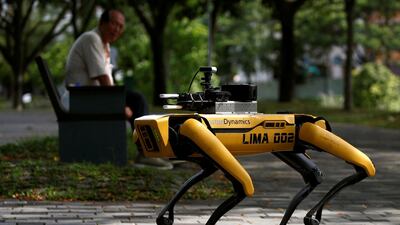
Spot, a robotic dog created by Boston Dynamics, an American engineering and robotics design company, has been roaming around Singaporean parks, ensuring people maintain a safe distance from each other.
The National Parks Board confirmed that Spot will be patrolling a six-kilometre area of Bishan-Ang Mo Kio Park during off-peak hours, playing pre-recorded messages that remind park-users to observe social distancing measures.
The robot, which will be controlled remotely, is also fitted with cameras that will be used to estimate how many people are visiting the park. While it will eventually diminish the need for human contact, a person will accompany the dog during the testing period, it was reported.
Last month, the bot also helped healthcare workers at Brigham and Women's Hospital of Harvard University treat coronavirus patients remotely.
Inflatable face shields
Across the world, a number of designs for face shields and masks have been conceived. One of the more interesting ones comes from MARGstudio, Alessio Casciano Design and Angeletti Ruzza.
It's a brightly hued inflatable face shield that will allow people to socialise safely in restaurants and other situations, as well as take in food and drink while wearing it. It has not been designed with healthcare workers in mind, reports design website Dezeen.
It's called Soffio, which is the Italian word for "blow". It will be made from PVC with a plastic visor and elastic head strap, and the shield will be positioned away from the face so whoever is wearing it can eat or drink at the same time.
The designers say each mask could be manufactured for less than one Euro (Dh3.9) and could be handed out at bars and restaurants, and branded.
A laser project
A laser-based solution is the brainchild of Harm van Beek, research and design director for design agency The Incredible Machine, reports Spar3D.com.
They've called the tool The Social Distance Thing and it features a laser that shines at a rotating mirror and projects a circle around the wearer on the ground, marking out how far other people should stand in order to maintain a safe distance.
Its maker shared a demonstration video and detailed instructions so other people can build the device themselves, using items they probably already have at home. Materials that can be used include a laser pointer, small mirror, computer fan, electrical wire, battery pack, Lego and a PVC pipe.
Fibreglass frames
This is another idea to help people social distance in parks and was created by design studio SBGA Blengini Ghirardelli. Named C'entro, the modular frame is made from colourful fibreglass rods that would snap together to form a circle on the ground for up to two people to sit inside, reports Dezeen.
A spacer between each hoop will show other people how far they need to stay away in order to maintain a safe distance.
It's inspired by the technology of camping tents and the device, which would weigh a maximum of 500 grams, can be dismantled and carried around in a bag.
The Italian studio came up with the idea after Milan's mayor Giuseppe Sala called for people to come up with ideas on how the city can reopen after two months in lockdown.
A golf ball retriever
Entertainment facilities from cinemas to golf courses will need to ensure safe social distancing practices for the foreseeable future. This has led Cobblestone Golf Course in Georgia, US to come up with a nifty idea for retrieving golf balls from holes.
It's called the E-Z Lyft and it plucks balls right out of the hole without the need for a human to touch them and without impeding on the normal course of play, reports Golf.com.
The device, which has a patent pending, features a handle that aligns with the flagstick. It's connected to a plastic ring at the bottom of the hole. So all golfers need to do is lift the handle with their clubhead and the ball rolls out. Watch the video in the Instagram post above to see how it all works.
An alarm system
Budavarapu Sneha, a student in the Indian state of Telangana, has come up with the idea for an instrument named 'Covid-19 Alert ID Card' that will sound an alarm when anyone comes within one metre of the person wearing it, reports Telangana Today.
Sneha, a resident of Jyothinagar in Karimnagar, also designed a watch that would alert the wearer if he or she touches their own face.

