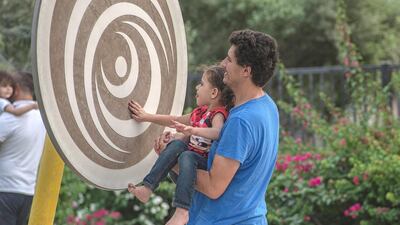
Quality time without someone glued to a gadget has become something of a rarity in this digital age. In our constant quest to consume information online, we have become less observant of the world around us. For instance, children, unfortunately, are more likely to learn about plants or the animal kingdom from a screen than a walk outdoors.
American author and journalist Richard Louv said it best when he coined the term nature deficit disorder in his 2005 book Last Child in the Woods, outlining how people, specifically children, are spending less time outdoors. He argued that it makes them feel alienated from nature, and more prone to negative moods such as stress and anxiety, reduced attention span and increased obesity.
Experts agree. A research article titled Residential Green Space in Childhood is Associated with Lower Risk of Psychiatric Disorders from Adolescence into Adulthood, published last year in the journal Proceedings of the National Academy of Sciences of the United States of America, concluded that exposure to green spaces during childhood is associated with better mental health, supporting efforts to better integrate natural environments into urban planning and childhood life.
Time spent in natural surroundings relieves mental fatigue, which in return relieves inattentiveness, irritability and impulsiveness – recognised by psychologists as precursors to violence. Parks, more specifically, provide spaces and opportunities for unstructured play and leisure for all ages, activities that boost cognitive behaviour and improve physical health.
With regard to screen time, the norm used to be none for children under 2, and up to two hours for children and teenagers. However, the American Academy of Pediatrics has since updated its guidelines to match the realities of today’s world.
The academy notes that it is practically impossible to enforce a strict two-hour daily limit on school-age children. Instead, it recommends that parents place a sensible limit, and outlines that it’s more important to examine the big picture.
Despite these recommendations, the Centers for Disease Control and Prevention (CDC) reports that children between the ages of 8 and 10 spend an average of six hours per day in front of a screen, those in the 11 to 14 age range spend an average of nine hours, and teenagers from 15 to 18 an average of 7.5 hours.
To make matters more challenging, the Covid-19 pandemic brought its own set of limitations. With everyone confined indoors and with most public and outdoors spaces closed for about four months, us, and our children, were left with only a handful of feasible activities.
A survey conducted by ParentsTogether, a family-centred website, produced alarming results. It noted that the amount of time children spent in front of a screen increased by a staggering 500 per cent during the pandemic, with 30 per cent of the 3,000 parents surveyed confirming that their children were getting four hours or more of additional non-school-related screen time on a daily basis.
So how can we – as parents, caregivers, teachers and even policymakers – prioritise giving our little ones outdoor time on a regular basis?
Give children ‘phygital’ experiences
We cannot deny the realities of today’s world: we are living in a digital era, and our children are becoming increasingly dependent on screens. Rather than ignoring or fearing the fact that, as digital natives, our children will turn to a screen to play, learn and even perform daily tasks, we must instead learn to embrace the positives of modern technology.
One way to do that is by providing children with “phygital” experiences, which blend physical and technological experiences effortlessly, creating an immersive activity that merges the best of both worlds. A cinema in the park experience, for instance, or using a physical toy or experience with digital interaction, ideally in the great outdoors.
Take advantage of the cool weather to explore nature
With the weather cooling down across the UAE, restrictions eased, and parks reopening, families can use the opportunity to step outside.
Set a goal of an hour per day and use green spaces, where children can play and learn in equal measure, to educate, enrich and explore.
Aside from the various health benefits, urban parks allow people to unplug and connect with nature. They offer children a sense of place and belonging as an antidote to social alienation.
It increases their motivation to discover different aspects of their world, a penchant for flora and fauna via a botanical garden or petting zoo, perhaps. It also engages them in informal, experiential learning through play, while health-promoting recreational activities improve overall well-being.
Support a curriculum that allows education through recreation
According to the Brec Foundation, research shows that healthier and happier children do better in school, and that education is an important determinant of future health. However, education is not just about lessons within the four walls of a classroom, and many children do not learn exclusively in class.
They need alternative, hands-on learning environments to match their varied learning styles. City parks, greenways, and naturalised school grounds can be a crucial antidote. They can motivate young people to learn through the natural environment (and about it as well), bringing environmental education into the mainstream of state-mandated instructional programmes.
The outdoor environment encourages skills such as problem-solving and assessing risk, while also emphasising emotional and social needs, as well as opportunities for creativity – which are all important components for development.
The more exposed children are to the outdoors, the better their health, social functioning, character and skills. In addition, educational tours have been proven to be beneficial to teachers, overall improving job satisfaction and personal well-being.
Rasha Kablawi is head of corporate affairs and communications at Umm Al Emarat Park, which is equipped with features such as an amphitheatre, open-air cinema, botanic garden, animal barn and petting zoo, and a 1.2-kilometre green jogging track

RESULTS
Bantamweight:
Zia Mashwani (PAK) bt Chris Corton (PHI)
Super lightweight:
Flavio Serafin (BRA) bt Mohammad Al Khatib (JOR)
Super lightweight:
Dwight Brooks (USA) bt Alex Nacfur (BRA)
Bantamweight:
Tariq Ismail (CAN) bt Jalal Al Daaja (JOR)
Featherweight:
Abdullatip Magomedov (RUS) bt Sulaiman Al Modhyan (KUW)
Middleweight:
Mohammad Fakhreddine (LEB) bt Christofer Silva (BRA)
Middleweight:
Rustam Chsiev (RUS) bt Tarek Suleiman (SYR)
Welterweight:
Khamzat Chimaev (SWE) bt Mzwandile Hlongwa (RSA)
Lightweight:
Alex Martinez (CAN) bt Anas Siraj Mounir (MAR)
Welterweight:
Jarrah Al Selawi (JOR) bt Abdoul Abdouraguimov (FRA)
MATCH INFO
Manchester City 1 (Gundogan 56')
Shakhtar Donetsk 1 (Solomon 69')
Who's who in Yemen conflict
Houthis: Iran-backed rebels who occupy Sanaa and run unrecognised government
Yemeni government: Exiled government in Aden led by eight-member Presidential Leadership Council
Southern Transitional Council: Faction in Yemeni government that seeks autonomy for the south
Habrish 'rebels': Tribal-backed forces feuding with STC over control of oil in government territory
New UK refugee system
- A new “core protection” for refugees moving from permanent to a more basic, temporary protection
- Shortened leave to remain - refugees will receive 30 months instead of five years
- A longer path to settlement with no indefinite settled status until a refugee has spent 20 years in Britain
- To encourage refugees to integrate the government will encourage them to out of the core protection route wherever possible.
- Under core protection there will be no automatic right to family reunion
- Refugees will have a reduced right to public funds
The five pillars of Islam
Ten tax points to be aware of in 2026
1. Domestic VAT refund amendments: request your refund within five years
If a business does not apply for the refund on time, they lose their credit.
2. E-invoicing in the UAE
Businesses should continue preparing for the implementation of e-invoicing in the UAE, with 2026 a preparation and transition period ahead of phased mandatory adoption.
3. More tax audits
Tax authorities are increasingly using data already available across multiple filings to identify audit risks.
4. More beneficial VAT and excise tax penalty regime
Tax disputes are expected to become more frequent and more structured, with clearer administrative objection and appeal processes. The UAE has adopted a new penalty regime for VAT and excise disputes, which now mirrors the penalty regime for corporate tax.
5. Greater emphasis on statutory audit
There is a greater need for the accuracy of financial statements. The International Financial Reporting Standards standards need to be strictly adhered to and, as a result, the quality of the audits will need to increase.
6. Further transfer pricing enforcement
Transfer pricing enforcement, which refers to the practice of establishing prices for internal transactions between related entities, is expected to broaden in scope. The UAE will shortly open the possibility to negotiate advance pricing agreements, or essentially rulings for transfer pricing purposes.
7. Limited time periods for audits
Recent amendments also introduce a default five-year limitation period for tax audits and assessments, subject to specific statutory exceptions. While the standard audit and assessment period is five years, this may be extended to up to 15 years in cases involving fraud or tax evasion.
8. Pillar 2 implementation
Many multinational groups will begin to feel the practical effect of the Domestic Minimum Top-Up Tax (DMTT), the UAE's implementation of the OECD’s global minimum tax under Pillar 2. While the rules apply for financial years starting on or after January 1, 2025, it is 2026 that marks the transition to an operational phase.
9. Reduced compliance obligations for imported goods and services
Businesses that apply the reverse-charge mechanism for VAT purposes in the UAE may benefit from reduced compliance obligations.
10. Substance and CbC reporting focus
Tax authorities are expected to continue strengthening the enforcement of economic substance and Country-by-Country (CbC) reporting frameworks. In the UAE, these regimes are increasingly being used as risk-assessment tools, providing tax authorities with a comprehensive view of multinational groups’ global footprints and enabling them to assess whether profits are aligned with real economic activity.
Contributed by Thomas Vanhee and Hend Rashwan, Aurifer
F1 line ups in 2018
Mercedes-GP Lewis Hamilton and Valtteri Bottas; Ferrari Sebastian Vettel and Kimi Raikkonen; Red Bull Daniel Ricciardo and Max Verstappen; Force India Esteban Ocon and Sergio Perez; Renault Nico Hülkenberg and Carlos Sainz Jr; Williams Lance Stroll and Felipe Massa / Robert Kubica / Paul di Resta; McLaren Fernando Alonso and Stoffel Vandoorne; Toro Rosso TBA; Haas F1 Romain Grosjean and Kevin Magnussen; Sauber TBA
Skoda Superb Specs
Engine: 2-litre TSI petrol
Power: 190hp
Torque: 320Nm
Price: From Dh147,000
Available: Now
Countdown to Zero exhibition will show how disease can be beaten
Countdown to Zero: Defeating Disease, an international multimedia exhibition created by the American Museum of National History in collaboration with The Carter Center, will open in Abu Dhabi a month before Reaching the Last Mile.
Opening on October 15 and running until November 15, the free exhibition opens at The Galleria mall on Al Maryah Island, and has already been seen at the Jimmy Carter Presidential Library and Museum in Atlanta, the American Museum of Natural History in New York, and the London School of Hygiene and Tropical Medicine.
The specs
- Engine: 3.9-litre twin-turbo V8
- Power: 640hp
- Torque: 760nm
- On sale: 2026
- Price: Not announced yet
Western Region Asia Cup T20 Qualifier
Sun Feb 23 – Thu Feb 27, Al Amerat, Oman
The two finalists advance to the Asia qualifier in Malaysia in August
Group A
Bahrain, Maldives, Oman, Qatar
Group B
UAE, Iran, Kuwait, Saudi Arabia
UAE group fixtures
Sunday Feb 23, 9.30am, v Iran
Monday Feb 25, 1pm, v Kuwait
Tuesday Feb 26, 9.30am, v Saudi
UAE squad
Ahmed Raza, Rohan Mustafa, Alishan Sharafu, Ansh Tandon, Vriitya Aravind, Junaid Siddique, Waheed Ahmed, Karthik Meiyappan, Basil Hameed, Mohammed Usman, Mohammed Ayaz, Zahoor Khan, Chirag Suri, Sultan Ahmed
Emergency
Director: Kangana Ranaut
Stars: Kangana Ranaut, Anupam Kher, Shreyas Talpade, Milind Soman, Mahima Chaudhry
Rating: 2/5
Race%20card
%3Cp%3E6pm%3A%20Al%20Maktoum%20Challenge%20Round%201%20%E2%80%93%20Group%201%20(PA)%20%2450%2C000%20(Dirt)%201%2C600m%3Cbr%3E6.35pm%3A%20Dubai%20Racing%20Club%20Classic%20%E2%80%93%20Handicap%20(TB)%20%24100%2C000%20(D)%202%2C410m%3Cbr%3E7.10pm%3A%20Dubawi%20Stakes%20%E2%80%93%20Group%203%20(TB)%20%24150%2C000%20(D)%201%2C200m%3Cbr%3E7.45pm%3A%20Jumeirah%20Classic%20Trial%20%E2%80%93%20Conditions%20(TB)%20%24150%2C000%20(Turf)%201%2C400m%3Cbr%3E8.20pm%3A%20Al%20Maktoum%20Challenge%20Round%201%20%E2%80%93%20Group%202%20(TB)%20%24250%2C000%20(D)%201%2C600m%3Cbr%3E8.55pm%3A%20Al%20Fahidi%20Fort%20%E2%80%93%20Group%202%20(TB)%20%24180%2C000%20(T)%201%2C400m%3Cbr%3E9.30pm%3A%20Ertijaal%20Dubai%20Dash%20%E2%80%93%20Listed%20(TB)%20%24100%2C000%20(T)%201%2C000m%3C%2Fp%3E%0A
