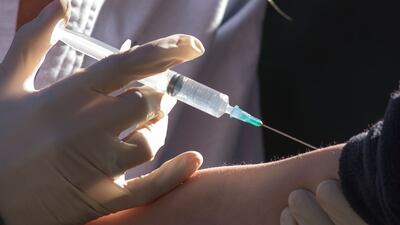
Despite being commonly perceived as a mild illness, chickenpox can lead to death in severe cases. Getty Images

Scientists recommend chickenpox vaccine for children in Britain's NHS


Marwa Hassan
  • English
  • Arabic

The chickenpox vaccine should be introduced for children in Britain's publicly funded healthcare system, scientists have told the government.

The vaccine should be given to children aged 12 to 18 months in the National Health Service, the Joint Committee on Vaccination and Immunisation said.

It added that the vaccine, also known as the varicella shot, should be administered in two doses, at 12 months and then at 18 months.

The recommendations are supported by data from other countries, where the vaccine has significantly reduced the prevalence of chickenpox and prevented most severe cases in children.

The JCVI suggested a temporary catch-up programme for older children who miss the initial vaccination age.

Officials in the Department of Health and Social Care were reviewing the recommendation.

University of Oxford studies found that two doses of the vaccine – given as two separate injections at least four weeks apart – give about 98 per cent protection in children and about 75 per cent protection in teenagers and adults.

Historically, the NHS has been hesitant to introduce the chickenpox vaccine, citing concerns that it might increase the risk of chickenpox and shingles in adults.

The underlying reasoning was that vaccination would prevent childhood infection, potentially leading to more severe cases in unvaccinated adults.

However, there has been a shift in perspective based on new data and international experiences.

Prof Sir Andrew Pollard, chairman of the JCVI, emphasised the seriousness of chickenpox, particularly in babies, younger children, and adults.

“Chickenpox is well known, and most parents will probably consider it a common and mild illness among children,” he said.

“But for some babies, young children and even adults, chickenpox or its complications can be very serious, resulting in hospitalisation and even death.”

Adding the varicella vaccine to the childhood immunisation programme will dramatically reduce the number of chickenpox cases in the community, Prof Pollard said, leading to far fewer of the more serious cases.

“We now have decades of evidence from the US and other countries showing that introducing this programme is safe, effective and will have a really positive impact on the health of young children,” he said.

What is chickenpox?

Chickenpox, caused by the varicella-zoster virus, is an acute and highly contagious disease.

Up to 90 per cent of non-immune individuals in close contact with an infected person are at risk of infection.

The disease begins with mild fever and headaches, followed by a rash that develops into itchy fluid-filled blisters. The virus spreads through direct contact with the rash, airborne droplets, or infected items like clothing.

Symptoms typically appear 14 to 21 days after infection. Infectiousness peaks one to two days before the rash and continues until all blisters crust over.

After chickenpox infection, the virus can remain dormant in the nervous system and reactivate years later as shingles (herpes zoster).

It mostly affects children under 10 and spreads rapidly in close-contact settings like schools.

While usually mild in children, chickenpox can be more severe in adolescents, adults, and specific groups like newborns, pregnant women, and the immunocompromised.

Possible complications include pneumonia, secondary bacterial infections, encephalitis, and in rare cases, death.

In pregnant women, varicella infection can lead to severe chickenpox and congenital varicella syndrome in the foetus, causing limb deformities, skin scarring, cataracts, and growth retardation.

Symptom management mainly involves reducing fever and itchiness.

Antiviral drugs and immunoglobulin are available for high-risk individuals to prevent severe illness.

Chickenpox is endemic worldwide, with peak outbreaks in winter and spring in temperate climates.

By age 15, nine out of 10 people in the UK have had chickenpox.

Two vaccines are licensed in the UK. Vaccination is advised for children close to high-risk individuals and non-immune healthcare workers.


The specs
Engine: 3.0-litre twin-turbo flat-six

Power: 480hp at 6,500rpm

Torque: 570Nm from 2,300-5,000rpm

Transmission: 8-speed dual-clutch auto

Fuel consumption: 10.4L/100km

Price: from Dh547,600

On sale: now 

Some of Darwish's last words

"They see their tomorrows slipping out of their reach. And though it seems to them that everything outside this reality is heaven, yet they do not want to go to that heaven. They stay, because they are afflicted with hope." - Mahmoud Darwish, to attendees of the Palestine Festival of Literature, 2008

His life in brief: Born in a village near Galilee, he lived in exile for most of his life and started writing poetry after high school. He was arrested several times by Israel for what were deemed to be inciteful poems. Most of his work focused on the love and yearning for his homeland, and he was regarded the Palestinian poet of resistance. Over the course of his life, he published more than 30 poetry collections and books of prose, with his work translated into more than 20 languages. Many of his poems were set to music by Arab composers, most significantly Marcel Khalife. Darwish died on August 9, 2008 after undergoing heart surgery in the United States. He was later buried in Ramallah where a shrine was erected in his honour.

THE SPECS

Engine: 6.0-litre, twin-turbocharged W12

Transmission: eight-speed automatic

Power: 626bhp

Torque: 900Nm

Price: Dh1,050,000

On sale: now

Will the pound fall to parity with the dollar?

The idea of pound parity now seems less far-fetched as the risk grows that Britain may split away from the European Union without a deal.

Rupert Harrison, a fund manager at BlackRock, sees the risk of it falling to trade level with the dollar on a no-deal Brexit. The view echoes Morgan Stanley’s recent forecast that the currency can plunge toward $1 (Dh3.67) on such an outcome. That isn’t the majority view yet – a Bloomberg survey this month estimated the pound will slide to $1.10 should the UK exit the bloc without an agreement.

New Prime Minister Boris Johnson has repeatedly said that Britain will leave the EU on the October 31 deadline with or without an agreement, fuelling concern the nation is headed for a disorderly departure and fanning pessimism toward the pound. Sterling has fallen more than 7 per cent in the past three months, the worst performance among major developed-market currencies.

“The pound is at a much lower level now but I still think a no-deal exit would lead to significant volatility and we could be testing parity on a really bad outcome,” said Mr Harrison, who manages more than $10 billion in assets at BlackRock. “We will see this game of chicken continue through August and that’s likely negative for sterling,” he said about the deadlocked Brexit talks.

The pound fell 0.8 per cent to $1.2033 on Friday, its weakest closing level since the 1980s, after a report on the second quarter showed the UK economy shrank for the first time in six years. The data means it is likely the Bank of England will cut interest rates, according to Mizuho Bank.

The BOE said in November that the currency could fall even below $1 in an analysis on possible worst-case Brexit scenarios. Options-based calculations showed around a 6.4 per cent chance of pound-dollar parity in the next one year, markedly higher than 0.2 per cent in early March when prospects of a no-deal outcome were seemingly off the table.

Bloomberg

UAE currency: the story behind the money in your pockets
Updated: November 14, 2023, 1:16 PM