


Centuries-old umbrella-shaped dragon's blood trees line the rugged peaks of Yemen's Socotra – symbols of the Indian Ocean archipelago's extraordinary biodiversity, but also a bleak warning of environmental crisis.
Forests of these ancient trees are being reduced by increasingly intense storms, while replacement saplings are eaten by goats, leaving the fragile biological hot spot vulnerable to desertification.
"The trees bring water, so they are so important," said Adnan Ahmed, a mathematics teacher and tour guide whose passion is Socotra's flora and fauna.
"Without trees, we will be in trouble."
Lying in turquoise seas between Arabia and Africa about 350 kilometres south of Yemen's coast, Socotra is home to more than 50,000 people and is relatively untouched by the civil war raging on the mainland.
Naming it a world heritage site in 2008, Unesco described the main island as one of the world's "most biodiversity rich and distinct" places.
It has also been called the "Galapagos of the Indian Ocean".
Mr Ahmed said islanders traditionally do not fell dragon's blood trees for firewood, both because they perpetuate regular rainfall and because its blood-red sap is medicinal.
But scientists and islanders said that the trees will largely die out within decades, buckling under pressure from global warming that is driving cyclones, as well as invasive species and overgrazing.
"Goats eat the seedlings, so young trees are only found on cliff faces in the most inaccessible places," Mr Ahmed said.
The trees take nearly half a century before they reproduce, he said. "If nothing is done, it will not take long before all are gone."
-
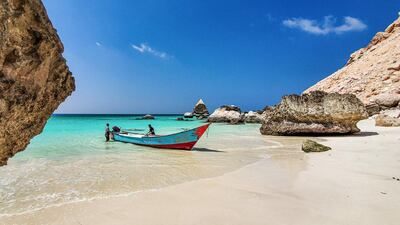
Fishermen take their boat to sea, off Shoab beach, on the Yemeni Island of Socotra. Yemen is hoping its Socotra archipelago will become a dream destination despite the country's nightmarish conflict. The four islands and two rocky islets home to some 50,000 people have remained relatively untouched by the war that has devastated the mainland, with adventurous travellers showing a growing interest in visiting. AFP -

The Arher sand beach on Socotra Island. Located in the Indian Ocean, about 200km south of the Yemeni mainland, the Socotra archipelago is a site of global importance for biodiversity conservation – with its lush landscape, distinctive trees, unique animals and turquoise waters home to dolphins. AFP -

Desert rose (Adenium socotranum) plants grow on Di-Hamri mountain, on Socotra Island. AFP -

A man stands at the top of a peak on Di-Hamri mountain. The four islands and two rocky islets, home to some 50,000 people, have remained relatively untouched by the war that has devastated Yemen's mainland, with adventurous travellers showing a growing interest in visiting. AFP -
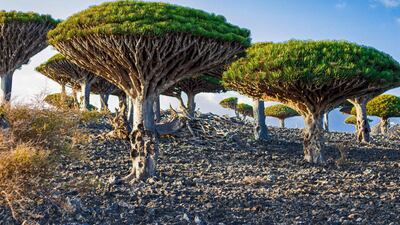
Dragon's blood (Dracaena cinnabari) trees at the top of Dixam mountain on Socotra island AFP -
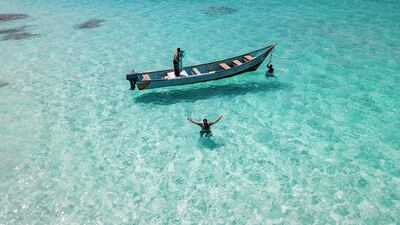
Fishermen wade in the water by a boat off Shoab beach. AFP -

A fresh water spring on the mountain of Homhil on Socotra island. AFP


'Running out of time'
The shrinking forests are an indicator of the threat to Socotra's environment, said Belgian biologist Kay Van Damme, from the University of Ghent.
"It remains a treasure trove of biodiversity," said Mr Van Damme, chairman of the Friends of Socotra support group. "But we may soon be running out of time to protect Socotra's flagship species."
Each lost tree drives a reduction in the hydrological cycle upon which all life depends.
Islanders said trees have been battered by storms more ferocious than anyone remembers.
At Diksam, on the plateau surrounding the Hagher mountains, running like a spine along the 130-kilometre island and 1,500 metres high, dead trees lie scattered like bowling pins.
Other local species are just as hard-hit by storms and overgrazing, including the 10 endemic species of frankincense tree.
Gales have torn through nearly a third of the trees in the Homhil forest over the past decade.
Without replanting efforts, the forest "will be gone in only a few decades", Mr Van Damme said.
One study found the number of frankincense trees had plummeted by 78 per cent in this area between 1956 and 2017.
"The immune system of Socotra is now compromised," he said, but added, "there is still hope".
The scars of landslides caused by vegetation loss are common.
"If the trend continues, future generations might be able to visit a Socotran frankincense tree only in a botanical garden, accompanied by a little plaque saying 'extinct in the wild'," Mr Van Damme said.
The International Union for Conservation of Nature (IUCN) said Socotra is under "high threat", and the "deteriorating" situation will be "accelerated by climate change".
Islanders are feeling the impact of changing weather patterns.
Abdullah Ahmed, from a small fishing village near Shuab, a cluster of solidly built coral-stone homes, said the 40 residents were threatened both by extreme high seas and landslides.
They have built a village 10 minutes' walk from the sea.
"Waves in the last storms smashed the windows of our home," the 25-year-old said, describing how his family had sheltered, terrified, in caves for days.
"The last monsoon was worse than anyone had experienced."
'We have a chance'
But with effort, the worst impact can be slowed – and some Socotris are doing what they can to protect their island.
At a community-run dragon's blood tree nursery the size of a football pitch, dozens of knee-high saplings resembling pineapple plants are the result of at least 15 years' growth.
"It is a start, but much more is needed," said Mr Ahmed, peering over the chest-high stone wall that protects the saplings from goats. "We need support."
Sadia Eissa Suliman was born and raised at the Detwah lagoon, which is listed as a wetland of global importance under the Ramsar Convention.
"I saw how the lagoon was changing," said the 61-year old grandmother, who watched swathes of trees being chopped down, plastic being dumped and fishing nets trawling the water, a nursery for young fish.
"Everyone said someone else would do something," she said. "But I said, 'Enough: I will do it, and people will see the difference.'"
She now helps the community enforce a fishing ban and raises funds to enclose trees and to tackle littering.
Scientists are also determined Socotra will not just become another case study of loss.
"We have a chance as humans to not mess this one up, otherwise we've learnt nothing from other examples of huge extinctions on islands," Mr Van Damme said.
"Socotra is the only island in the entire world where no reptile, plant or bird that we know of has gone extinct in the last 100 years. We have to make sure it stays that way."

