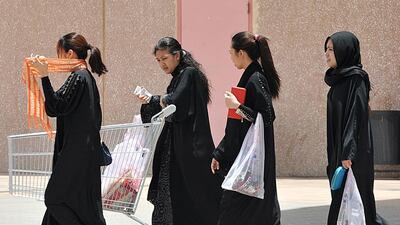
Saudi Arabia banned the word "maid" as derogatory under new regulations aimed to uphold the rights of foreign workers in advertisements for new jobs and in the recruitment process.
The Saudi Ministry of Commerce said job adverts should not include terms such as “servant” or “maid”, and instead advertise for “workers”.
The new directives stipulate that workers will not bear any financial costs "under any circumstances" for exchanges of work permits or similar paperwork changes.
Such alterations can be made only with the workers' consent and employers cannot refer to such payments in job advertisements.
Advertisements cannot publish personal photos, identity card copies, residency permit or any other personal data.
The kingdom is home to 10 million foreign workers, including 3.7 million domestic workers, and has taken measures in recent years to boost employment protection and prevent abuse.
Saudis and expatriates living in the kingdom praised the changes.
Zainab Yusuf, a photographer from the Philippines who lives in Jeddah, told The National that she was pleasantly surprised by the news.
“In today’s age, we cannot have room for racism and discrimination," Ms Yusuf said.
"We cannot raise our children to believe those who work in our homes are lesser than us by using terms like ‘khadama’ [female servant in Arabic].
“It is time to change our mindset and this can be done by changing our vocabulary and actions.
"Give everyone dignity of labour. Domestic workers or CEOs, we are one and the same."
Saudi salary guide – how much you can expect to earn
Parents also welcomed the news, saying such values must be instilled in children at a young age.
“I am so surprised to hear this because I have raised my kids the same way,” said Madiha Khan, an Indian living in Dhahran. "We have always called them helpers, not maids.
"I think it’s important for the society to reflect and encourage good manners and respect every member of society, although I believe the disparity is much greater in India.
"I wish we could have such laws back home that would teach society how to treat people regardless of status.”
Amal Zahrani, a Saudi artist in Jeddah, said it was right to show due respect to people who travel thousands of miles from home to work in the kingdom.
“I think this was much needed," Ms Zahrani said. "They are human and deserve to be respected.
"Thousands of domestic workers leave their families and children to come work for Saudis and it is not easy on them. It is their right to be respected and loved.
“They play a huge role in households and helping us sustain them. Our helper is my child’s second mother and he proudly says it.
"She is part of our family and it would be wrong to think of her as anything less."
Since March 14, expatriates no longer need their employers' permission to change jobs, travel or leave Saudi Arabia, as part of the National Transformation Programme under Vision 2030.

Read more from Johann Chacko
Learn more about Qasr Al Hosn
In 2013, The National's History Project went beyond the walls to see what life was like living in Abu Dhabi's fabled fort:
The Vile
Starring: Bdoor Mohammad, Jasem Alkharraz, Iman Tarik, Sarah Taibah
Director: Majid Al Ansari
Rating: 4/5
UAE squad to face Ireland
Ahmed Raza (captain), Chirag Suri (vice-captain), Rohan Mustafa, Mohammed Usman, Mohammed Boota, Zahoor Khan, Junaid Siddique, Waheed Ahmad, Zawar Farid, CP Rizwaan, Aryan Lakra, Karthik Meiyappan, Alishan Sharafu, Basil Hameed, Kashif Daud, Adithya Shetty, Vriitya Aravind
In numbers: PKK’s money network in Europe
Germany: PKK collectors typically bring in $18 million in cash a year – amount has trebled since 2010
Revolutionary tax: Investigators say about $2 million a year raised from ‘tax collection’ around Marseille
Extortion: Gunman convicted in 2023 of demanding $10,000 from Kurdish businessman in Stockholm
Drug trade: PKK income claimed by Turkish anti-drugs force in 2024 to be as high as $500 million a year
Denmark: PKK one of two terrorist groups along with Iranian separatists ASMLA to raise “two-digit million amounts”
Contributions: Hundreds of euros expected from typical Kurdish families and thousands from business owners
TV channel: Kurdish Roj TV accounts frozen and went bankrupt after Denmark fined it more than $1 million over PKK links in 2013
%20Ramez%20Gab%20Min%20El%20Akher
%3Cp%3E%3Cstrong%3ECreator%3A%3C%2Fstrong%3E%20Ramez%20Galal%3C%2Fp%3E%0A%3Cp%3E%3Cstrong%3EStarring%3A%3C%2Fstrong%3E%20Ramez%20Galal%3C%2Fp%3E%0A%3Cp%3E%3Cstrong%3EStreaming%20on%3A%20%3C%2Fstrong%3EMBC%20Shahid%3C%2Fp%3E%0A%3Cp%3E%3Cstrong%3ERating%3A%20%3C%2Fstrong%3E2.5%2F5%3C%2Fp%3E%0A
Company Profile
Name: Thndr
Started: 2019
Co-founders: Ahmad Hammouda and Seif Amr
Sector: FinTech
Headquarters: Egypt
UAE base: Hub71, Abu Dhabi
Current number of staff: More than 150
Funds raised: $22 million
Dengue%20fever%20symptoms
%3Cul%3E%0A%3Cli%3EHigh%20fever%3C%2Fli%3E%0A%3Cli%3EIntense%20pain%20behind%20your%20eyes%3C%2Fli%3E%0A%3Cli%3ESevere%20headache%3C%2Fli%3E%0A%3Cli%3EMuscle%20and%20joint%20pains%3C%2Fli%3E%0A%3Cli%3ENausea%3C%2Fli%3E%0A%3Cli%3EVomiting%3C%2Fli%3E%0A%3Cli%3ESwollen%20glands%3C%2Fli%3E%0A%3Cli%3ERash%3C%2Fli%3E%0A%3C%2Ful%3E%0A%3Cp%3EIf%20symptoms%20occur%2C%20they%20usually%20last%20for%20two-seven%20days%3C%2Fp%3E%0A
Mercer, the investment consulting arm of US services company Marsh & McLennan, expects its wealth division to at least double its assets under management (AUM) in the Middle East as wealth in the region continues to grow despite economic headwinds, a company official said.
Mercer Wealth, which globally has $160 billion in AUM, plans to boost its AUM in the region to $2-$3bn in the next 2-3 years from the present $1bn, said Yasir AbuShaban, a Dubai-based principal with Mercer Wealth.
“Within the next two to three years, we are looking at reaching $2 to $3 billion as a conservative estimate and we do see an opportunity to do so,” said Mr AbuShaban.
Mercer does not directly make investments, but allocates clients’ money they have discretion to, to professional asset managers. They also provide advice to clients.
“We have buying power. We can negotiate on their (client’s) behalf with asset managers to provide them lower fees than they otherwise would have to get on their own,” he added.
Mercer Wealth’s clients include sovereign wealth funds, family offices, and insurance companies among others.
From its office in Dubai, Mercer also looks after Africa, India and Turkey, where they also see opportunity for growth.
Wealth creation in Middle East and Africa (MEA) grew 8.5 per cent to $8.1 trillion last year from $7.5tn in 2015, higher than last year’s global average of 6 per cent and the second-highest growth in a region after Asia-Pacific which grew 9.9 per cent, according to consultancy Boston Consulting Group (BCG). In the region, where wealth grew just 1.9 per cent in 2015 compared with 2014, a pickup in oil prices has helped in wealth generation.
BCG is forecasting MEA wealth will rise to $12tn by 2021, growing at an annual average of 8 per cent.
Drivers of wealth generation in the region will be split evenly between new wealth creation and growth of performance of existing assets, according to BCG.
Another general trend in the region is clients’ looking for a comprehensive approach to investing, according to Mr AbuShaban.
“Institutional investors or some of the families are seeing a slowdown in the available capital they have to invest and in that sense they are looking at optimizing the way they manage their portfolios and making sure they are not investing haphazardly and different parts of their investment are working together,” said Mr AbuShaban.
Some clients also have a higher appetite for risk, given the low interest-rate environment that does not provide enough yield for some institutional investors. These clients are keen to invest in illiquid assets, such as private equity and infrastructure.
“What we have seen is a desire for higher returns in what has been a low-return environment specifically in various fixed income or bonds,” he said.
“In this environment, we have seen a de facto increase in the risk that clients are taking in things like illiquid investments, private equity investments, infrastructure and private debt, those kind of investments were higher illiquidity results in incrementally higher returns.”
The Abu Dhabi Investment Authority, one of the largest sovereign wealth funds, said in its 2016 report that has gradually increased its exposure in direct private equity and private credit transactions, mainly in Asian markets and especially in China and India. The authority’s private equity department focused on structured equities owing to “their defensive characteristics.”
UAE currency: the story behind the money in your pockets
Red flags
- Promises of high, fixed or 'guaranteed' returns.
- Unregulated structured products or complex investments often used to bypass traditional safeguards.
- Lack of clear information, vague language, no access to audited financials.
- Overseas companies targeting investors in other jurisdictions - this can make legal recovery difficult.
- Hard-selling tactics - creating urgency, offering 'exclusive' deals.
Courtesy: Carol Glynn, founder of Conscious Finance Coaching
EMERGENCY PHONE NUMBERS
Estijaba – 8001717 – number to call to request coronavirus testing
Ministry of Health and Prevention – 80011111
Dubai Health Authority – 800342 – The number to book a free video or voice consultation with a doctor or connect to a local health centre
Emirates airline – 600555555
Etihad Airways – 600555666
Ambulance – 998
Knowledge and Human Development Authority – 8005432 ext. 4 for Covid-19 queries
