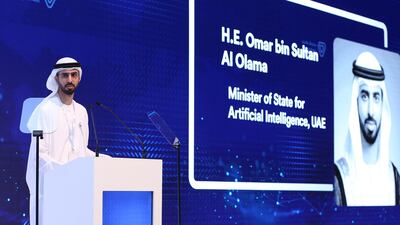
The UAE has been selected to join 49 other countries to be part of the Hiroshima AI Process Friends Group, Omar Al Olama, Minister of State for AI, Digital Economy and Remote Work Applications, has said.
"In this momentous stride towards progress, the UAE shines as a symbol of innovation and collaboration. Embracing the boundless potential of technology and innovation," he wrote on X, formerly Twitter.
"The UAE charts a path towards a future defined by excellence, advancement, and leadership on the world stage, fuelled by a vision that knows no bounds," he added, also noting that the UAE was the only Arab country and the only "regional country" to join the AI safety and security group.
Other countries in the group include the US, UK, Canada, India, Japan, South Korea and Spain.
Created last May during the 49th G7 Summit in Japan, the Hiroshima AI Process initiative was announced with hopes of providing a comprehensive framework to responsibly pursue AI advancements, while at the same time curtailing the potential problems posed by the fast-evolving technology.
According to a recently posted code of conduct provided by the Hiroshima AI Process Friends Group, organisations in the field of AI are encouraged to follow various actions throughout the course of AI development.
"In designing and implementing testing measures, organisations commit to devote attention to the following risks as appropriate," the code of conduct reads.
"Chemical, biological, radiological and nuclear risks, such as the ways in which advanced AI systems can lower barriers to entry, including for non-state actors, for weapons development, design acquisition, or use ... Risks from [AI] models of making copies of themselves or 'self-replicating' or training other models."
The code of conduct, according to the group, will be updated periodically amid ongoing meetings and consultations with member countries and other organisations.
The international framework is one of several efforts under way on a global scale that seek to create standards and shed light on the potential dangers of AI.
In October, Britain’s Prime Minister Rishi Sunak hosted an AI Summit attended by various world leaders and experts, resulting in the Bletchley Declaration, which endorsed proposals for tackling potentially catastrophic harm, either deliberate or unintentional, from AI technology.
The UAE has in recent years sought to be a leader in AI development and regulatory frameworks.
In 2019, well before AI momentum began to build, the UAE opened the Mohamed bin Zayed University of Artificial Intelligence, one of the first higher education institutions in the world to have a singular focus on AI.
Last year, several months after OpenAI's ChatGPT became the centre of the AI universe, the company's chief executive Sam Altman visited the UAE and spoke of his optimism that the Middle East and North Africa could play a central role in developing safe AI, while also noting the UAE “had been talking about AI since before it was cool”.
Mr Altman also spoke to Mr Al Olama during the 2024 World Governments Summit in Dubai, where he said the UAE would be "well-positioned to be a leader" in the discussions around AI safety measures and auditing.

In numbers: PKK’s money network in Europe
Germany: PKK collectors typically bring in $18 million in cash a year – amount has trebled since 2010
Revolutionary tax: Investigators say about $2 million a year raised from ‘tax collection’ around Marseille
Extortion: Gunman convicted in 2023 of demanding $10,000 from Kurdish businessman in Stockholm
Drug trade: PKK income claimed by Turkish anti-drugs force in 2024 to be as high as $500 million a year
Denmark: PKK one of two terrorist groups along with Iranian separatists ASMLA to raise “two-digit million amounts”
Contributions: Hundreds of euros expected from typical Kurdish families and thousands from business owners
TV channel: Kurdish Roj TV accounts frozen and went bankrupt after Denmark fined it more than $1 million over PKK links in 2013
Quick pearls of wisdom
Focus on gratitude: And do so deeply, he says. “Think of one to three things a day that you’re grateful for. It needs to be specific, too, don’t just say ‘air.’ Really think about it. If you’re grateful for, say, what your parents have done for you, that will motivate you to do more for the world.”
Know how to fight: Shetty married his wife, Radhi, three years ago (he met her in a meditation class before he went off and became a monk). He says they’ve had to learn to respect each other’s “fighting styles” – he’s a talk it-out-immediately person, while she needs space to think. “When you’re having an argument, remember, it’s not you against each other. It’s both of you against the problem. When you win, they lose. If you’re on a team you have to win together.”
Chef Nobu's advice for eating sushi
“One mistake people always make is adding extra wasabi. There is no need for this, because it should already be there between the rice and the fish.
“When eating nigiri, you must dip the fish – not the rice – in soy sauce, otherwise the rice will collapse. Also, don’t use too much soy sauce or it will make you thirsty. For sushi rolls, dip a little of the rice-covered roll lightly in soy sauce and eat in one bite.
“Chopsticks are acceptable, but really, I recommend using your fingers for sushi. Do use chopsticks for sashimi, though.
“The ginger should be eaten separately as a palette cleanser and used to clear the mouth when switching between different pieces of fish.”
Game Changer
Director: Shankar
Stars: Ram Charan, Kiara Advani, Anjali, S J Suryah, Jayaram
Rating: 2/5
What drives subscription retailing?
Once the domain of newspaper home deliveries, subscription model retailing has combined with e-commerce to permeate myriad products and services.
The concept has grown tremendously around the world and is forecast to thrive further, according to UnivDatos Market Insights’ report on recent and predicted trends in the sector.
The global subscription e-commerce market was valued at $13.2 billion (Dh48.5bn) in 2018. It is forecast to touch $478.2bn in 2025, and include the entertainment, fitness, food, cosmetics, baby care and fashion sectors.
The report says subscription-based services currently constitute “a small trend within e-commerce”. The US hosts almost 70 per cent of recurring plan firms, including leaders Dollar Shave Club, Hello Fresh and Netflix. Walmart and Sephora are among longer established retailers entering the space.
UnivDatos cites younger and affluent urbanites as prime subscription targets, with women currently the largest share of end-users.
That’s expected to remain unchanged until 2025, when women will represent a $246.6bn market share, owing to increasing numbers of start-ups targeting women.
Personal care and beauty occupy the largest chunk of the worldwide subscription e-commerce market, with changing lifestyles, work schedules, customisation and convenience among the chief future drivers.