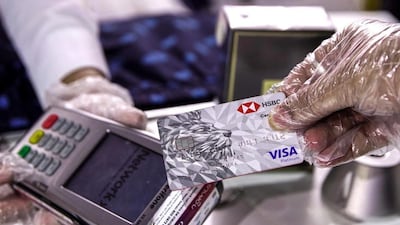
The Covid-19 pandemic is encouraging businesses to deploy technologies that will boost the digital payments business from $4.4 trillion this year to $8.26 trillion in 2024, according to Statista. Victor Besa / The National
The Covid-19 pandemic is encouraging businesses to deploy technologies that will boost the digital payments business from $4.4 trillion this year to $8.26 trillion in 2024, according to Statista. Vict

What a cashless society could look like


  • English
  • Arabic

The Covid-19 pandemic has spurred the rapid adoption of digital payments worldwide to meet soaring demand for contactless transactions, and the UAE is adapting to the "tectonic shift" faster than experts expected.

Technologies such as biometric identification and Quick Response (QR) codes are evolving as the next modes of payment, according to retail, technology and credit card companies.

"The introduction of biometrics, especially facial recognition, may emerge as a popular payment mechanism," Arjun Vir Singh, executive vice president of cards and payments at Dubai conglomerate Al-Futtaim Group, tells The National.

“You become the form-factor, you no longer need to even take out your phone,” he said.

This week, Amazon made that future a reality, as it introduced a payment-enabling palm scanner. The product, which links the characteristics of a person's palm to their Amazon account, will be tested at two of the company's physical stores in Seattle.

Using biometric data for commercial purposes goes all the way back to 1839, when a deed of sale on a house in China was signed with a fingerprint, according to Dr Anil K Jain, a board member of Mohamed Bin Zayed University of Artificial Intelligence.

Back then, it addressed issues of illiteracy. Today, the use of biometric data to initiate payments by mobile phone are expected to secure $2.5 trillion by 2024 from the $228 million forecast for 2019, according to UK-based Juniper Research.

About 90 per cent of smartphones will have some form of dedicated biometric hardware in the next four years, enabling payment by phone, facial recognition or a thumbprint scan, according to Juniper.

As the global economy emerges from what has been touted as the deepest recession since the Great Depression, analysts predict the uptake of digital payments will accelerate with the economic rebound.

In the UAE, consumers are anticipating a shift. Two-thirds of people expect the country to become fully cashless by 2030, according to a new poll by Standard Chartered.

Biometric authentication will be used to secure $2.5 trillion in mobile payment transactions by 2024. Reem Mohammed / The National

"The checkout experience has changed for good and we expect this trend to stay," Khalid Elgibali, Mastercard's division president for Middle East and North Africa, told The National.

“While previously driven by convenience, the concerns around public health and hygiene have accelerated this [transition] exponentially.”

Abu Dhabi-based PayBy, which launched mobile payment services in March, is offering a peer-to-peer transfer feature that scans a user’s QR code and conducts cashless transactions without sharing private data.

A QR Code is a square barcode that contains machine-scannable data that can be read by smartphones. The information stored in the code can be used to make a call, make payments, open a website and for many other applications.

"We expect digital payments to eventually overtake most cash usage as consumers favour convenience and a seamless checkout experience," Sebastian Reis, executive vice president of global e-commerce at Checkout.com, told The National.

Checkout.com offers connected payment solutions for many of the region’s leading brands including Careem, Deliveroo, Zomato and Hungerstation.

The road ahead needs to be marked by greater safety, security, speed and convenience, driven by industry players providing and supporting the digital payments infrastructure, experts said.

The pandemic was a “tectonic shift” in payments, said Akshay Chopra, head of innovation and design for Central Europe, Middle East and Africa, at Visa.

Three out of four UAE consumers will prefer a store where they don’t need to interact with a cashier and will gladly switch stores if it means contactless shopping, he added.

Visa is now imagining a world where customers can scan QR codes to add products to their shopping cart in-store and checkout without interacting with a sales person. It is testing the technology at its innovation centre in Dubai.

Amid a wider uptake, service providers said they are working to build the trust of consumers, which along with inclusion are top concerns for consumers and technology developers alike.

“Security by design is central to development of new payment technologies,” Mr Elgibali said.

More than 60 per cent of the UAE’s current working population, especially in manufacturing, trading, food and beverage and construction, sits outside the traditional banking system, according to Edenred data.

With the outbreak of Covid-19 "it is becoming critical for businesses to ensure financial inclusion," Anouar Bourakkadi Idrissi, chief executive at Edenred UAE, said.

Edenred launched a Mastercard-linked app in August to facilitate financial inclusion.

“Now even unbanked employees can become cardholders," he said.

The company serves more than two million employees with its payroll app.

In June, Dubai-based ride-hailing company Careem teamed up with Visa to offer its drivers real-time access to their daily trip earnings.

The company has experienced an uptick in digital transactions during the pandemic.

Currently 90 per cent of its UAE customers are using cashless option Careem Pay against the 75 per cent before the pandemic, said Hassan Mahbub, head of strategy at Careem Pay.

“Covid struck and we saw, like other e-commerce platforms, a shift to non-cash ... on the payments front, it gives us a very strong footprint and baseline,” he said.

The Careem Pay wallet is the most downloaded wallet in the region and one in three rides are paid for through it.

To facilitate the digital transactions, banks are also sprucing up their infrastructure.

As banks increase their digital capabilities in the evolving environment they need to ensure seamless functionality across platforms, said Colin Dallas, head of retail banking at the National Bank of Fujairah.

It is critical to have effective measures in place to protect passwords, biometrics, linking mobile devices and customer’s online account, he added.

To enhance its mobile banking capabilities, the National Bank of Fujairah enrolled in ‘Klip’ - the nationwide multi-bank initiative, launched by Emirates Digital Wallet, that provides instant and person-to-person payments in the UAE through a mobile app.

“Transactions needs to be a quick and simple process with a maximum of one tap," Mr Dallas said. A bank "needs to ensure that all merchants will accept these payment methods”.

Paatal Lok season two

Directors: Avinash Arun, Prosit Roy 

Stars: Jaideep Ahlawat, Ishwak Singh, Lc Sekhose, Merenla Imsong

Rating: 4.5/5

How to protect yourself when air quality drops

Install an air filter in your home.

Close your windows and turn on the AC.

Shower or bath after being outside.

Wear a face mask.

Stay indoors when conditions are particularly poor.

If driving, turn your engine off when stationary.

Iran's dirty tricks to dodge sanctions

There’s increased scrutiny on the tricks being used to keep commodities flowing to and from blacklisted countries. Here’s a description of how some work.

1 Going Dark

A common method to transport Iranian oil with stealth is to turn off the Automatic Identification System, an electronic device that pinpoints a ship’s location. Known as going dark, a vessel flicks the switch before berthing and typically reappears days later, masking the location of its load or discharge port.

2. Ship-to-Ship Transfers

A first vessel will take its clandestine cargo away from the country in question before transferring it to a waiting ship, all of this happening out of sight. The vessels will then sail in different directions. For about a third of Iranian exports, more than one tanker typically handles a load before it’s delivered to its final destination, analysts say.

3. Fake Destinations

Signaling the wrong destination to load or unload is another technique. Ships that intend to take cargo from Iran may indicate their loading ports in sanction-free places like Iraq. Ships can keep changing their destinations and end up not berthing at any of them.

4. Rebranded Barrels

Iranian barrels can also be rebranded as oil from a nation free from sanctions such as Iraq. The countries share fields along their border and the crude has similar characteristics. Oil from these deposits can be trucked out to another port and documents forged to hide Iran as the origin.

* Bloomberg

War

Director: Siddharth Anand

Cast: Hrithik Roshan, Tiger Shroff, Ashutosh Rana, Vaani Kapoor

Rating: Two out of five stars 

India squad for fourth and fifth Tests

Kohli (c), Dhawan, Rahul, Shaw, Pujara, Rahane (vc), Karun, Karthik (wk), Pant (wk), Ashwin, Jadeja, Pandya, Ishant, Shami, Umesh, Bumrah, Thakur, Vihari

The 100 Best Novels in Translation
Boyd Tonkin, Galileo Press

NYBL PROFILE

Company name: Nybl 

Date started: November 2018

Founder: Noor Alnahhas, Michael LeTan, Hafsa Yazdni, Sufyaan Abdul Haseeb, Waleed Rifaat, Mohammed Shono

Based: Dubai, UAE

Sector: Software Technology / Artificial Intelligence

Initial investment: $500,000

Funding round: Series B (raising $5m)

Partners/Incubators: Dubai Future Accelerators Cohort 4, Dubai Future Accelerators Cohort 6, AI Venture Labs Cohort 1, Microsoft Scale-up 

Omar Yabroudi's factfile

Born: October 20, 1989, Sharjah

Education: Bachelor of Science and Football, Liverpool John Moores University

2010: Accrington Stanley FC, internship

2010-2012: Crystal Palace, performance analyst with U-18 academy

2012-2015: Barnet FC, first-team performance analyst/head of recruitment

2015-2017: Nottingham Forest, head of recruitment

2018-present: Crystal Palace, player recruitment manager


All%20The%20Light%20We%20Cannot%20See%20
%3Cp%3E%3Cstrong%3ECreator%3A%20%3C%2Fstrong%3ESteven%20Knight%3C%2Fp%3E%0A%3Cp%3E%3Cstrong%3EStars%3A%C2%A0%3C%2Fstrong%3EMark%20Ruffalo%2C%20Hugh%20Laurie%2C%20Aria%20Mia%20Loberti%3C%2Fp%3E%0A%3Cp%3E%3Cstrong%3ERating%3A%20%3C%2Fstrong%3E1%2F5%C2%A0%3C%2Fp%3E%0A
Profile

Name: Carzaty

Founders: Marwan Chaar and Hassan Jaffar

Launched: 2017

Employees: 22

Based: Dubai and Muscat

Sector: Automobile retail

Funding to date: $5.5 million

Tips to keep your car cool
  • Place a sun reflector in your windshield when not driving
  • Park in shaded or covered areas
  • Add tint to windows
  • Wrap your car to change the exterior colour
  • Pick light interiors - choose colours such as beige and cream for seats and dashboard furniture
  • Avoid leather interiors as these absorb more heat
South Africa squad

Faf du Plessis (captain), Hashim Amla, Temba Bavuma, Quinton de Kock (wicketkeeper), Theunis de Bruyn, AB de Villiers, Dean Elgar, Heinrich Klaasen (wicketkeeper), Keshav Maharaj, Aiden Markram, Morne Morkel, Wiaan Mulder, Lungi Ngidi, Vernon Philander and Kagiso Rabada.

MATCH INFO

Uefa Champions League semi-final, second leg result:

Ajax 2-3 Tottenham

Tottenham advance on away goals rule after tie ends 3-3 on aggregate

Final: June 1, Madrid

Retail gloom

Online grocer Ocado revealed retail sales fell 5.7 per cen in its first quarter as customers switched back to pre-pandemic shopping patterns.

It was a tough comparison from a year earlier, when the UK was in lockdown, but on a two-year basis its retail division, a joint venture with Marks&Spencer, rose 31.7 per cent over the quarter.

The group added that a 15 per cent drop in customer basket size offset an 11.6. per cent rise in the number of customer transactions.

The winners

Fiction

  • ‘Amreekiya’  by Lena Mahmoud
  •  ‘As Good As True’ by Cheryl Reid

The Evelyn Shakir Non-Fiction Award

  • ‘Syrian and Lebanese Patricios in Sao Paulo’ by Oswaldo Truzzi;  translated by Ramon J Stern
  • ‘The Sound of Listening’ by Philip Metres

The George Ellenbogen Poetry Award

  • ‘Footnotes in the Order  of Disappearance’ by Fady Joudah

Children/Young Adult

  •  ‘I’ve Loved You Since Forever’ by Hoda Kotb 
THE%20FLASH
%3Cp%3E%3Cstrong%3EDirector%3A%3C%2Fstrong%3E%20Andy%20Muschietti%3Cbr%3E%3Cstrong%3EStars%3A%3C%2Fstrong%3E%20Sasha%20Calle%2C%20Ben%20Affleck%2C%20Ezra%20Miller%3Cbr%3E%3Cstrong%3ERating%3A%20%3C%2Fstrong%3E3%2F5%3C%2Fp%3E%0A
What sanctions would be reimposed?

Under ‘snapback’, measures imposed on Iran by the UN Security Council in six resolutions would be restored, including:

  • An arms embargo
  • A ban on uranium enrichment and reprocessing
  • A ban on launches and other activities with ballistic missiles capable of delivering nuclear weapons, as well as ballistic missile technology transfer and technical assistance
  • A targeted global asset freeze and travel ban on Iranian individuals and entities
  • Authorisation for countries to inspect Iran Air Cargo and Islamic Republic of Iran Shipping Lines cargoes for banned goods
