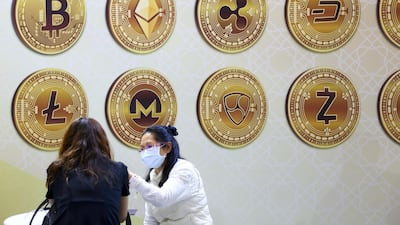
The launch of a digital currency that could purportedly be used to buy goods online and in-store is a scam, Dubai's government said.
Dubai Coin – a cryptocurrency used for a trial in 2017 and later shelved – was "relaunched" this week amid claims it had official backing.
Its value rose 14-fold from below $0.09 per coin on Tuesday to $1.13 as of 6.45pm UAE time on Thursday, as investors snapped it up.
But the relaunch was a scam with no official backing, Dubai Government Media Office said on Thursday night.
"Dubai Coin cryptocurrency was never approved by any official authority," it said.
"The website promoting the coin is an elaborate phishing campaign that is designed to steal personal information from its visitors."
It is not clear who is behind the scam.
ArabianChain Technology, a UAE-based blockchain start-up that set up Dubai Coin in 2017, said the relaunch was fake and that its name and logo had been used fraudulently in a news release and website.
The company, which owns the Palmex cryptocurrency exchange, shelved Dubai Coin in 2019 to concentrate on Palmex, it said in a previous blog post.
“We haven't made such an announcement, please be cautious,” the company said on Twitter.
It also described a website offering the coins for sale as a "scam".
The website, which featured ArabianChain's logo, was purportedly being run by a company calling itself Dubpay International, but contained no contact details and is no longer operational.
ArabianChain did not respond to further requests for comment.
'Pump and dump schemes'
Although Dubai Coin was effectively shelved, it still exists and can be mined. Such coins can be used by people for nefarious purposes, such as "pump and dump" schemes.
The people behind the ploy buy coins when the price is low, then convince others to join them, causing the price to inflate. This happened with Dubai Coin this week, when a news release was sent out and picked up by a local PR newswire.
The people running the scheme then sell out before the price begins to tank. The buyers who are not in on the game are left with virtually worthless assets.
There are more than 4.26 million Dubai Coins in circulation, meaning it has a market capitalisation of $4.84 million, according to Crypto.com.
The Central Bank of the UAE did not respond to requests for comment, but it has previously issued guidance stating that it "is not presently accepting (or acknowledging) crypto-assets or virtual assets as a legal tender in the UAE".
"The only legal tender in the UAE is the UAE dirham," the regulator said in December.
"Since 2017, crypto scammers are coming up with such illegal tactics at least twice a year … they use the names of Dubai, Abu Dhabi royal family or Saudi royal family, saying that they are issuing digital assets backed by oil and gold," Irina Heaver, a technology lawyer and cryptocurrency enthusiast in Switzerland, told The National.
"People need to be very diligent. First, never invest your hard-earned money based on website news or tweets. Second, do your own research and always avoid random portals that could just come and go overnight."

UAE currency: the story behind the money in your pockets
Key facilities
- Olympic-size swimming pool with a split bulkhead for multi-use configurations, including water polo and 50m/25m training lanes
- Premier League-standard football pitch
- 400m Olympic running track
- NBA-spec basketball court with auditorium
- 600-seat auditorium
- Spaces for historical and cultural exploration
- An elevated football field that doubles as a helipad
- Specialist robotics and science laboratories
- AR and VR-enabled learning centres
- Disruption Lab and Research Centre for developing entrepreneurial skills
Company%C2%A0profile
%3Cp%3ECompany%3A%20Zywa%3Cbr%3EStarted%3A%202021%3Cbr%3EFounders%3A%20Nuha%20Hashem%20and%20Alok%20Kumar%3Cbr%3EBased%3A%20UAE%3Cbr%3EIndustry%3A%20FinTech%3Cbr%3EFunding%20size%3A%20%243m%3Cbr%3ECompany%20valuation%3A%20%2430m%3C%2Fp%3E%0A
Director: Romany Saad
Starring: Mirfat Amin, Boumi Fouad and Tariq Al Ibyari
Who's who in Yemen conflict
Houthis: Iran-backed rebels who occupy Sanaa and run unrecognised government
Yemeni government: Exiled government in Aden led by eight-member Presidential Leadership Council
Southern Transitional Council: Faction in Yemeni government that seeks autonomy for the south
Habrish 'rebels': Tribal-backed forces feuding with STC over control of oil in government territory
SPECS
%3Cp%3EEngine%3A%20Twin-turbocharged%204-litre%20V8%3Cbr%3EPower%3A%20625%20bhp%3Cbr%3ETorque%3A%20630Nm%3Cbr%3EOn%20sale%3A%20Now%3Cbr%3EPrice%3A%20From%20Dh974%2C011%3C%2Fp%3E%0A
The Matrix Resurrections
Director: Lana Wachowski
Stars: Keanu Reeves, Carrie-Anne Moss, Jessica Henwick
Rating:****
The years Ramadan fell in May
Profile box
Founders: Michele Ferrario, Nino Ulsamer and Freddy Lim
Started: established in 2016 and launched in July 2017
Based: Singapore, with offices in the UAE, Malaysia, Hong Kong, Thailand
Sector: FinTech, wealth management
Initial investment: $500,000 in seed round 1 in 2016; $2.2m in seed round 2 in 2017; $5m in series A round in 2018; $12m in series B round in 2019; $16m in series C round in 2020 and $25m in series D round in 2021
Current staff: more than 160 employees
Stage: series D
Investors: EightRoads Ventures, Square Peg Capital, Sequoia Capital India
Anghami
Started: December 2011
Co-founders: Elie Habib, Eddy Maroun
Based: Beirut and Dubai
Sector: Entertainment
Size: 85 employees
Stage: Series C
Investors: MEVP, du, Mobily, MBC, Samena Capital
Mercer, the investment consulting arm of US services company Marsh & McLennan, expects its wealth division to at least double its assets under management (AUM) in the Middle East as wealth in the region continues to grow despite economic headwinds, a company official said.
Mercer Wealth, which globally has $160 billion in AUM, plans to boost its AUM in the region to $2-$3bn in the next 2-3 years from the present $1bn, said Yasir AbuShaban, a Dubai-based principal with Mercer Wealth.
“Within the next two to three years, we are looking at reaching $2 to $3 billion as a conservative estimate and we do see an opportunity to do so,” said Mr AbuShaban.
Mercer does not directly make investments, but allocates clients’ money they have discretion to, to professional asset managers. They also provide advice to clients.
“We have buying power. We can negotiate on their (client’s) behalf with asset managers to provide them lower fees than they otherwise would have to get on their own,” he added.
Mercer Wealth’s clients include sovereign wealth funds, family offices, and insurance companies among others.
From its office in Dubai, Mercer also looks after Africa, India and Turkey, where they also see opportunity for growth.
Wealth creation in Middle East and Africa (MEA) grew 8.5 per cent to $8.1 trillion last year from $7.5tn in 2015, higher than last year’s global average of 6 per cent and the second-highest growth in a region after Asia-Pacific which grew 9.9 per cent, according to consultancy Boston Consulting Group (BCG). In the region, where wealth grew just 1.9 per cent in 2015 compared with 2014, a pickup in oil prices has helped in wealth generation.
BCG is forecasting MEA wealth will rise to $12tn by 2021, growing at an annual average of 8 per cent.
Drivers of wealth generation in the region will be split evenly between new wealth creation and growth of performance of existing assets, according to BCG.
Another general trend in the region is clients’ looking for a comprehensive approach to investing, according to Mr AbuShaban.
“Institutional investors or some of the families are seeing a slowdown in the available capital they have to invest and in that sense they are looking at optimizing the way they manage their portfolios and making sure they are not investing haphazardly and different parts of their investment are working together,” said Mr AbuShaban.
Some clients also have a higher appetite for risk, given the low interest-rate environment that does not provide enough yield for some institutional investors. These clients are keen to invest in illiquid assets, such as private equity and infrastructure.
“What we have seen is a desire for higher returns in what has been a low-return environment specifically in various fixed income or bonds,” he said.
“In this environment, we have seen a de facto increase in the risk that clients are taking in things like illiquid investments, private equity investments, infrastructure and private debt, those kind of investments were higher illiquidity results in incrementally higher returns.”
The Abu Dhabi Investment Authority, one of the largest sovereign wealth funds, said in its 2016 report that has gradually increased its exposure in direct private equity and private credit transactions, mainly in Asian markets and especially in China and India. The authority’s private equity department focused on structured equities owing to “their defensive characteristics.”
