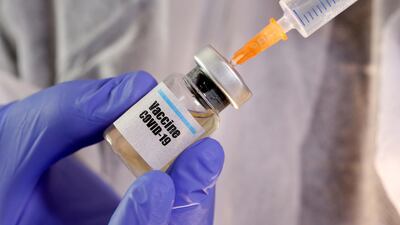
Scams advertising fake Covid-19 vaccines are increasing around the world.Reuters

Covid-19 vaccines sold on darknet from $250 to $1,200 and paid for with Bitcoin


Alkesh Sharma
  • English
  • Arabic

Three major Covid-19 vaccines – Pfizer-BioNTech, AstraZeneca, and Moderna – are being advertised for sale on the darknet and being paid for with Bitcoin, according to cyber security firm Kaspersky.

The price per vaccine ranges from $250 to $1,200, with the average cost about $500, the cyber security firm said. Besides, vaccines from the approved manufacturers, the anonymous sellers are also advertising unverified Covid-19 vaccines.

The majority of those selling Covid-19 vaccines on the darknet are from France, Germany, the UK and the US, Kaspersky said, following an analysis of 15 hidden marketplaces. The darknet is a part of the internet that is not visible to search engines and requires the use of an anonymous browser, such as Tor, to gain access.

Kaspersky said buyers and sellers are communicating via encrypted messaging apps, like Wickr and Telegram, while payments are requested in the form of cryptocurrency, primarily Bitcoin.

“You can find just about anything on the darknet, so it’s not surprising … sellers there would attempt to capitalise on the vaccination campaign,” Dmitry Galov, a security expert at Kaspersky, said. “People [are] selling [not only] vaccine doses, but they are also selling vaccination records … pieces of paper that can help you travel freely. Users need to be cautious of any deal related to the pandemic … it’s never a good idea to buy a vaccine off the darknet,” Mr Galov said.

Over the past year, many online fraudulent campaigns and scams exploiting the Covid-19 pandemic have been unearthed. Earlier this year, US authorities uncovered a criminal operation that was distributing fake Covid-19 vaccines for $1,000 and also seized a website that was advertising Covid-19 scams.

Kaspersky said the majority of underground sellers have made between 100 and 500 transactions, indicating that sales were taking place. But it remained unclear what exactly darknet users were purchasing.

“It is impossible to tell how many of the vaccine doses being advertised online are actual doses and how many advertisements are a scam … most likely what you would receive would not be an effective, valid dose,” the company said.


Stan%20Lee
%3Cp%3E%3Cstrong%3EDirector%3A%3C%2Fstrong%3E%20David%20Gelb%3C%2Fp%3E%0A%3Cp%3E%3Cstrong%3ERating%3A%3C%2Fstrong%3E%203%2F5%3C%2Fp%3E%0A
Afro%20salons
%3Cp%3E%3Cstrong%3EFor%20women%3A%3C%2Fstrong%3E%3Cbr%3ESisu%20Hair%20Salon%2C%20Jumeirah%201%2C%20Dubai%3Cbr%3EBoho%20Salon%2C%20Al%20Barsha%20South%2C%20Dubai%3Cbr%3EMoonlight%2C%20Al%20Falah%20Street%2C%20Abu%20Dhabi%3Cbr%3E%3Cstrong%3EFor%20men%3A%3C%2Fstrong%3E%3Cbr%3EMK%20Barbershop%2C%20Dar%20Al%20Wasl%20Mall%2C%20Dubai%3Cbr%3ERegency%20Saloon%2C%20Al%20Zahiyah%2C%20Abu%20Dhabi%3Cbr%3EUptown%20Barbershop%2C%20Al%20Nasseriya%2C%20Sharjah%3C%2Fp%3E%0A
BRAZIL SQUAD

Alisson (Liverpool), Daniel Fuzato (Roma), Ederson (Man City); Alex Sandro (Juventus), Danilo (Juventus), Eder Militao (Real Madrid), Emerson (Real Betis), Felipe (Atletico Madrid), Marquinhos (PSG), Renan Lodi (Atletico Madrid), Thiago Silva (PSG); Arthur (Barcelona), Casemiro (Real Madrid), Douglas Luiz (Aston Villa), Fabinho (Liverpool), Lucas Paqueta (AC Milan), Philippe Coutinho (Bayern Munich); David Neres (Ajax), Gabriel Jesus (Man City), Richarlison (Everton), Roberto Firmino (Liverpool), Rodrygo (Real Madrid), Willian (Chelsea).

Correspondents

By Tim Murphy

(Grove Press)

Mercer, the investment consulting arm of US services company Marsh & McLennan, expects its wealth division to at least double its assets under management (AUM) in the Middle East as wealth in the region continues to grow despite economic headwinds, a company official said.

Mercer Wealth, which globally has $160 billion in AUM, plans to boost its AUM in the region to $2-$3bn in the next 2-3 years from the present $1bn, said Yasir AbuShaban, a Dubai-based principal with Mercer Wealth.

Within the next two to three years, we are looking at reaching $2 to $3 billion as a conservative estimate and we do see an opportunity to do so,” said Mr AbuShaban.

Mercer does not directly make investments, but allocates clients’ money they have discretion to, to professional asset managers. They also provide advice to clients.

“We have buying power. We can negotiate on their (client’s) behalf with asset managers to provide them lower fees than they otherwise would have to get on their own,” he added.

Mercer Wealth’s clients include sovereign wealth funds, family offices, and insurance companies among others.

From its office in Dubai, Mercer also looks after Africa, India and Turkey, where they also see opportunity for growth.

Wealth creation in Middle East and Africa (MEA) grew 8.5 per cent to $8.1 trillion last year from $7.5tn in 2015, higher than last year’s global average of 6 per cent and the second-highest growth in a region after Asia-Pacific which grew 9.9 per cent, according to consultancy Boston Consulting Group (BCG). In the region, where wealth grew just 1.9 per cent in 2015 compared with 2014, a pickup in oil prices has helped in wealth generation.

BCG is forecasting MEA wealth will rise to $12tn by 2021, growing at an annual average of 8 per cent.

Drivers of wealth generation in the region will be split evenly between new wealth creation and growth of performance of existing assets, according to BCG.

Another general trend in the region is clients’ looking for a comprehensive approach to investing, according to Mr AbuShaban.

“Institutional investors or some of the families are seeing a slowdown in the available capital they have to invest and in that sense they are looking at optimizing the way they manage their portfolios and making sure they are not investing haphazardly and different parts of their investment are working together,” said Mr AbuShaban.

Some clients also have a higher appetite for risk, given the low interest-rate environment that does not provide enough yield for some institutional investors. These clients are keen to invest in illiquid assets, such as private equity and infrastructure.

“What we have seen is a desire for higher returns in what has been a low-return environment specifically in various fixed income or bonds,” he said.

“In this environment, we have seen a de facto increase in the risk that clients are taking in things like illiquid investments, private equity investments, infrastructure and private debt, those kind of investments were higher illiquidity results in incrementally higher returns.”

The Abu Dhabi Investment Authority, one of the largest sovereign wealth funds, said in its 2016 report that has gradually increased its exposure in direct private equity and private credit transactions, mainly in Asian markets and especially in China and India. The authority’s private equity department focused on structured equities owing to “their defensive characteristics.”

Earth under attack: Cosmic impacts throughout history

4.5 billion years ago: Mars-sized object smashes into the newly-formed Earth, creating debris that coalesces to form the Moon

- 66 million years ago: 10km-wide asteroid crashes into the Gulf of Mexico, wiping out over 70 per cent of living species – including the dinosaurs.

50,000 years ago: 50m-wide iron meteor crashes in Arizona with the violence of 10 megatonne hydrogen bomb, creating the famous 1.2km-wide Barringer Crater

1490: Meteor storm over Shansi Province, north-east China when large stones “fell like rain”, reportedly leading to thousands of deaths.  

1908: 100-metre meteor from the Taurid Complex explodes near the Tunguska river in Siberia with the force of 1,000 Hiroshima-type bombs, devastating 2,000 square kilometres of forest.

1998: Comet Shoemaker-Levy 9 breaks apart and crashes into Jupiter in series of impacts that would have annihilated life on Earth.

-2013: 10,000-tonne meteor burns up over the southern Urals region of Russia, releasing a pressure blast and flash that left over 1600 people injured.