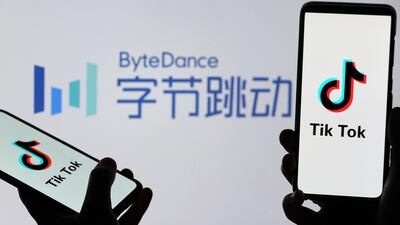
ByteDance, the Chinese owner of TikTok, asked the federal appeals court in Washington to intervene to prevent the US government from requiring it to sell the popular video-sharing app or face a ban in America.
The Beijing-based company is seeking to block an order forcing it to sell by Thursday its most important international business, a viral video service with upwards of 100 million users in the US. The Trump administration issued an executive order banning TikTok in the US on national security grounds, and demanded the Chinese company cede control of TikTok to American investors.
A deal was eventually struck to sell about 20 per cent of a new TikTok entity to Oracle and Walmart, but that agreement is now in limbo after Joe Biden won the US presidential election and a legal challenge to the Trump administration’s ban. A US security panel had previously set a November 12 deadline for TikTok to finalise an accord, and TikTok has requested a 30-day extension to keep working toward a solution that would avert a full sale of TikTok as required in the order.
That request went unanswered, though TikTok is hoping that regardless of the outcome of Tuesday’s petition, an extension could still be granted, a person familiar with the process said.
Facing the Thursday deadline set by the Committee on Foreign Investment (Cfius in the US, TikTok said, it had no choice but to turn to the appeals court “to defend our rights and those of our more than 1,500 employees in the US”. ByteDance said the divestment order violated its due process rights as well as rules of administrative procedure that require the government to explain its reasoning for regulatory decisions.
“For a year, TikTok has actively engaged with Cfius in good faith to address its national security concerns, even as we disagree with its assessment,” TikTok said in a statement. “In the nearly two months since the president gave his preliminary approval to our proposal to satisfy those concerns, we have offered detailed solutions to finalise that agreement — but have received no substantive feedback on our extensive data privacy and security framework.”
The US contends that TikTok is a national security threat, saying it could give China’s government access to the personal data of millions of Americans because it’s owned by a Chinese company.
Tuesday’s court filing includes a letter written by Cfius explaining the government’s national security concerns with ByteDance’s ownership of TikTok, the first time those concerns have been made public in such detail.
The July 30 letter from the Treasury Department is based on unclassified information, though Cfius said its determination was also based on classified information.
Cfius also said ByteDance stores user data on servers hosted by China’s Alibaba and cited press reports that Alibaba actively supports the Chinese government’s intelligence and surveillance efforts.
As it faced criticism earlier this year from US President Donald Trump and the order to find a buyer for its American operations, TikTok had been in talks with a number of potential suitors, including Microsoft, though eventually ByteDance selected the dual proposal from software maker Oracle and retail giant Walmart.
In its petition Tuesday, ByteDance said that it submitted a new proposal on November 6 that called for a restructuring of TikTok in the US and the creation of a new entity that would be wholly owned by Oracle, Walmart and existing US investors. Mr Trump has voiced support for such an arrangement. The new company would be responsible for handling data and content moderation for US users, ByteDance said.
ByteDance has already won court orders blocking a set of prohibitions on TikTok that Mr Trump unveiled in August. The prohibitions that TikTok has successfully halted in court would have also gone into effect immediately on November 12, preventing new users from downloading the app and forbidding companies from providing the underlying web services that make it accessible.
But its petition on Tuesday targeted a separate process: an order by Cfius requiring it to divest TikTok by November 12. The implications of the divestment order are less clear. The language of the order gives the attorney general authority to “take any steps necessary” to enforce the order. The Justice Department didn’t respond to a request for comment.

More from Neighbourhood Watch:
PRISCILLA
%3Cp%3EDirector%3A%20Sofia%20Coppola%3C%2Fp%3E%0A%3Cp%3EStarring%3A%20Cailee%20Spaeny%2C%20Jacob%20Elordi%3C%2Fp%3E%0A%3Cp%3ERating%3A%203%2F5%3C%2Fp%3E%0A
Ten tax points to be aware of in 2026
1. Domestic VAT refund amendments: request your refund within five years
If a business does not apply for the refund on time, they lose their credit.
2. E-invoicing in the UAE
Businesses should continue preparing for the implementation of e-invoicing in the UAE, with 2026 a preparation and transition period ahead of phased mandatory adoption.
3. More tax audits
Tax authorities are increasingly using data already available across multiple filings to identify audit risks.
4. More beneficial VAT and excise tax penalty regime
Tax disputes are expected to become more frequent and more structured, with clearer administrative objection and appeal processes. The UAE has adopted a new penalty regime for VAT and excise disputes, which now mirrors the penalty regime for corporate tax.
5. Greater emphasis on statutory audit
There is a greater need for the accuracy of financial statements. The International Financial Reporting Standards standards need to be strictly adhered to and, as a result, the quality of the audits will need to increase.
6. Further transfer pricing enforcement
Transfer pricing enforcement, which refers to the practice of establishing prices for internal transactions between related entities, is expected to broaden in scope. The UAE will shortly open the possibility to negotiate advance pricing agreements, or essentially rulings for transfer pricing purposes.
7. Limited time periods for audits
Recent amendments also introduce a default five-year limitation period for tax audits and assessments, subject to specific statutory exceptions. While the standard audit and assessment period is five years, this may be extended to up to 15 years in cases involving fraud or tax evasion.
8. Pillar 2 implementation
Many multinational groups will begin to feel the practical effect of the Domestic Minimum Top-Up Tax (DMTT), the UAE's implementation of the OECD’s global minimum tax under Pillar 2. While the rules apply for financial years starting on or after January 1, 2025, it is 2026 that marks the transition to an operational phase.
9. Reduced compliance obligations for imported goods and services
Businesses that apply the reverse-charge mechanism for VAT purposes in the UAE may benefit from reduced compliance obligations.
10. Substance and CbC reporting focus
Tax authorities are expected to continue strengthening the enforcement of economic substance and Country-by-Country (CbC) reporting frameworks. In the UAE, these regimes are increasingly being used as risk-assessment tools, providing tax authorities with a comprehensive view of multinational groups’ global footprints and enabling them to assess whether profits are aligned with real economic activity.
Contributed by Thomas Vanhee and Hend Rashwan, Aurifer
The five pillars of Islam
The Energy Research Centre
Founded 50 years ago as a nuclear research institute, scientists at the centre believed nuclear would be the “solution for everything”.
Although they still do, they discovered in 1955 that the Netherlands had a lot of natural gas. “We still had the idea that, by 2000, it would all be nuclear,” said Harm Jeeninga, director of business and programme development at the centre.
"In the 1990s, we found out about global warming so we focused on energy savings and tackling the greenhouse gas effect.”
The energy centre’s research focuses on biomass, energy efficiency, the environment, wind and solar, as well as energy engineering and socio-economic research.
Fight Night
FIGHT NIGHT
Four title fights:
Amir Khan v Billy Dib - WBC International title
Hughie Fury v Samuel Peter - Heavyweight co-main event
Dave Penalosa v Lerato Dlamini - WBC Silver title
Prince Patel v Michell Banquiz - IBO World title
Six undercard bouts:
Michael Hennessy Jr v Abdul Julaidan Fatah
Amandeep Singh v Shakhobidin Zoirov
Zuhayr Al Qahtani v Farhad Hazratzada
Lolito Sonsona v Isack Junior
Rodrigo Caraballo v Sajid Abid
Ali Kiydin v Hemi Ahio
Our legal consultant
Name: Dr Hassan Mohsen Elhais
Position: legal consultant with Al Rowaad Advocates and Legal Consultants.
COMPANY%20PROFILE
%3Cp%3E%3Cstrong%3EDate%20started%3A%3C%2Fstrong%3E%202020%3Cbr%3E%3Cstrong%3EFounders%3A%3C%2Fstrong%3E%20Khaldoon%20Bushnaq%20and%20Tariq%20Seksek%3Cbr%3E%3Cstrong%3EBased%3A%3C%2Fstrong%3E%20Abu%20Dhabi%20Global%20Market%3Cbr%3E%3Cstrong%3ESector%3A%3C%2Fstrong%3E%20HealthTech%3Cbr%3E%3Cstrong%3ENumber%20of%20staff%3A%3C%2Fstrong%3E%20100%3Cbr%3E%3Cstrong%3EFunding%20to%20date%3A%3C%2Fstrong%3E%20%2415%20million%3C%2Fp%3E%0A
pakistan Test squad
Azhar Ali (capt), Shan Masood, Abid Ali, Imam-ul-Haq, Asad Shafiq, Babar Azam, Fawad Alam, Haris Sohail, Imran Khan, Kashif Bhatti, Mohammad Rizwan (wk), Naseem Shah, Shaheen Shah Afridi, Mohammad Abbas, Yasir Shah, Usman Shinwari
ASHES SCHEDULE
First Test
November 23-27 (The Gabba, Brisbane)
Second Test
December 2-6 (Adelaide Oval, Adelaide)
Third Test
December 14-18 (Waca Ground, Perth)
Fourth Test
December 26-30 (Melbourne Cricket Ground, Melbourne)
Fifth Test
January 4-8, 2018 (Sydney Cricket Ground, Sydney)
Citadel: Honey Bunny first episode
Directors: Raj & DK
Stars: Varun Dhawan, Samantha Ruth Prabhu, Kashvi Majmundar, Kay Kay Menon
Rating: 4/5
Skoda Superb Specs
Engine: 2-litre TSI petrol
Power: 190hp
Torque: 320Nm
Price: From Dh147,000
Available: Now
